
Designing Learning Outcomes of Chulalongkorn University’s Bachelor of Education Program: A Curriculum Research using Text Mining and Machine Learning
Keywords:
Teacher Graduate Competencies, Large Language Models, Text Mining, Semantic Topic Modeling, Curriculum ResearchAbstract
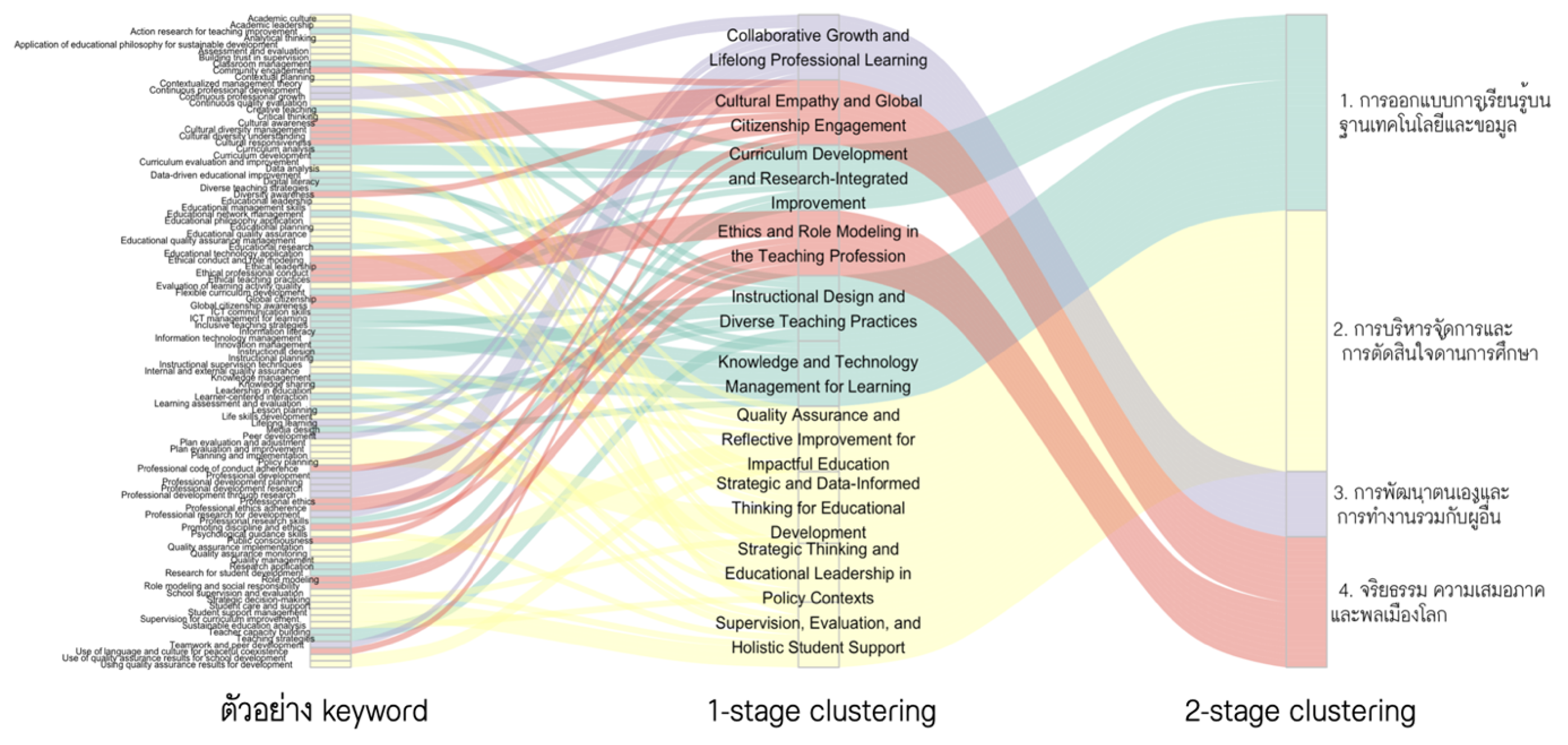
The objectives of this research were threefold: (1) to develop the initial framework of teacher graduate competencies for the Faculty of Education, Chulalongkorn University, derived from Thai professional teaching standards, the university’s mission, and the faculty’s mission and values, using semantic text clustering; (2) to refine and validate the teacher graduate competency framework using semi-supervised topic modeling based on the initial framework; and (3) to define the learning objectives of the Bachelor of Education program by synthesizing the Faculty of Education, Chulalongkorn University teacher graduate competency framework. The research data sources consisted of 21 documents related to policies, teacher professional standards, global competency frameworks, and stakeholder opinions. The primary data for analysis comprised 1,627 keywords and phrases regarding desirable teacher attributes, extracted from these documents using large language models (LLMs). Data analysis was divided into two stages: the first stage involved constructing the initial teacher graduate competency framework using text clustering based on embedding vectors, combined with expert synthesis, while the second stage expanded and refined the initial framework into a complete competency framework using semi-supervised topic modeling. Thereafter, a critical review was conducted on the learning objectives that were established by the stakeholders involved in the administration of the Bachelor of Education curriculum at Chulalongkorn University. The results yielded a Faculty of Education, Chulalongkorn University teacher graduate competency framework comprising four main domains: (1) Technology and Data-Driven Learner-Centered Instructional Design; (2) Educational Management and Decision Making; (3) Self-Development and Collaboration; and (4) Ethics, Equity, and Global Citizenship. This framework demonstrated content completeness and empirical validity based on statistical content analysis at both word and document levels. It was subsequently used as a basis for defining the learning objectives of the Bachelor of Education program, enabling graduates to integrate data, technology, and ethics in designing, deciding, and developing learning sustainably. The resulting learning outcomes reflect the new role of 21st-century teachers as ‘learning engineers’ who possess systemic capabilities, cognitive flexibility, and responsibility toward society and the digital world.
Downloads
References
คณะกรรมการคุรุสภา. (2562). ประกาศคณะกรรมการคุรุสภา เรื่อง รายละเอียดของมาตรฐานความรู้และประสบการณ์วิชาชีพครู ตามข้อบังคับคุรุสภา ว่าด้วยมาตรฐานวิชาชีพ (ฉบับที่ 4) พ.ศ. 2562. ราชกิจจานุเบกษา, เล่ม 137, ตอนพิเศษ 109 ง. https://ratchakitcha.soc.go.th/documents/17130946.pdf
คณะครุศาสตร์ จุฬาลงกรณ์มหาวิทยาลัย. (2562). หลักสูตรครุศาสตรบัณฑิต (หลักสูตร 4 ปี) : หลักสูตรปรับปรุง พ.ศ. 2562. จุฬาลงกรณ์มหาวิทยาลัย.
คณะครุศาสตร์ จุฬาลงกรณ์มหาวิทยาลัย. (2567). แผนยุทธศาสตร์ 2024-2028 : Innovate, Research, Prepare and Engage. https://www.edu.chula.ac.th/index.php/strategies
จุฬาลงกรณ์มหาวิทยาลัย. (2567). วิสัยทัศน์และยุทธศาสตร์. https://www.chula.ac.th/about/administration/vision-and-strategy/
สำนักงานคณะกรรมการการอุดมศึกษา. (2565). มาตรฐานคุณวุฒิระดับอุดมศึกษา พ.ศ. 2565. ราชกิจจานุเบกษา. https://www.ratchakitcha.soc.go.th/DATA/PDF/2565/A/020/T_0028.PDF
สำนักงานเลขาธิการสภาการศึกษา กระทรวงศึกษาธิการ. (2560). แผนการศึกษาแห่งชาติ พ.ศ. 2560-2579. http://www.onec.go.th/index.php/book/BookView/1540
สำนักวิจัยและพัฒนาการศึกษา สำนักงานเลขาธิการสภาการศึกษา. (2565). ทักษะที่จำเป็นแห่งอนาคต (Future Skill) เพื่อเตรียมการพัฒนาคุณภาพคนไทยทุกช่วงวัย รองรับการเปลี่ยนแปลงอย่างรวดเร็ว (Disruption) ของโลกศตวรรษที่ 21 : ผลการศึกษาและแนวทางการส่งเสริม. สำนักงานเลขาธิการสภาการศึกษา กระทรวงศึกษาธิการ. http://www.thaiedresearch.org/home/paperview/180873
Awasthi, R., & Tiwari, A. (2024). Role of data mining in redesigning the existing curriculum: A survey-based literature review. Journal of Computational Analysis and Applications, 33(7), 1552–1564. https://eudoxuspress.com/index.php/pub/article/view/1754
Benoit, K., Watanabe, K., Wang, H., Nulty, P., Obeng, A., Müller, S., & Matsuo, A. (2018). quanteda: An R package for the quantitative analysis of textual data. Journal of Open Source Software, 3(30), Article 774. https://doi.org/10.21105/joss.00774
Bringula, R., Ulfa, S., Miranda, J. P. P., & Atienza, F. A. L. (2022). Text mining analysis on students’ expectations and anxieties towards data analytics course. Cogent Engineering, 9(1), Article 2127469. https://doi.org/10.1080/23311916.2022.2127469
Datakruroo. (2025). TidyChunking: Smart markdown chunking for text analysis [R package]. GitHub. https://github.com/datakruroo/TidyChunking
Dondi, M., Klier, J., Panier, F., & Schubert, J. (2021). Defining the skills citizens will need in the future world of work. McKinsey & Company. https://www.mckinsey.com/industries/public-sector/our-insights/defining-the-skills-citizens-will-need-in-the-future-world-of-work
Google. (n.d.). Gemini for Google Workspace prompting guide 101: A quick-start handbook for effective prompts. https://services.google.com/fh/files/misc/gemini-for-google-workspace-prompting-guide-101.pdf
Kotsiou, A., Fajardo-Tovar, D. D., Cowhitt, T., Major, L., & Wegerif, R. (2022). A scoping review of future skills frameworks. Irish Educational Studies, 41(1), 171–186. https://doi.org/10.1080/03323315.2021.2022522
Ministry of Education Thailand. (2024). Transforming education in the digital era: Happy learning: anywhere anytime. https://13ased.moe.go.th/wp-content/uploads/2024/08/E-Book-Transforming-Education-in-the-Digital-Era.pdf
National Institute of Education. (2024). The enhanced V³SK model. Nanyang Technological University. https://www.ntu.edu.sg/nie/about-us/programme-offices/office-of-teacher-education-and-undergraduate-programmes/te21/v3sk
OECD. (2019). OECD learning compass 2030: A series of concept notes. OECD Publishing. https://www.oecd.org/content/dam/oecd/en/about/projects/edu/education-2040/1-1-learning-compass/OECD_Learning_Compass_2030_Concept_Note_Series.pdf
OECD. (2023). OECD digital education outlook 2023: Towards an effective digital education ecosystem. OECD Publishing. https://doi.org/10.1787/c74f03de-en
OpenAI. (2024, January 25). New embedding models and API updates. OpenAI. https://openai.com/index/new-embedding-models-and-api-updates/
Polat, E. (2025). Artificial intelligence literacy, lifelong learning, and fear of innovation: Identification of profiles and relationships. Education and Information Technologies, 30, 20183–20214. https://doi.org/10.1007/s10639-025-13548-y
Sandoval-Ríos, F., Gajardo-Poblete, C., & López-Núñez, J. A. (2025). Role of data literacy training for decision-making in teaching practice: A systematic review. Frontiers in Education, 10, Article 1485821. https://doi.org/10.3389/feduc.2025.1485821
Sievert, C., & Shirley, K. E. (2014). LDAvis: A method for visualizing and interpreting topics. In J. Chuang, S. Green, M. Hearst, J. Heer, & P. Koehn (Eds.), Proceedings of the Workshop on Interactive Language Learning, Visualization, and Interfaces (pp. 63–70). Association for Computational Linguistics. https://doi.org/10.3115/v1/W14-3110
Silge, J., & Robinson, D. (2016). Tidytext: Text mining and analysis using tidy data principles in R. Journal of Open Source Software, 1(3), Article 37. https://doi.org/10.21105/joss.00037
Teachers’ Council of Thailand. (2018). Southeast Asia teachers competency framework (SEA-TCF). https://www.seameo-innotech.org/wp-content/uploads/2020/09/SEA-TCF_2018.pdf
Tibshirani, R., Walther, G., & Hastie, T. (2001). Estimating the number of clusters in a data set via the gap statistic. Journal of the Royal Statistical Society Series B: Statistical Methodology, 63(2), 411–423. https://doi.org/10.1111/1467-9868.00293
U.S. Department of Education, Office of Educational Technology. (2023). Artificial intelligence and the future of teaching and learning: Insights and recommendations. U.S. Department of Education. https://www.ed.gov/sites/ed/files/documents/ai-report/ai-report.pdf
UNESCO. (2023a). Guidance for generative AI in education and research. UNESCO.
UNESCO. (2023b). Six pillars for the digital transformation of education. UNESCO.
UNESCO. (2023c). The futures we build: Abilities and competencies for future education and work. UNESCO Publishing. https://unesdoc.unesco.org/ark:/48223/pf0000386933_eng
UNESCO. (2024). AI competency framework for teachers. UNESCO Publishing. https://www.unesco.org/en/articles/ai-competency-framework-teachers
Vreuls, J., van der Klink, M., Koeslag-Kreunen, M., Stoyanov, S., Boshuizen, H., & Nieuwenhuis, L. (2025). Responsive curriculum development: Which factors support breaking through institutional barriers? Journal of Vocational Education & Training, 77(3), 582–610. https://doi.org/10.1080/13636820.2023.2270470
Wickham, H., Averick, M., Bryan, J., Chang, W., McGowan, L. D., François, R., Grolemund, G., Hayes, A., Henry, L., Hester, J., Kuhn, M., Lin Pedersen, T., Miller, E., Bache, S. M., Müller, K., Ooms, J., Robinson, D., Seidel, D. P., Spinu, V., … Yutani, H. (2019). Welcome to the tidyverse. Journal of Open Source Software, 4(43), Article 1686. https://doi.org/10.21105/joss.01686
World Economic Forum. (2020). The future of jobs report 2020. https://www.weforum.org/publications/the-future-of-jobs-report-2020/
World Economic Forum. (2025). The future of jobs report 2025: Skill outlook. https://www.weforum.org/publications/the-future-of-jobs-report-2025/
Translated Thai References
Bureau of Educational Research and Development, Office of the Education Council. (2022). Future skills for preparing thai people of all ages for rapid global changes in the 21st century (Disruption): Study results and policy recommendations. Office of the Education Council, Ministry of Education. http://www.thaiedresearch.org/home/paperview/180873
Chulalongkorn University. (2024). Vision and strategy. https://www.chula.ac.th/about/administration/vision-and-strategy/
Faculty of Education, Chulalongkorn University. (2019). Bachelor of education program (4-year revised curriculum), B.E. 2562 (2019). Chulalongkorn University.
Faculty of Education, Chulalongkorn University. (2024). Strategic plan 2024–2028: Innovate, research, prepare and engage. https://www.edu.chula.ac.th/index.php/strategies
Office of the Education Council, Ministry of Education. (2017). National education plan 2017–2036. http://www.onec.go.th/index.php/book/BookView/1540
Office of the Higher Education Commission. (2022). Higher education qualification standards B.E. 2565 (2022). Royal Thai Government Gazette. https://www.ratchakitcha.soc.go.th/DATA/PDF/2565/A/020/T_0028.pdf
Teachers’ Council of Thailand. (2019). Announcement of the teachers’ council of Thailand on the details of professional knowledge standards and professional experience standards under the teachers’ council regulations on professional standards (4th edition), B.E. 2562 (2019). Royal Thai Government Gazette, 137, Special Issue 109 Ng. https://ratchakitcha.soc.go.th/documents/17130946.pdf
Downloads
Published
How to Cite
Issue
Section
License
Copyright (c) 2025 Siwachoat Srisuttiyakorn, Yotsawee Saifah, Kanit Sriklaub

This work is licensed under a Creative Commons Attribution-NonCommercial-NoDerivatives 4.0 International License.
All published content in JRM is licensed under a Creative Commons Attribution-NonCommercial-NoDerivatives 4.0 International License (CC BY-NC-ND 4.0).

