
Using QCAmap for Qualitative Content Analysis: A Tutorial with Simulated Teacher Interviews
Keywords:
QCAmap, Content Analysis, Qualitative Data AnaAbstract
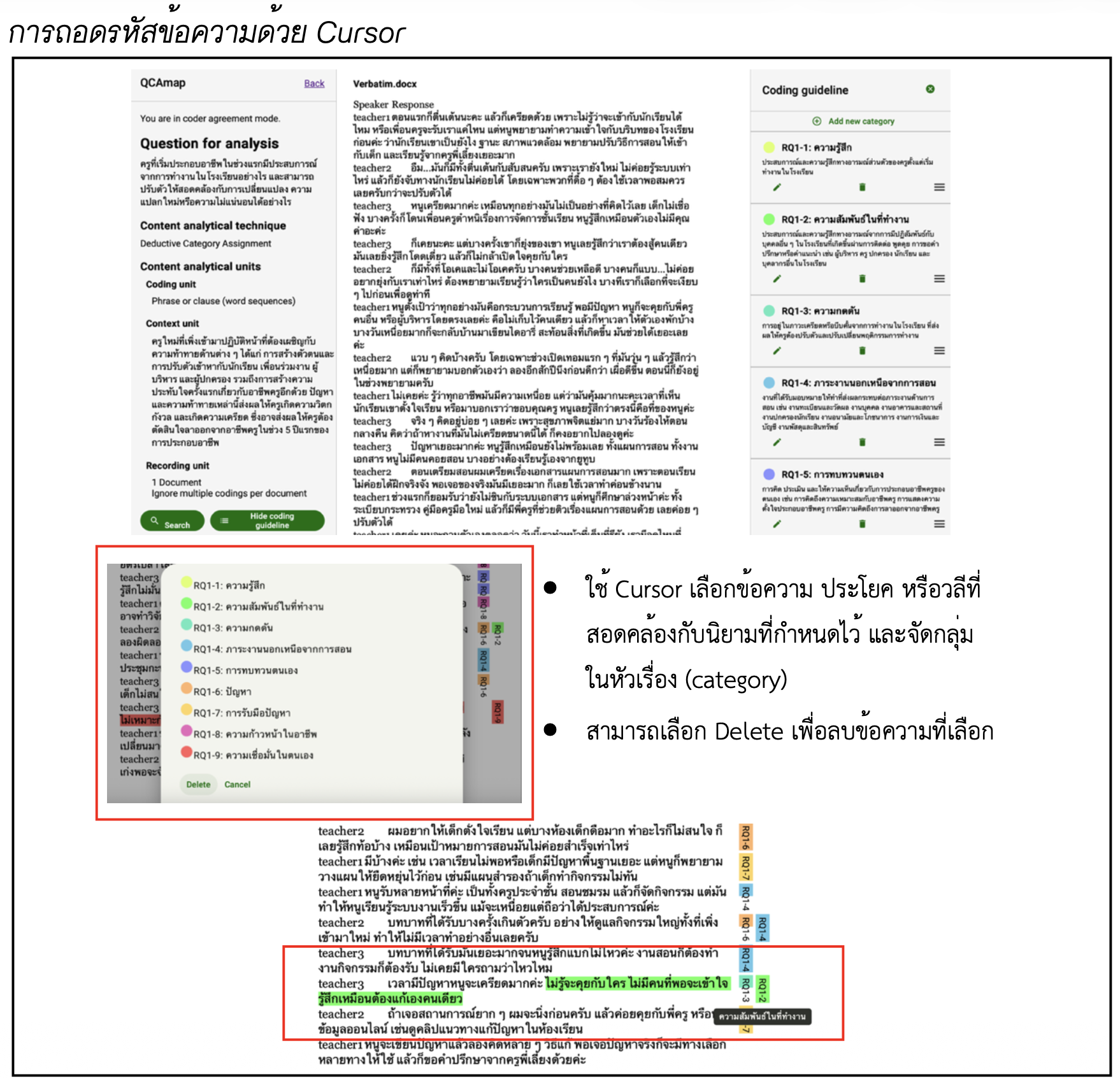
Qualitative data analysis is often complex and requires the researcher’s meticulous attention in organizing, interpreting, and systematically summarizing data. QCAmap was developed as a tool for content analysis to assist with coding, decoding, and presenting analytical results derived from qualitative data. To demonstrate its practical application, this article presents a case study generated using ChatGPT, in which the author created a simulated scenario where a researcher interviews teachers who have recently been appointed during their first three years of work. The objective of this article is to introduce and demonstrate the step-by-step use of QCAmap for content analysis. It presents the initial setup and methodological framework leading to the development of categories, definitions, anchor examples, and coding rules, which are then used to decode interview data and display the results in a frequency table of categories and excerpts. The trial use of QCAmap reveals that the platform effectively manages textual data, is user-friendly, and supports the Thai language. Therefore, it is suitable for those interested in conducting qualitative content analysis and learning to use systematic analytical tools.
Downloads
References
ชยุตม์ ภิรมย์สมบัติ. (2567). Advanced(?) content analysis: Known, yet misunderstood [เอกสารประกอบการสอน]. คณะครุศาสตร์ จุฬาลงกรณ์มหาวิทยาลัย.
ชยุตม์ ภิรมย์สมบัติ. (2568). Content analysis: Widely used, wildly misused [เอกสารประกอบการสอน]. คณะครุศาสตร์ จุฬาลงกรณ์มหาวิทยาลัย.
Carolus, A., Augustin, Y., Markus, A., & Wienrich, C. (2023). Digital interaction literacy model – Conceptualizing competencies for literate interactions with voice-based AI systems. Computers and Education: Artificial Intelligence, 4, Article 100114. https://doi.org/10.1016/j.caeai.2022.100114
Egger-Rainer, A., Sahinoglu, F., Schreier, M. M., Brandl, C., Brandstötter-Gugg, C., Bublitz, S. K., Lorenzl, S., Mayr-Pirker, B., Weck, C., & Paal, P. (2024). Workshop on hastened death as “space for an appreciative discussion”: A qualitative study. Nurse Education in Practice, 79, Article 104081. https://doi.org/10.1016/j.nepr.2024.104081
Geirhos, A., Lunkenheimer, F., Holl, R. W., Minden, K., Schmitt, A., Temming, S., Baumeister, H., & Domhardt, M. (2021). Involving patients’ perspective in the development of an internet- and mobile-based CBT intervention for adolescents with chronic medical conditions: Findings from a qualitative study. Internet Interventions, 24, Article 100383. https://doi.org/10.1016/j.invent.2021.100383
Hinneburg, J., Hecht, L., Berger-Höger, B., Buhse, S., Lühnen, J., & Steckelberg, A. (2020). Development and piloting of a blended learning training programme for physicians and medical students to enhance their competences in evidence-based decision-making. Zeitschrift für Evidenz, Fortbildung und Qualität im Gesundheitswesen, 150–152, 104–111. https://doi.org/10.1016/j.zefq.2020.02.004
Kujala, S., Simola, S., Wang, B., Soone, H., Hagström, J., Bärkås, A., Hörhammer, I., Cajander, Å., Fagerlund, A. J., Kane, B., Kharko, A., Kristiansen, E., Moll, J., Rexphepi, H., Hägglund, M., & Johansen, M. A. (2024). Benchmarking usability of patient portals in Estonia, Finland, Norway, and Sweden. International Journal of Medical Informatics, 181, Article 105302. https://doi.org/10.1016/j.ijmedinf.2023.105302
Mayring, P., & Fenzl, T. (2022). QCAmap [Computer software]. Verein zur Förderung qualitativer Forschung (ASQ). https://www.qcamap.org/ui/en/home
Nuzzo, E., & Brocca, N. (2024). Raising the (meta)pragmatic awareness of non-native pre-service teachers of L2 Italian with a telecollaborative data-driven learning project on formal email writing. System, 127, Article 103518. https://doi.org/10.1016/j.system.2024.103518
Savickas, M. L. (2005). The theory and practice of career construction. In S. D. Brown & R. W. Lent (Eds.), Career development and counseling: Putting theory and research to work (pp. 42–70). John Wiley & Sons.
Savickas, M. L., & Porfeli, E. J. (2012). Career adapt-abilities scale: Construction, reliability, and measurement equivalence across 13 countries. Journal of Vocational Behavior, 80(3), 661–673. https://doi.org/10.1016/j.jvb.2012.01.011
Savickas, M. L., Nota, L., Rossier, J., Dauwalder, J.-P., Duarte, M. E., Guichard, J., Soresi, S., Van Esbroeck, R., & van Vianen, A. E. M. (2009). Life designing: A paradigm for career construction in the 21st century. Journal of Vocational Behavior, 75(3), 239–250. https://doi.org/10.1016/j.jvb.2009.04.004
Wollmann, K., van der Keylen, P., Tomandl, J., Meerpohl, J. J., Sofroniou, M., Maun, A., & Voigt-Radloff, S. (2021). The information needs of internet users and their requirements for online health information—A scoping review of qualitative and quantitative studies. Patient Education and Counseling, 104(8), 1904–1932. https://doi.org/10.1016/j.pec.2021.01.020
Translated Thai References
Piromsombat, C. (2024). Advanced(?) content analysis: Known, yet misunderstood [Lecture notes]. Faculty of Education, Chulalongkorn University.
Piromsombat, C. (2025). Content analysis: Widely used, wildly misused [Lecture notes]. Faculty of Education, Chulalongkorn University.
Downloads
Published
How to Cite
Issue
Section
License
Copyright (c) 2025 Chisanhupong Punchayatorn

This work is licensed under a Creative Commons Attribution-NonCommercial-NoDerivatives 4.0 International License.
All published content in JRM is licensed under a Creative Commons Attribution-NonCommercial-NoDerivatives 4.0 International License (CC BY-NC-ND 4.0).

