
Development of Computer Software for Criterion-referenced Item Analysis
Keywords:
Software Development, Criterion-referenced Test, Item Analysis, Standards-based CurriculumAbstract
This research aimed to develop and assess the quality of computer software for criterion-referenced item analysis, designed to align with Thailand’s standards-based basic education curriculum.
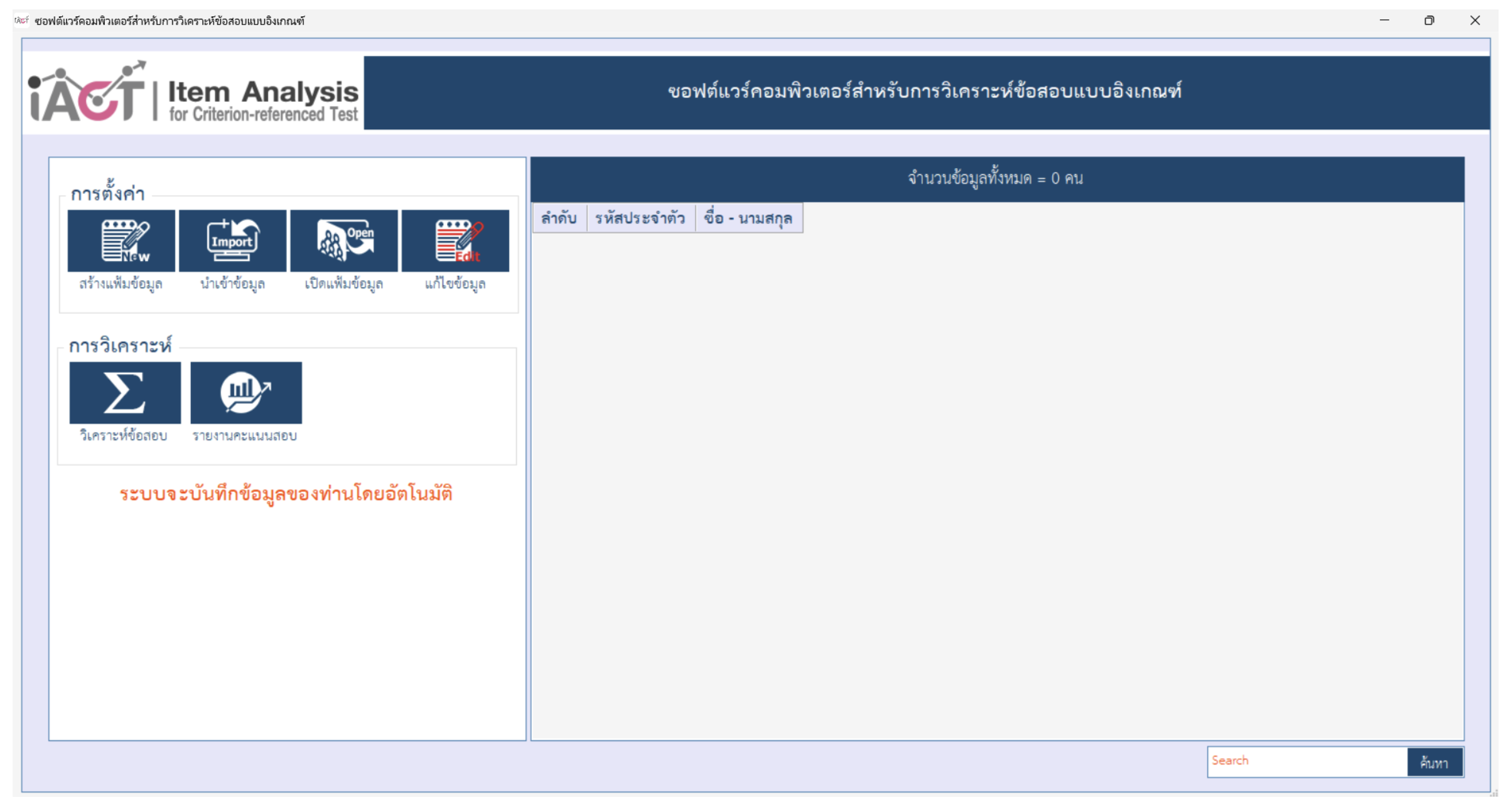
A research and development (R&D) methodology was employed, comprising two phases: Phase 1, software development, and Phase 2, software quality assessment. The research instruments included a heuristic evaluation checklist for assessing the appropriateness of the software interface and a user experience questionnaire. The participants who tested the software consisted of 50 users. The results revealed the following: 1) The developed software could serve as a replacement for existing software whose analytical outputs may be difficult to interpret for users without a background in educational measurement and evaluation, while also being compatible with current operating systems. The software developed in this study, named i-ACT (Item Analysis for Criterion-Referenced Test), was developed using the Visual Basic programming language and can be used without installation (portable software). The key item analysis results generated by the software include the difficulty index, discrimination index, and reliability coefficient, based on criterion-referenced test analysis concepts. 2) Regarding software quality assessment, users reported a positive experience with the software. Users rated the software highly in terms of performance efficiency (M = 6.26, SD = 0.89) and ease of learning (M = 6.24, SD = 0.71). In addition, users perceived the developed software as appealing (M = 6.20, SD = 0.81).
Downloads
References
สาคร แสงผึ้ง. (2547). การวิเคราะห์ข้อสอบเลือกตอบ. http://lpn.nfe.go.th/pranee/UserFiles/Pdf/manual%20B-Index.pdf
สำนักวิชาการและมาตรฐานการศึกษา สำนักงานคณะกรรมการการศึกษาขั้นพื้นฐาน กระทรวงศึกษาธิการ. (2557). แนวปฏิบัติการวัดและประเมินผลการเรียนรู้ ตามหลักสูตรแกนกลางการศึกษาขั้นพื้นฐาน พุทธศักราช 2551 (พิมพ์ครั้งที่ 4). โรงพิมพ์ชุมนุมสหกรณ์การเกษตรแห่งประเทศไทย จำกัด.
ศิริชัย กาญจนวาสี. (2556). ทฤษฎีการทดสอบแบบดั้งเดิม (พิมพ์ครั้งที่ 7). สำนักพิมพ์แห่งจุฬาลงกรณ์มหาวิทยาลัย.
Ampatzoglou, A., Ampatzoglou, A., Chatzigeorgiou, A., & Avgeriou, P. (2015). The financial aspect of managing technical debt: A systematic literature review. Information and Software Technology, 64, 52–73. https://doi.org/10.1016/j.infsof.2015.04.001
Conger, S. A. (2011). Software development life cycles and methodologies: Fixing the old and adopting the new. International Journal of Information Technologies and Systems Approach, 4(1), 1–22. https://doi.org/10.4018/jitsa.2011010101
Galavi, Z., Norouzi, S., & Khajouei, R. (2024). Heuristics used for evaluating the usability of mobile health applications: A systematic literature review. Digital Health, 10, Article 20552076241253539. https://doi.org/10.1177/20552076241253539
Latif, A. B., Yusof, I. J., Amin, N. F. M., Libunao, W. H., & Yusri, S. S. (2016). Multiple-choice items analysis using classical test theory and Rasch measurement model. Man in India, 96(1–2), 173–181.
Lee, J., Alonzo, D., Beswick, K., Abril, J. M. V., Chew, A. W., & Oo, C. Z. (2024). Dimensions of teachers’ data literacy: A systematic review of literature from 1990 to 2021. Educational Assessment, Evaluation and Accountability, 36, 145–200. https://doi.org/10.1007/s11092-024-09435-8
Nielsen, J. (1994). Enhancing the explanatory power of usability heuristics. In Proceedings of the SIGCHI Conference on Human Factors in Computing Systems (pp. 152–158). Association for Computing Machinery. https://doi.org/10.1145/191666.191729
Norman, D. A. (2013). The design of everyday things (Revised and expanded ed.). Basic Books.
Rao, D. B. J., Kalpana, P., Kumar, G. S. N., & Atcha, N. M. (2025). A comparative analysis of software development models: Waterfall, Agile and DevOps. In V. S. Reddy, V. K. Prasad, J. Wang, & N. M. Rao Dasari (Eds.), Intelligent systems and sustainable computing (Vol. 417, pp. 589–599). Springer. https://doi.org/10.1007/978-981-97-8355-7_51
Shneiderman, B. (2010). Designing the user interface: Strategies for effective human-computer interaction (5th ed.). Pearson Education India.
Translated Thai References
Bureau of Academic Affairs and Educational Standards, Office of the Basic Education Commission, Ministry of Education. (2014). Guidelines for learning measurement and evaluation according to the Basic Education Core Curriculum B.E. 2551 (4th ed.). The Agricultural Co-operative Federation of Thailand Printing House. [in Thai]
Kanjanawasee, S. (2013). Classical test theory (7th ed.). Chulalongkorn University Press. [in Thai]
Saengphueng, S. (2004). Analysis of multiple-choice tests. http://lpn.nfe.go.th/pranee/UserFiles/Pdf/manual%20B-Index.pdf [in Thai]
Downloads
Published
How to Cite
Issue
Section
License
Copyright (c) 2026 Nhabhat Chaimongkol

This work is licensed under a Creative Commons Attribution-NonCommercial-NoDerivatives 4.0 International License.
All published content in JRM is licensed under a Creative Commons Attribution-NonCommercial-NoDerivatives 4.0 International License (CC BY-NC-ND 4.0).

