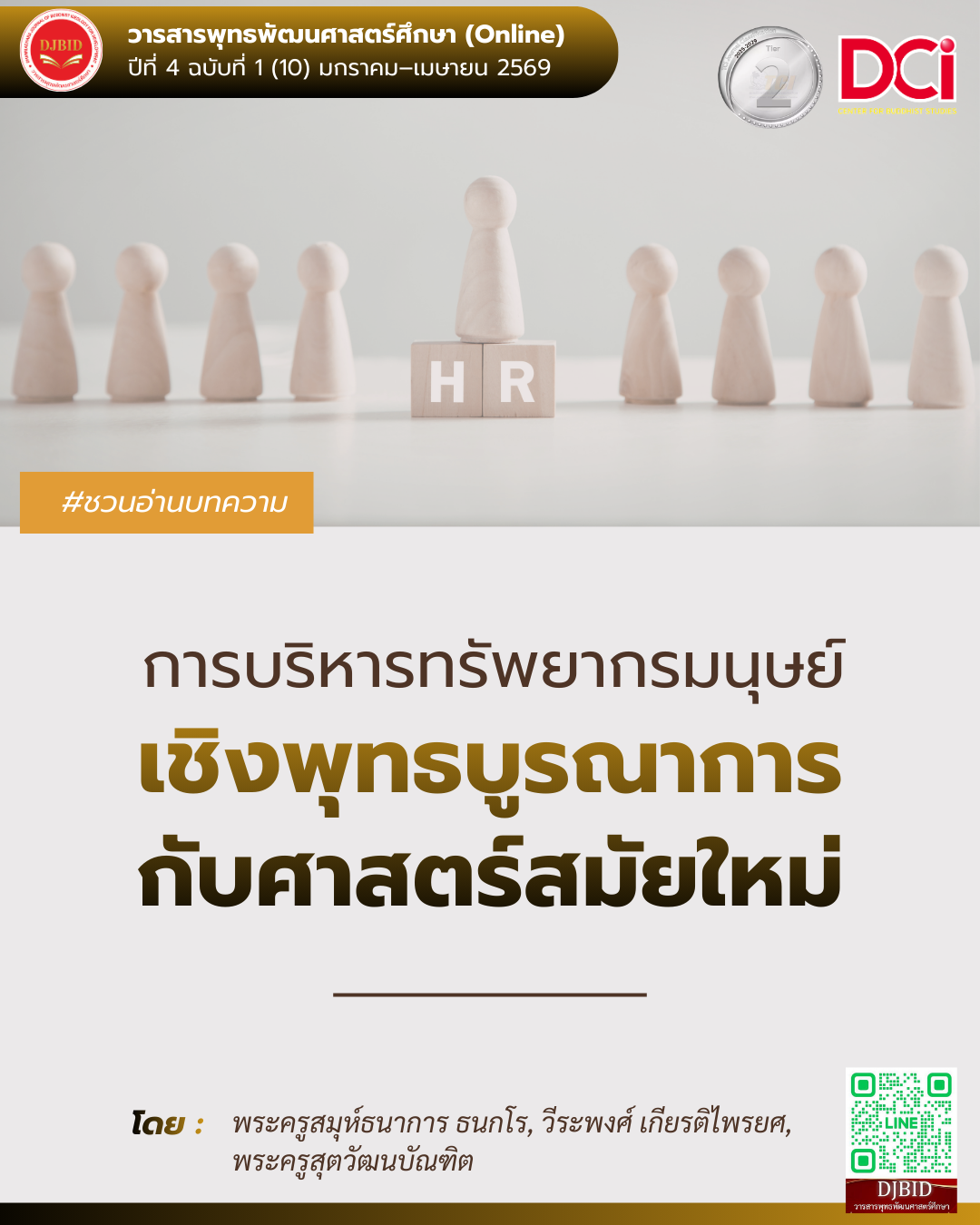
Integrating Buddhist Principles with Modern Science in Human Resource Management
Keywords:
Human Resource Management, Buddhist Integration, Modern ScienceAbstract
This academic article aims to examine the importance of human resource management in organizations and to explore the integration of Buddhist principles with human resource management for organizational success. The study employed a documentary research approach by reviewing relevant documents and previous studies. The collected information was analyzed according to predetermined issues and subsequently synthesized to develop a body of knowledge on Buddhist-integrated human resource management.
The findings indicate that the process of human resource management consists of four key principles: planning, recruitment, development, and retention. Buddhist teachings can be effectively applied to these stages of human resource development as follows: (1) the Six Directions in the planning stage, (2) the concepts of true friends and false friends in the recruitment stage, (3) the Four Sublime States of Mind (Brahmavihāra) in the personnel development stage, and (4) the Four Bases of Social Solidarity (Saṅgahavatthu) in the retention stage. Integrating Buddhist principles into human resource management contributes to the development of personnel who possess both professional competence and moral integrity. Furthermore, it promotes the collective development of individuals across three organizational levels–internal personnel, external personnel, and network personnel–thereby fostering sustainable organizational growth and long-term prosperity.
References
กองวิชาการ มหาวิทยาลัยธรรมกาย แคลิฟอร์เนีย. จักรวาลวิทยา. ม.ป.ท.: ม.ป.พ., 2548.
ก่อวิท พรมจักร. “แนวทางการบริหารจัดการนิติบุคคลอาคารชุด ตามหลักพุทธธรรม เพื่อสร้างความพึงพอใจให้กับผู้พักอาศัยในเขตพื้นที่กรุงเทพมหานคร”. วารสารพุทธพัฒนศาสตร์ศึกษา. ปีที่ 2 ฉบับที่ 1 (4) (มกราคม–เมษายน 2567). 14–32.
บุรฉัตร จันทร์แดง. “กระบวนการบริหารทรัพยากรมนุษย์”. วารสารสถาบันวิจัยและพัฒนา มหาวิทยาลัยราชภัฏมหาสารคาม. ปีที่ 5 ฉบับที่ 1 (มกราคม–มิถุนายน 2561). 219–235.
พระพรหมคุณาภรณ์ (ป.อ. ปยุตฺโต). การพัฒนาที่ยั่งยืน. พิมพ์ครั้งที่ 6. กรุงเทพฯ: บ. สหธรรมิก จำกัด, 2550.
_____. พระพุทธศาสนาพัฒนาคนและสังคม. พิมพ์ครั้งที่ 6. กรุงเทพฯ: บ. สหธรรมิก จำกัด, 2549.
พระภาวนาวิริยคุณ (เผด็จ ทัตตชีโว). คัมภีร์ปฏิรูปมนุษย์. กรุงเทพฯ: กราฟิคอาร์ตพริ้นติ้ง, 2545.
พระมหาบันเจตร์ ถิรจิตฺโต. “ทิศ 6: การประยุกต์กับแนวคิดระบบและแผนพัฒนาการศึกษาขั้นพื้นฐาน”. วารสารพุทธพัฒนศาสตร์ศึกษา. ปีที่ 2 ฉบับที่ 3 (6) (กันยายน–ธันวาคม 2567). 50–79.
เพ็ญศรี วายวานนท์. การจัดการทรัพยากรคน. พิมพ์ครั้งที่ 2. กรุงเทพฯ: โรงพิมพ์จุฬาลงกรณ์, 2537.
ภัทรวดี เข้มแข็ง. “การประยุกต์ใช้หลักปาปณิกธรรมกับการบริหารองค์กรสมรรถนะสูงในโลกยุคใหม่”. วารสารพุทธพัฒนศาสตร์ศึกษา. ปีที่ 2 ฉบับที่ 1 (4) (มกราคม–เมษายน 2567). 58–73.
มนมีน. ปัญหาของการบริหารทรัพยากรมนุษย์. ออนไลน์. https://www.gotoknow.org/posts/228731. [1 กันยายน 2568].
มหามกุฏราชวิทยาลัย. พระไตรปิฎกฉบับสยามรัฐ (แปล) เล่ม 1–45. นครปฐม: มหามกุฏราชวิทยาลัย, 2552.
_____. พระไตรปิฎกและอรรถกถาแปล เล่ม 1–91. นครปฐม: มหามกุฏราชวิทยาลัย, 2543.
อาบิดะ บริพันธ์. “ธุรกิจเครือข่าย: พัฒนาการขายตรงที่ก้าวไกล”. วารสารมหาวิทยาลัยนราธิวาสราชนครินทร์. ปีที่ 1 ฉบับที่ 3 (กันยายน–ธันวาคม 2552). 19–32.
Clark, H. H. Arenas of language use. CA: University of Chicago, 1992.
Mondy, W. and Noe, R. M. Personnel Management, New York: Prentice Hall, 1996.