Capitalism and Thai Education: Inequality and Social Reproduction
Article Sidebar
Main Article Content
Abstract
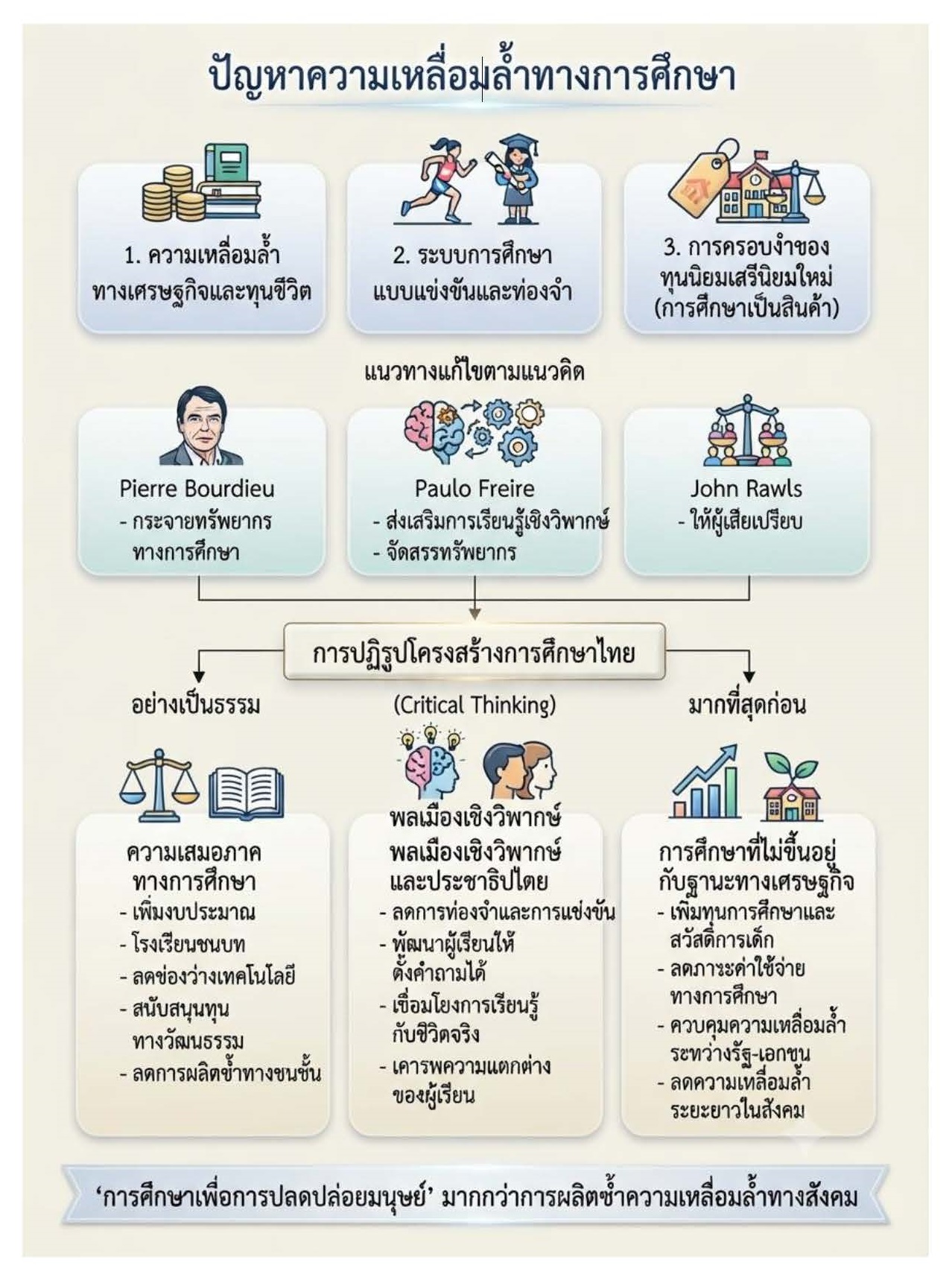
This academic article critically examines the relationship between capitalism and the Thai educational system by conceptualizing education as a socio-political mechanism that functions to reproduce labor power, sustain the capitalist economic structure, and perpetuate class inequality through institutionalized educational practices. Drawing upon the critical theoretical perspectives of western philosophers, to explain the interrelationship among capital accumulation, ideological power, cultural reproduction, and educational inequality within the context of contemporary Thai society. Employing a critical and interpretive approach, the study investigates how educational institutions operate under the logic of neoliberal capitalism and how such dynamics shape educational opportunities, social mobility, and class relations.
The analysis reveals that the Thai educational system does not genuinely function as an egalitarian institution that promotes social justice and democratic citizenship. Instead, it increasingly serves as a mechanism for reproducing socio-economic, cultural, and structural inequalities. Educational institutions tend to privilege students who possess greater economic, social, and cultural capital, thereby reinforcing patterns of inequality across generations. Students from affluent families are more likely to gain access to elite schools, educational technologies, and influential social networks, whereas students from marginalized and economically disadvantaged backgrounds encounter structural barriers that limit their educational achievement and upward social mobility. Consequently, educational inequality in Thailand should not be understood solely as the result of individual ability or personal effort, but rather as a manifestation of structural disparities embedded within capitalist society. Furthermore, the article argues that the commodification of education under neoliberal capitalism has transformed education from a public good into a competitive commodity. Educational success is increasingly measured through standardized examinations, institutional rankings, and economic performance indicators, resulting in the normalization of meritocratic ideology and the concealment of structural inequality. As a consequence, the educational system functions as an ideological apparatus that legitimizes unequal power relations and suppresses critical consciousness among learners. The article concludes that meaningful educational reform in Thailand must move beyond superficial policy adjustments and directly confront the structural influence of capitalism on educational institutions. Educational transformation should prioritize social justice, critical pedagogy, democratic participation, and equitable resource distribution in order to position education as a tool for human emancipation rather than a mechanism for reproducing inequality and class domination.
Article Details

This work is licensed under a Creative Commons Attribution-NonCommercial-NoDerivatives 4.0 International License.
This article is published under a Creative Commons Attribution-NonCommercial-NoDerivatives 4.0 International License (CC BY-NC-ND 4.0), which allows others to share the article with proper attribution to the authors and prohibits commercial use or modification. For any other reuse or republication, permission from the journal and the authors is required.
References
พรพะเยาว์ ก๋งเม่ง และฉัตรวรัญ องคสิงห์. (2565). แนวจริตของนักเรียนโรงเรียนทวิภาษา. วารสารศิลปศาสตร์ มหาวิทยาลัยรังสิต, 18(2), 61-68.
ริฏวาน ศอลิห์วงศ์สกุล และคณะ. (2566). การผลิตซ้ำทางสังคม และความเหลื่อมล้ำทางการศึกษาในสามจังหวัดชายแดนภาคใต้. วารสารรูสมิแล, 44(3), 47–62.
สำนักงานเลขาธิการสภาการศึกษา. (2564). ความเหลื่อมล้ำทางการศึกษาไทย: สภาพปัญหาและแนวทางแก้ไข. กรุงเทพฯ: สำนักงานเลขาธิการสภาการศึกษา.
สุวิมล ว่องวาณิช. (2563). ความเหลื่อมล้ำทางการศึกษา: ปัญหาและแนวทางแก้ไข. กรุงเทพฯ: สำนักพิมพ์ แห่งจุฬาลงกรณ์มหาวิทยาลัย.
Althusser, L. (1971). Ideology and ideological state apparatuses. In Lenin and philosophy and other essays (pp. 127-186). Monthly Review Press.
Bourdieu, P. (1986). The forms of capital. In J. Richardson (Ed.), Handbook of theory and research for the sociology of education (pp. 241-258). Greenwood Press.
Bourdieu, P. & Passeron, J.-C. (1977). Reproduction in education, society and culture. Sage Publications.
Freire, P. (1970). Pedagogy of the oppressed. Continuum.
Marx, K. (1976). Capital: A critique of political economy (Vol. 1). Penguin Books.
Rawls, J. (1971). A theory of justice. Harvard University Press.
Sripokangkul, S. (2020). Education for the production and reproduction of docile bodies: The problems of civic education in Thailand. Intellectual Discourse, 28(1), 261-294.
