Integrating Khok Nong Na, Organic Farming and Buddhist Way for Sustainable Development
Article Sidebar
Main Article Content
Abstract
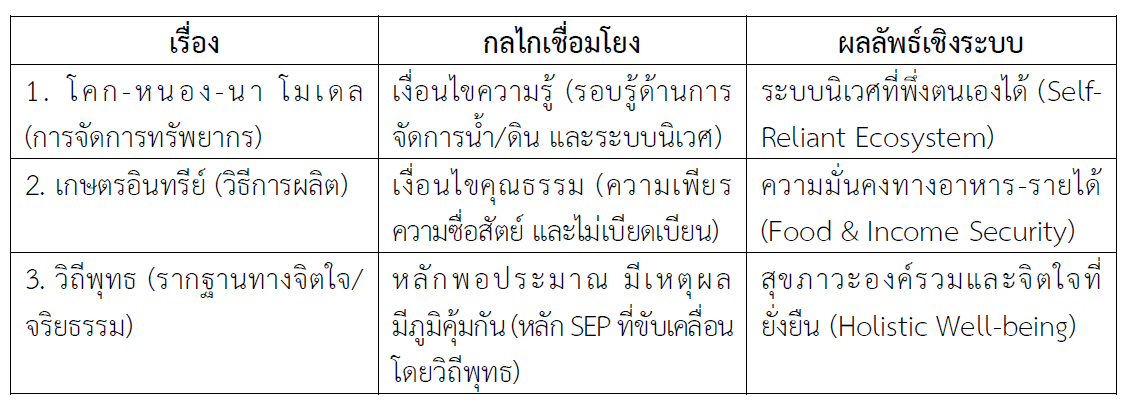
This documentary article aims to delineate the principles and conceptual intersections of the “Kok-Nong-Na” Model (Integrated Land Management), Organic Agriculture, and Buddhist Ethics as an integrated framework for sustainability under the Sufficiency Economy Philosophy (SEP). The methodology employed is a synthesis of relevant literature and empirical evidence. The analysis indicates that the synergistic integration of these three components establishes a self-reliant ecosystem that effectively enhances biodiversity, reduces reliance on external inputs, and strengthens household-level food and income security. Furthermore, this framework contributes to holistic well-being in accordance with Buddhist tenets, specifically by operationalizing the SEP core values: Moderation, Reasonableness, and Self-Immunity (guided by the conditions of Knowledge and Virtue). The article concludes by proposing an integrated conceptual model and providing policy recommendations for spatial scaling-up. It emphasizes that sustainable resilience is fundamentally achieved through the systematic management of water and soil resources, organic cultivation practices, and the psychological cultivation of a mind attuned to natural Harmony.
Article Details

This work is licensed under a Creative Commons Attribution-NonCommercial-NoDerivatives 4.0 International License.
This article is published under a Creative Commons Attribution-NonCommercial-NoDerivatives 4.0 International License (CC BY-NC-ND 4.0), which allows others to share the article with proper attribution to the authors and prohibits commercial use or modification. For any other reuse or republication, permission from the journal and the authors is required.
References
กรมพัฒนาที่ดิน. (2563). คู่มือการออกแบบและบริหารจัดการพื้นที่เกษตรตามแนวทฤษฎีใหม่ประยุกต์สู่โคกหนองนาโมเดล. กรุงเทพฯ: กรมพัฒนาที่ดิน.
กรมการพัฒนาชุมชน. (2563). เกษตรทฤษฎีใหม่ประยุกต์สู่โคก หนอง นา. [ออนไลน์]. แหล่งที่มา: https://district.cdd.go.th/plapak/wp-content/uploads/sites/226/2020/11/ศาสตร์พระราชาสู่โคกหนองนาโมเดล.pdf [10 มิถุนายน 2568].
พระปลัดสำราญ ฐานธมฺโม .(2564). รูปแบบเกษตรอินทรีย์วิถีโคกหนองนาโมเดล: กรณีศึกษารูปแบบชุมชนสันติสุขของบ้านถ้ำโกบ ตำบลหน้าเขา อำเภอเขาพนม จังหวัดกระบี่. วิทยานิพนธ์พุทธศาสตรมหาบัณฑิต, สาขาวิชาสันติศึกษา, มหาวิทยาลัยมหาจุฬาลงกรณราชวิทยาลัย.
พระมหาปริญญา วรญาโณ และคณะ. (2560). เกษตรวิถีพุทธ : แนวคิดและการจัดการบนพื้นฐานของพลังชุมชน กรณีศึกษาจังหวัดอุดรธานี. รายงานการวิจัย, สถาบันวิจัยพุทธศาสตร์, มหาวิทยาลัย มหาจุฬาลงกรณราชวิทยาลัย.
พระมหาหรรษา ธัมมหาโส และคณะ (2565). แนวคิดโคกหนองนาโมเดลเพื่อการพัฒนาที่ยั่งยืน. วารสารศิลปการจัดการ. 6(1), 419-434. สืบค้นจาก https://so02.tcithaijo.orgindex.php/jam/article/view/254107/171534
พระอธิการพรนารายณ์ กิตฺติคุโณ (ปานบุตร). (2565). โคกหนองนาโมเดลกับการพัฒนาที่ยั่งยืนแนวพุทธศาสตร์. วารสารวิจยวิชาการ. 5(1), 285-292. สืบค้นจาก https://so06.tci-thaijo.org/index.php/jra/article/view/245923
พระพรหมคุณาภรณ์ (ป.อ. ปยุตฺโต). (2557). เศรษฐศาสตร์แนวพุทธ. พิมพ์ครั้งที่ 14. กรุงเทพฯ: จ. เจริญ อินเตอร์พริ้น.
รุจิกาญจน์ สานนท์ และคณะ. (2564). การประยุกต์ใช้โคกหนองนาโมเดลสำหรับการจัดการเกษตรในเมืองเพื่อความยั่งยืน. วารสารเครือข่ายส่งเสริมการวิจัยทางมนุษยศาสตร์และสังคมศาสตร์. 4(2), 137–150. สืบค้นจาก https://so06.tci-thaijo.org/index.php/hsrnj/issue/view/17168
สำนักงานคณะกรรมการพิเศษเพื่อประสานงานโครงการอันเนื่องมาจากพระราชดำริ. รายงานประจำปี 2563 (1 ตุลาคม 2562 - 30 กันยายน 2563). [ออนไลน์]. แหล่งที่มา: http://www.rdpb.go.th/th/Download/รายงานประจำปี. [2 พฤศจิกายน 2568].
Chaisrisawatsuk, S., & Chaisrisawatsuk, W. (2024). Area-based development for sustainability: The case of Kok Nong Na model. Journal of Applied Economics and Management Strategy,11(2), 180–197. Retrieved from: https://kuojs.lib.ku.ac.th/index.php/jaems/article/view/5922
