A Study of Learning Achievement in Buddhism on the Topic of the Threefold Training through Activity-Based Learning among Prathom Suksa 6 Students at Ban Don Talumpuk (Charoen Chit Witthaya) School, Nonthaburi Province
Article Sidebar
Main Article Content
Abstract
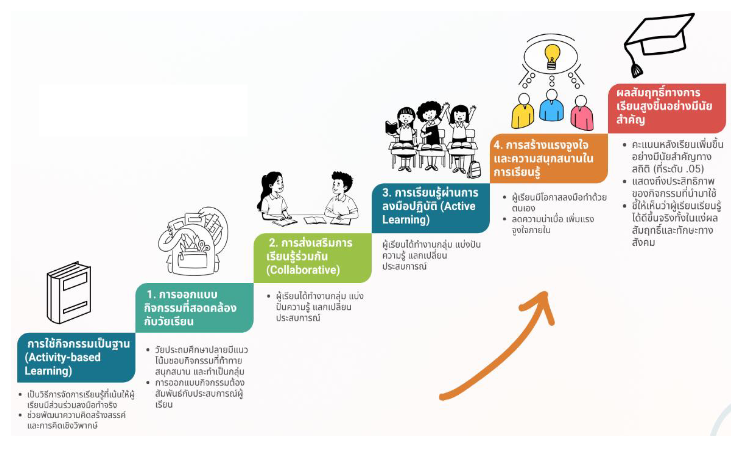
This research article aims to study the academic achievement scores in Buddhist Studies on the topic of the Threefold Training (Ovadapatimokkha) using activity-based learning, and to compare the learning achievement before and after the the activity-based learning intervention among Grade 6 students at Ban Don Talumpuk (Charoenchit Wittaya) School, Nonthaburi Province. The sample group consisted of 15 Grade 6 students, selected through purposive sampling. The research was conducted over five instructional plans developed based on the concept of activity-based learning. The research instruments included lesson plans on the Threefold Training and a 20-item achievement test administered before and after the learning sessions. The data were analyzed using descriptive statistics percentage, mean, and standard deviation and inferential statistics using the paired sample t-test to compare pre-test and post-test results.
The research findings revealed that every student achieved higher post-test scores compared to their pre-test scores. The average post-test score was 88.00 percent, indicating a significant improvement in learning achievement. The use of activity-based learning, which emphasizes student-centered learning processes, had a clearly positive effect on academic performance. Furthermore, the comparison of pre-test and post-test scores showed a statistically significant difference at the .05 level. In conclusion, the implementation of activity-based learning proved to be effective in enhancing students’ academic achievement in Buddhist Studies, specifically on the topic of the Threefold Training. This approach also encouraged greater student engagement in the learning process. The results align with the principles of quality education development that emphasize learner-centered approaches, supporting both knowledge acquisition and the cultivation of desirable characteristics in primary school students through Buddhist education.
Article Details

This work is licensed under a Creative Commons Attribution-NonCommercial-NoDerivatives 4.0 International License.
This article is published under a Creative Commons Attribution-NonCommercial-NoDerivatives 4.0 International License (CC BY-NC-ND 4.0), which allows others to share the article with proper attribution to the authors and prohibits commercial use or modification. For any other reuse or republication, permission from the journal and the authors is required.
References
กฎกระทรวง การสร้าง การตั้ง การรวม การย้าย และการยุบเลิกวัด การขอรับพระราชทานวิสุงคามสีมา และการยกวัดร้างขึ้นเป็นวัดมีพระภิกษุอยู่จำพรรณนา พ.ศ. 2559. (2560, 27 มกราคม). ราชกิจจานุเษกษา. เล่มที่ 134 ตอนที่ 12 ก, หน้า 41-51.
พระธรรมปิฎก (ป.อ. ปยุตโต). (2546ก). พจนานุกรมพุทธศาสน์ ฉบับประมวลธรรม. พิมพ์ครั้งที่ 12. กรุงเทพฯ: โรงพิมพ์มหาจุฬาลงกรณราชวิทยาลัย.
พระธรรมปิฎก (ป.อ. ปยุตโต). (2546ข). พจนานุกรมพุทธศาสตร์ ฉบับประมวลศัพท์. กรุงเทพฯ: มหาจุฬาลงกรณราชวิทยาลัย.
พระมหาสิทธิโชค สิริวณฺโณ. (2565). การพัฒนาผลสัมฤทธิ์ทางการเรียนโดยใช้การเรียนรู้เชิงรุกวิชาพระพุทธศาสนาของนักเรียนชั้นประถมศึกษาปีที่ 6. วิทยานิพนธ์ครุศาสตรมหาบัณฑิต, บัณฑิตวิทยาลัย: มหาวิทยาลัยมหาจุฬาลงกรณราชวิทยาลัย.
ศิวนาถ ฤชุพันธุ์. นายกสมาคมโหรแห่งประเทศไทยในพระบรมราชินูปถัมภ์. 9 กุมภาพันธ์ 2566. สัมภาษณ์.
อัจฉรา ยะคำ. (2556). การสร้างหนังสือการ์ตูนสาระพุทธศาสนา เรื่องพุทธโอวาท 3 เพื่อสร้างเสริมคุณธรรมพื้นฐานของนักเรียน ชั้นประถมศึกษาปีที่ 2 โรงเรียนวัดห้วยทราย อำเภอแม่ออน จังหวัดเชียงใหม่. วิทยานิพนธ์ศึกษาศาสตรมหาบัณฑิต, สาขาวิชาการสอนสังคมศึกษา, บัณฑิตวิทยาลัย, มหาวิทยาลัยเชียงใหม่.
เสริมพงศ์ วงศ์กมลาไสย. (2548). การพัฒนาแผนการจัดการเรียนรู้ภาษาไทย เรื่อง หลวงตาพลวง โดยใช้ กิจกรรมกลุ่มแบบจิกซอว์และแผนผังความคิด ชั้นประถมศึกษาปีที่ 5. การศึกษาค้นคว้าอิสระการศึกษามหาบัณฑิต, ภาควิชาหลักสูตรและการสอน, มหาวิทยาลัยมหาสารคาม.
Hattie, J. (2009). Visible learning: A synthesis of over 800 meta-ana lyses related to achievement. London: Routledge.
Trilling, B., & Fadel, C. (2009). 21st Century Skills: Learning for Life in Our Times. San Francisco, CA: John Wiley & Sons.
Prince, M. (2004). Does Active Learning Work? A Review of the Research. Journal of Engineering Education, 93, 223-231.
