Moral and Ethical Development Guidelines for Thai Youth in the 21st Century
Article Sidebar
Main Article Content
Abstract
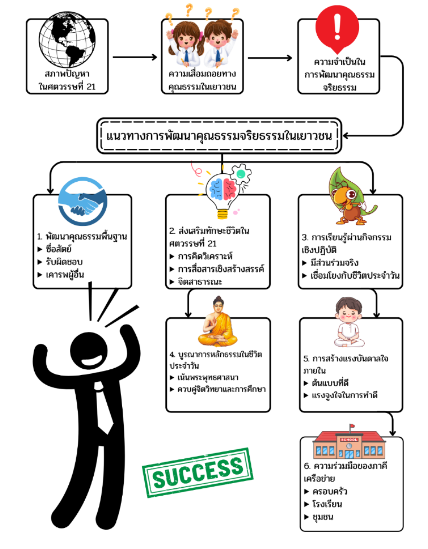
This article aims to present guidelines for developing moral and ethical values among Thai youth in alignment with the context of the 21st century society, the study found that society is full of technological changes, economy, and social values. The current moral crisis among youth manifested through risky behaviors, violence, lack of public consciousness, and declining personal responsibility highlights the urgent need for a systematic and sustainable moral development framework. The proposed approach emphasizes the integration of religious principles into daily learning processes, particularly within educational, familial, and community settings. It also promotes essential 21st-century life skills such as critical thinking, creative communication, collaboration, leadership, and ethical use of innovation. The development process relies on positive role models, inspirational experiences, and genuine youth engagement in practical learning activities. These approaches have been shown to instill desirable traits such as discipline, drug avoidance, and civic responsibility. Therefore, promoting morality and ethics requires an integrated development model based on religious wisdom, psychological principles, and educational practices. This model must be responsive to the Thai social context and global trends, with the goal of cultivating youth as morally grounded and professionally competent citizens who contribute meaningfully to the nation.
Article Details

This work is licensed under a Creative Commons Attribution-NonCommercial-NoDerivatives 4.0 International License.
This article is published under a Creative Commons Attribution-NonCommercial-NoDerivatives 4.0 International License (CC BY-NC-ND 4.0), which allows others to share the article with proper attribution to the authors and prohibits commercial use or modification. For any other reuse or republication, permission from the journal and the authors is required.
References
กรมวิชาการ. (2555). คู่มือการสร้างเครื่องวัดคุณลักษณะด้านจิตพิสัย. กรุงเทพฯ: คุรุสภา.
ชมพู เนื่องจำนงค์ และคณะ. (2563). กรอบทักษะการเรียนรู้ในศตวรรษที่ 21 กับการจัดการเรียนรู้โดยใช้โครงงานเป็นฐาน. วารสารวิชาการสถาบันเทคโนโลยีแห่งสุวรรณภูมิ. 1(1), 623-640.
สุภาพร ศรีเรืองสกุล, ดร. (2568). โครงการอบรมการพัฒนาคุณธรรมในศตวรรษที่ 21 ณ โรงเรียนศุภวรรณ กรุงเทพมหานคร (สัมภาษณ์).
ดวงเดือน พันธุมนาวิน. (2554). จริยธรรมของเยาวชนไทย. กรุงเทพฯ: สถาบันวิจัยพฤติกรรมศาสตร์มหาวิทยาลัยศรีนครินทรวิโรฒ ประสานมิตร.
พระพรหมคุณาภรณ์ (ป.อ. ปยุตโต). (2555). พุทธธรรม ฉบับปรับขยาย. กรุงเทพฯ: พิมพ์ครั้งที่ 32.กองทุน ป.อ. ปยุตฺโต เพื่อเชิดชูธรรม.
เพ็ญแข ประจนปัจจนึก และคณะ. (2554). การยกระดับคุณธรรมจริยธรรมของสังคมไทยเพื่อการปฏิรูปสังคม: แนวทางและการปฏิบัติ. รายงานการวิจัย. กรุงเทพฯ: มหาวิทยาลัยมหิดล.
สายฤดี วรกิจโภคาทร และคณะ. (2552). คุณลักษณะและกระบวนการปลูกฝังคุณธรรมและจริยธรรมในประเทศไทย. รายงานการวิจัย. กรุงเทพฯ: ศูนย์ส่งเสริมและการพัฒนาพลังแผ่นดินเชิงคุณธรรมสำนักงานบริหารและพัฒนาองค์ความรู้ (องค์การมหาชน).
สำนักงานสภาพัฒนาการเศรษฐกิจและสังคมแห่งชาติ สำนักนายกรัฐมนตรี. (2565). แผนพัฒนาเศรษฐกิจและสังคมแห่งชาติ ฉบับที่ 13 (พ.ศ. 2566-2570). ราชกิจจานุเบกษา. [ออนไลน์]. แหล่งที่มา: http://www.ratchakitcha.soc.go.th/DATA/PDF/2565/E/258/T_0001.PDF [20 มกราคม 2568].
สำนักงานส่งเสริมและประสานงานสถาบันอุดมศึกษา สำนักงานคณะกรรมการการอุดมศึกษา. (2549). สรุปผลโครงการส่งเสริมการเรียนรู้เพื่อป้องกันและแก้ไขปัญหาเอดส์ในสถาบันอุดมศึกษา สังกัดสำนักงานคณะกรรมการการอุดมศึกษา ประจำปีงบประมาณ พ.ศ.2549. กรุงเทพฯ: สำนักส่งเสริมและประสานงานสถาบันอุดมศึกษา สำนักงานคณะกรรมการการอุดมศึกษา.
Giacomo, James J. (2000). Teaching Right From Wrong: The Moral Education of today’s Youth. National Catholic Education. Washington, DC.
Good, C.V. (1973). Dictionary of Education. New York: McGraw-Hill.
