A Study on Game-based Learning Management in Thai History for Grade 7 Students at Ban Plong Liam School under the Samut Sakhon Provincial Administrative Organization
Article Sidebar
Main Article Content
Abstract
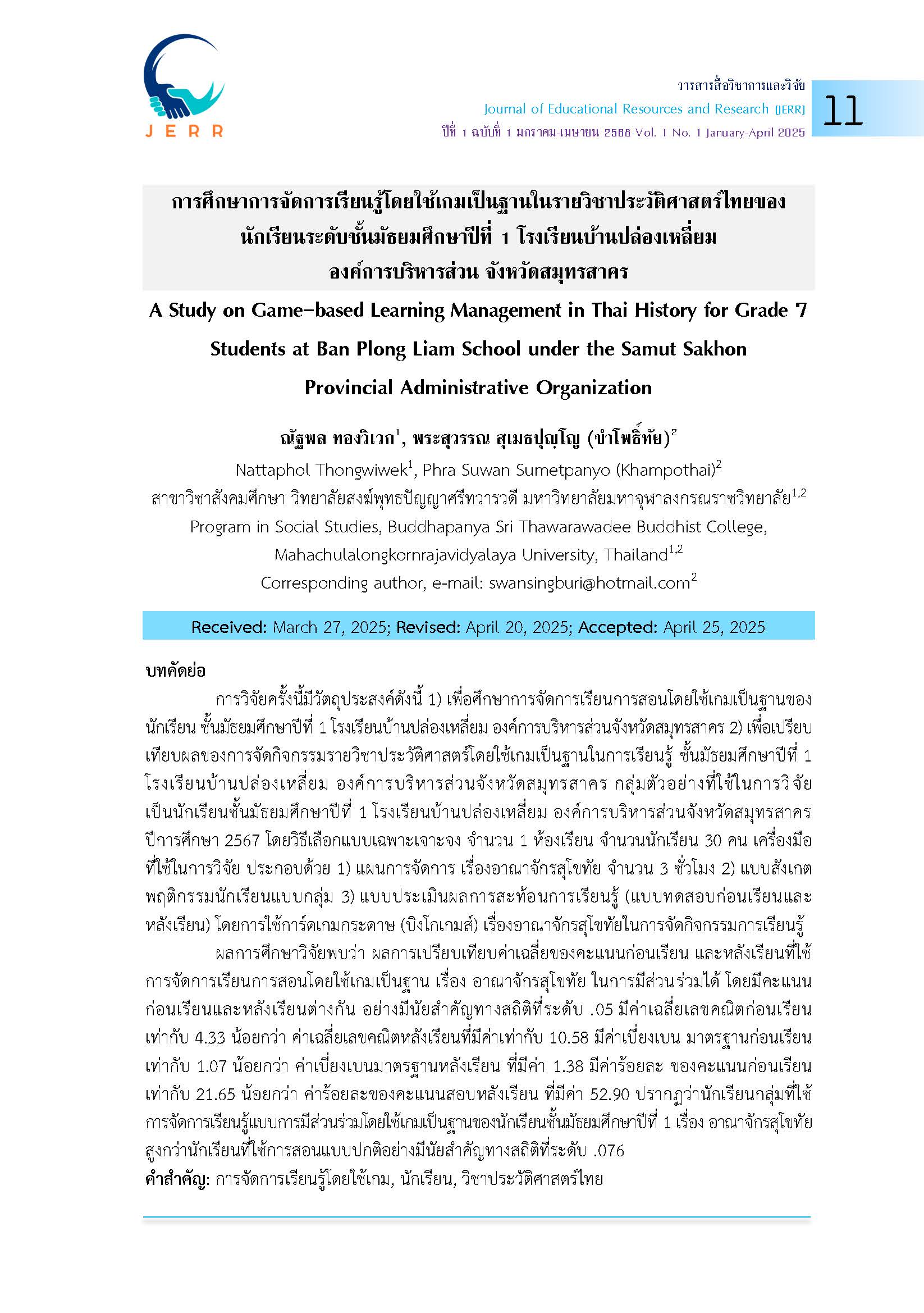
This study aimed to: 1) investigate the effectiveness of game-based instructional management for Grade 7 students at Ban Plongliam School, Samut Sakhon Provincial Administrative Organization, and 2) compare the learning outcomes of game-based activities in the history subject for Grade 7 students at the same school. The research sample comprised 30 Grade 7 students from Ban Plongliam School, Samut Sakhon Provincial Administrative Organization, during the 2024 academic year, selected through purposive sampling of one classroom. Research instruments included: 1) a three-hour instructional plan on the Sukhothai Kingdom, 2) a group-based student behavior observation form, and 3) reflective learning assessments (pre-test and post-test) using a paper-based bingo card game focused on the Sukhothai Kingdom during learning activities.
Research findings indicated a statistically significant difference at the .05 level between pre-test and post-test mean scores following game-based instruction on the Sukhothai Kingdom. The pre-test mean was 4.33, significantly lower than the post-test mean of 10.58. The standard deviation of pre-test scores (1.07) was also lower compared to post-test scores (1.38). Pre-test scores averaged at 21.65%, whereas post-test scores improved significantly to 52.90%. Furthermore, students participating in game-based learning showed significantly higher achievement than students taught using conventional instructional methods, with statistical significance at the level of .076.
Article Details

This work is licensed under a Creative Commons Attribution-NonCommercial-NoDerivatives 4.0 International License.
This article is published under a Creative Commons Attribution-NonCommercial-NoDerivatives 4.0 International License (CC BY-NC-ND 4.0), which allows others to share the article with proper attribution to the authors and prohibits commercial use or modification. For any other reuse or republication, permission from the journal and the authors is required.
References
กระทรวงศึกษาธิการ. พระราชบัญญัติการศึกษาแห่งชาติ พ.ศ. 2542. ราชกิจจานุเบกษา. เล่ม 116 ตอนที่ 34 ก 15 สิงหาคม 2542.
จิตนา กิจบำรุง. (2545). การเปรียบเทียบผลสัมฤทธิ์ทางการเรียน เรื่องประวัติศาสตร์สมัยสุโขทัยและศึกษาทักษะการทำงานกลุ่มของนักเรียนชั้นมัธยมศึกษาปีที่ 1 ที่สอนด้วยวิธีสอนแบบร่วมมือกันเรียนรู้และวิธีสอนตามคู่มือครู. วิทยานิพนธ์การศึกษามหาบัณฑิต, สาขาวิชาหลักสูตรและการนิเทศ, ภาควิชาหลักสูตรและวิธีสอน, บัณฑิตวิทยาลัย, มหาวิทยาลัยศิลปากร.
ทิศนา แขมมณี. (2555). ศาสตร์การสอน องค์ความรู้เพื่อการจัดกระบวนการเรียนรู้ที่มีประสิทธิภาพ. พิมพ์ครั้งที่ 15 กรุงเทพฯ: สำนักพิมพ์แห่งจุฬาลงกรณ์มหาวิทยาลัย.
วรัตต์ อินทสระ. (2562). Game Based Learning The Latest Trend Education 2019 เปลี่ยนห้องเรียน เป็นห้องเล่น. เอกสารประกอบการอบรมและปฏิบัติการ “เปลี่ยนห้องเรียนเป็นห้องเล่น” [Game Based Learning]. กรุงเทพฯ: มหาวิทยาลัยสวนดุสิต.
วรัตต์ อินทสระ. (2562). เปลี่ยนห้องเรียนเป็นห้องเล่น. กรุงเทพฯ: มหาวิทยาลัยสวนดุสิต.
วิทยา วาโย และคณะ. (2563). การจัดการเรียนการสอนแบบออนไลน์ภายใต้สถานการณ์แพร่ระบาดของไวรัส COVID-19: แนวคิดและการประยุกต์ใช้จัดการเรียนการสอน. วารสารศูนย์อนามัยที่ 9. 14(34): 285-298.
สำนักวิทยบริการและเทคโนโลยีสารสนเทศ ARIT NPRU. ทักษะการเรียนรู้ในศตวรรษที่ 21. [ออนไลน์]. แหล่งที่มา: http://arit.npru.ac.th/. [20 มกราคม 2564].
