
Undergraduate Students' Perspectives on Death Management Policy: A Secondary Data Analysis of Classroom Learning Traces
Keywords:
Death Management Policy, Secondary Data Analysis, Collaborative Learning, Flipped Classroom, Policy Triangle FrameworkAbstract
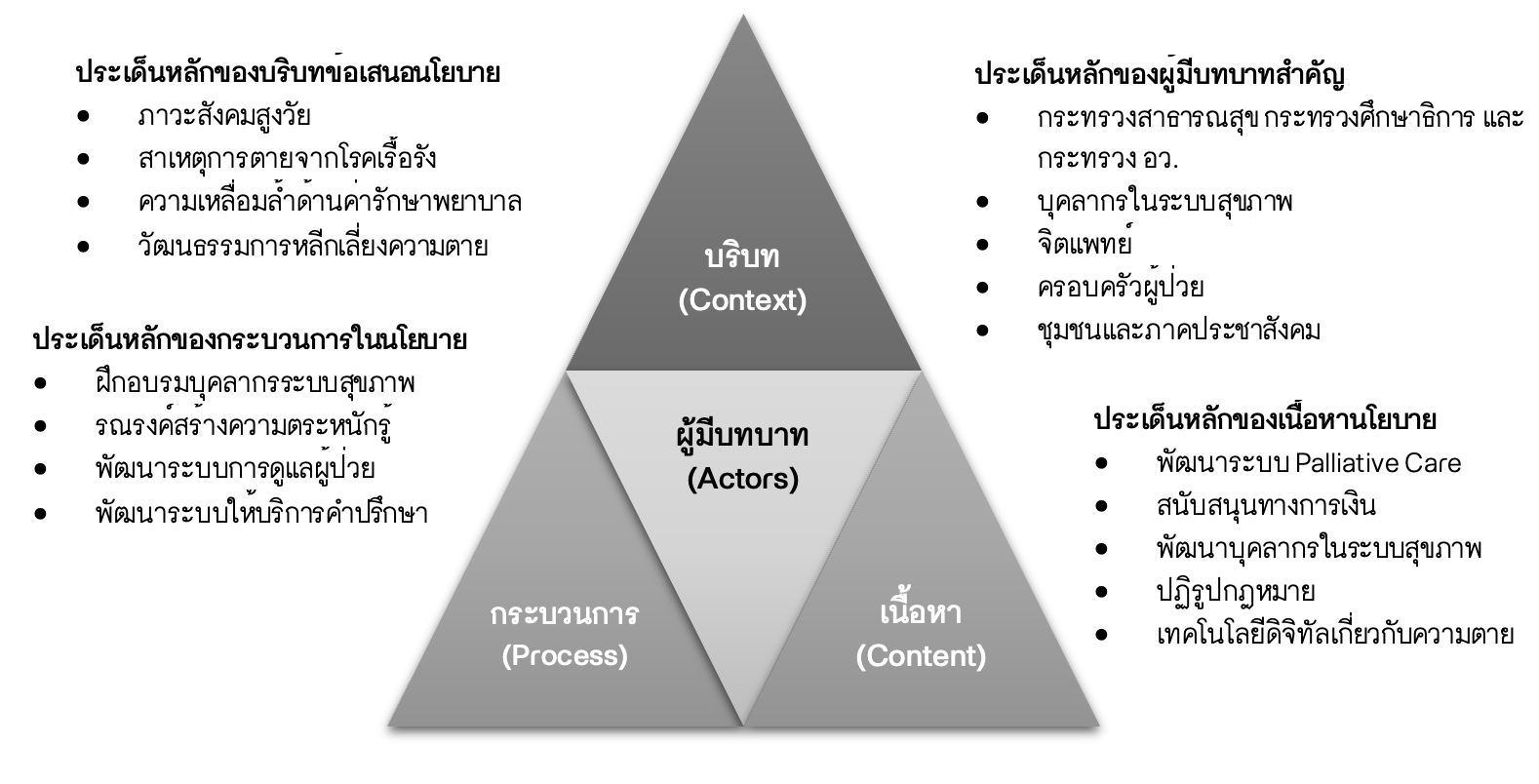
As Thailand transitions into an aged society with deaths exceeding births since 2021, death management policy has become an urgent public issue. Yet the perspectives of younger generations on this topic remain largely underrepresented in policy discourse. This article aims to: (1) examine the characteristics of learning processes and group work in designing death management policy proposals; (2) analyze the main issues and components of death management policy proposals from undergraduate students’ perspectives; and (3) analyze students’ perspectives toward death as reflected through their policy proposals. Using qualitative secondary data analysis (QSDA), we analyzed death management policy proposals produced by 20 student groups comprising 160 students in a Population and Development course during Semester 2 of Academic Year 2023. These proposals were generated through flipped classroom and collaborative learning activities. Data were analyzed using deductive-inductive content analysis and thematic analysis guided by the Policy Triangle Framework. The findings revealed three main points. First, student groups composed of members from multiple faculties and mixed-year levels proposed more diverse and comprehensive policies than homogeneous groups. Students strategically used humor in classroom presentations to reduce tension around death discussions. Second, students proposed policies covering three phases: before death, dying, and after death. These proposals encompassed all four dimensions of the Policy Triangle Framework, including context, content, process, and actors. Third, students’ perspectives on death reflected three transformations: acceptance of death as a public issue open for discussion, awareness of inequality in accessing dignified death, and a challenge to existing power structures in society that control death. This study demonstrates that qualitative secondary data analysis of learning activities is an appropriate approach for studying socially sensitive topics. This method enables access to authentic perspectives from young adults and may reduce social desirability bias, while also providing opportunities for the younger generation to participate in end-of-life policy development aligned with Thailand’s demographic transition context.
Downloads
References
กองบริหารการสาธารณสุข. (2567). คู่มือดำเนินการตามนโยบายสถานชีวาภิบาล 2024. กระทรวงสาธารณสุข. https://phdb.moph.go.th/main/index/detail/31505
กองยุทธศาสตร์และแผนงาน สำนักงานปลัดกระทรวงสาธารณสุข. (2566). สถิติสาธารณสุข พ.ศ. 2565. กระทรวงสาธารณสุข. https://spd.moph.go.th/wp-content/uploads/2023/11/Hstatistic65.pdf
กองยุทธศาสตร์และแผนงาน สำนักงานปลัดกระทรวงสาธารณสุข. (2568). สถิติสาธารณสุข พ.ศ. 2567. กระทรวงสาธารณสุข. https://spd.moph.go.th/public-health-statistics/
โกมาตร จึงเสถียรทรัพย์, นภนาท อนุพงศ์พัฒน์, ชาติชาย มุกสง, ราตรี ปิ่นแก้ว, นงลักษณ์ ตรงศีลสัตย์, วรัญญา เพ็ชรคง, มธุรส ศิริสถิตย์กุล, และประชาธิป กะทา. (2550). วัฒนธรรมความตายกับวาระสุดท้ายของชีวิต: คู่มือเรียนรู้มิติสังคมของการดูแลผู้ป่วยระยะสุดท้าย. สำนักวิจัยสังคมและสุขภาพ.
ชนสิทธิ์ สิทธิ์สูงเนิน. (2560). การพัฒนาการจัดการเรียนรู้แบบร่วมมือร่วมกับแนวคิดห้องเรียนกลับด้านเพื่อส่งเสริมความสามารถในการพัฒนาหลักสูตรท้องถิ่นสำหรับนักศึกษาครู คณะศึกษาศาสตร์ มหาวิทยาลัยศิลปากร. วารสารบัณฑิตศึกษา มหาวิทยาลัยราชภัฏวไลยอลงกรณ์ ในพระบรมราชูปถัมภ์, 11(3), 1–12.
ฐิตินันทน์ ผิวนิล. (2566, 28 ธันวาคม). “Social Death” ความตายทางสังคม: ความตายที่เกิดขึ้นได้ตลอดช่วงชีวิต. ศูนย์มานุษยวิทยาสิรินธร (องค์การมหาชน). https://www.sac.or.th/portal/th/article/detail/555
ฐิตินันทน์ ผิวนิล. (2568). ฉัน(น่า)จะมีชีวิตถึงอายุเท่าไร?: การศึกษาอายุคาดเฉลี่ยเชิงอัตวิสัยของนิสิตนักศึกษาในกรุงเทพมหานคร. วารสารวิจัยสังคมและปริทัศน์, 48(2), บทความ 280704. https://so04.tci-thaijo.org/index.php/socialresearchjournal/article/view/280704
น้ำปรุง บุญนพ, ภัทรมน สุวรรณคัณฑิ, พนมพร พุ่มจันทร์, เอื้ออนุช ถนอมวงษ์, สุชาดา สกลกิจรุ่งโรจน์, และมณฑิรา บุญทิพย์. (2566). ความสัมพันธ์ของการสนับสนุนทางสังคม เจตคติต่อความตาย และพฤติกรรมการเตรียมตัวตายของนิสิตมหาวิทยาลัยเกษตรศาสตร์. วารสารมนุษยศาสตร์และสังคมศาสตร์ วไลยอลงกรณ์ ในพระบรมราชูปถัมภ์, 18(2), 99–114.
ประเวศ วะสี. (2552). กระบวนการนโยบายสาธารณะ (พิมพ์ครั้งที่ 3). สำนักงานคณะกรรมการสุขภาพแห่งชาติ. https://old.nationalhealth.or.th/sites/default/files/upload_files/dmdocs/Art_Booklet_CSH01.pdf
พระกิตติพงศ์ สุกิตฺติโก (โคสูงเนิน), พระครูสังฆรักษ์เอกภัทร อภิฉนฺโท, และประสิทธิ์ แก้วศรี. (2566). การศึกษาทัศนคติต่อความตายของวัยรุ่นในยุคปรับเปลี่ยนชีวิตวิถีใหม่ กรณีศึกษานักเรียนชั้นมัธยมศึกษาตอนปลาย โรงเรียนสุราษฎร์พิทยา จังหวัดสุราษฎร์ธานี. วารสาร มจร การพัฒนาสังคม, 8(3), 238–246.
พลดา เดชพลมาตย์. (2567). นโยบายสาธารณะ: การจัดการความตาย. วารสาร มจร สังคมศาสตร์ปริทรรศน์, 13(4), 192–208.
พิสิษฐ์ ศรีอัคคโภคิน. (2565). ความเข้าใจเบื้องต้นเกี่ยวกับกฎหมายที่อนุญาตให้ยุติชีวิตผู้ป่วย. วารสารนิติศาสตร์ มหาวิทยาลัยธรรมศาสตร์, 51(4), 961–981.
ภาวิกา ศรีรัตนบัลล์. (2561). “บ้าน” สุดท้ายของชีวิต: มุมมองเชิงสังคมวิทยาต่อการบริบาลคุณภาพชีวิตระยะท้าย (พิมพ์ครั้งที่ 3). สำนักงานคณะกรรมการสุขภาพแห่งชาติ. https://infocenter.nationalhealth.or.th/Ebook/thesociologyofillness/book.html#p=1
วรรณวิสาข์ ไชยโย. (2563, กรกฎาคม). ทัศนคติที่มีต่อความหมายของชีวิตกับความตายของวัยรุ่น. ใน รายงานสืบเนื่องจากการประชุมวิชาการระดับชาติ ครั้งที่ 12 มหาวิทยาลัยราชภัฏนครปฐม (น. 2553–2560). มหาวิทยาลัยราชภัฏนครปฐม. https://publication.npru.ac.th/handle/123456789/963
วสันต์ ศรีหิรัญ. (2560). ห้องเรียนกลับด้านกับการคิดวิเคราะห์. วารสารบัณฑิตศึกษา มหาวิทยาลัยราชภัฏสกลนคร, 14(65), 19–28.
อพันตรี พูลพุทธา. (2562). การเปรียบเทียบทักษะการสร้างเครื่องมือประเมินผลการเรียนรู้ ทักษะการทำงานเป็นทีม และผลสัมฤทธิ์ทางการเรียน วิชาการวัดและประเมินผลการศึกษาของนิสิต ระหว่างการเรียนโดยใช้แบบฝึกประกอบการจัดการเรียนรู้กับกลุ่มร่วมมือแบบ LT กับการสอนแบบกลุ่มปกติ. วารสารวิชาการเครือข่ายบัณฑิตศึกษามหาวิทยาลัยราชภัฏภาคเหนือ, 9(2), 107–120.
อัยยา วงษ์วรรณะ, กัลยกร ศิรประภาพงศ์, ปณิฒิ ปิยะชน, นนทิชา โสฒิพันธ์ชัย, อรจิรา อาจารพงษ์, จิตรวีณา มหาคีตะ, และณัฐพล โชคไมตรี. (2567). การวางแผนการดูแลรักษาล่วงหน้าในระยะท้ายของชีวิตในนักศึกษาแพทย์: ทัศนคติ พฤติกรรม และปัจจัยที่เกี่ยวข้อง. เวชสารแพทย์ทหารบก, 77(3), 243–255.
เอมอัชฌา วัฒนบุรานนท์, และปัณณวิชญ์ ปิยะอร่ามวงศ์. (2564). ประเด็นเรื่องความตายที่ควรเรียนรู้ในมุมมองของนิสิตปริญญาบัณฑิต จุฬาลงกรณ์มหาวิทยาลัย ประเทศไทย. วารสารสุทธิปริทัศน์, 35(4), 125–144.
Cheng, S.-Y., Lin, C.-P., Chan, H. Y.-L., Martina, D., Mori, M., Kim, S.-H., & Ng, R. (2020). Advance care planning in Asian culture. Japanese Journal of Clinical Oncology, 50(9), 976–989. https://doi.org/10.1093/jjco/hyaa131
Elo, S., & Kyngäs, H. (2008). The qualitative content analysis process. Journal of Advanced Nursing, 62(1), 107–115. https://doi.org/10.1111/j.1365-2648.2007.04569.x
Gerard, N. (2017). Can millennials talk about death? Young adults’ perceptions of end-of-life care. Journal of Health Administration Education, 34(1), 23–48.
Jordan, R. I., Allsop, M. J., ElMokhallalati, Y., Jackson, C. E., Edwards, H. L., Chapman, E. J., Deliens, L., & Bennett, M. I. (2020). Duration of palliative care before death in international routine practice: A systematic review and meta-analysis. BMC Medicine, 18(1), Article 368. https://doi.org/10.1186/s12916-020-01829-x
Kim, H. (2023). Everyday rehearsal of death and the dilemmas of dying in super-ageing Japan. Modern Asian Studies, 57(1), 32–52. https://doi.org/10.1017/S0026749X21000445
Krumpal, I. (2013). Determinants of social desirability bias in sensitive surveys: A literature review. Quality & Quantity, 47(4), 2025–2047. https://doi.org/10.1007/s11135-011-9640-9
Kunakornvong, W., & Ngaosri, K. (2020). Public awareness and attitude toward palliative care in Thailand. Siriraj Medical Journal, 72(5), 424–430. https://doi.org/10.33192/SMJ.2020.57
Manomaipiboon, B., Wongvitvichot, S., Sumanasrethakul, C., Sutjakul, B., Anantanupong, O., Sae-Tang, S., & Sutthimethakorn, S. (2023). Attitudes toward end-of-life care and advance directives: A prospective survey in a family medicine clinic, Bangkok, Thailand. Chulalongkorn Medical Journal, 67(4), 287–296. https://doi.org/10.56808/2673-060X.5454
OECD. (2023). Time for better care at the end of life. OECD Publishing. https://doi.org/10.1787/722b927a-en
Omilion-Hodges, L. M., Manning, B. L., & Orbe, M. P. (2019). “Context matters”: An exploration of young adult social constructions of meaning about death and dying. Health Communication, 34(2), 139–148. https://doi.org/10.1080/10410236.2017.1384436
Panchenko, L., & Samovilova, N. (2020). Secondary data analysis in educational research: Opportunities for PhD students. SHS Web of Conferences, 75, Article 04005. https://doi.org/10.1051/shsconf/20207504005
Peaceful Death. (2561, 28 กุมภาพันธ์). Happy Deathday | ของขวัญชิ้นสุดท้าย...สุขสันต์วันตาย [วิดีโอ]. YouTube. https://www.youtube.com/watch?v=rzSJznB0Xk8
Peaceful Death. (2562, 19 มิถุนายน). ทำไมผู้ป่วยจึงถูกยื้อชีวิต ยืดความตาย [วิดีโอ]. YouTube. https://www.youtube.com/watch?v=EsN3KsEHBHM
Peaceful Death. (2566, 25 มีนาคม). ชุมชนกรุณา: แนวคิดและปฏิบัติการภาพรวมชุมชนกรุณาในสังคมไทย [วิดีโอ]. YouTube. https://www.youtube.com/watch?v=81Z4rS3qEtE
Pewnil, T., Pothisiri, W., & Sriratanaban, P. (2026). A scoping review of death preparation practices and sociocultural determinants in Thai society. Discover Social Science and Health, 6, Article 13. https://doi.org/10.1007/s44155-025-00346-7
Robinson, E. L., Hart, B., & Sanders, S. (2019). It’s okay to talk about death: Exploring the end-of-life wishes of healthy young adults. Death Studies, 43(6), 389–396. https://doi.org/10.1080/07481187.2018.1478913
Ruggiano, N., & Perry, T. E. (2019). Conducting secondary analysis of qualitative data: Should we, can we, and how? Qualitative Social Work, 18(1), 81–97. https://doi.org/10.1177/1473325017700701
Schuster, C. P., Anderson, B., & Brodowsky, G. (2014). Secondary data: Collection and analysis—Classroom activities for learning. Journal of the Academy of Business Education, 97–118. https://scholarworks.calstate.edu/downloads/kh04dq309
Tourangeau, R., & Yan, T. (2007). Sensitive questions in surveys. Psychological Bulletin, 133(5), 859–883. https://doi.org/10.1037/0033-2909.133.5.859
Walt, G., & Gilson, L. (1994). Reforming the health sector in developing countries: The central role of policy analysis. Health Policy and Planning, 9(4), 353–370. https://doi.org/10.1093/heapol/9.4.353
Translated Thai References
Boonnop, N., Suwankanti, P., Phoomchan, P., Tanomwong, U., Sakolkijrungroj, S., & Boonthip, M. (2023). Relationship between social support, death attitude, and death preparation behavior among Kasetsart University students. Journal of Humanities and Social Sciences Valaya Alongkorn, 18(2), 99–114. [in Thai]
Chaiyo, W. (2020, July 9–10). Adolescents’ attitudes toward the meaning of life and death. In Proceedings of the 12th NPRU National Academic Conference (pp. 2553–2560). Nakhon Pathom Rajabhat University. https://publication.npru.ac.th/handle/123456789/963 [in Thai]
Dechpolmat, P. (2024). Public policy: Death management. Journal of MCU Social Science Review, 13(4), 192–208. [in Thai]
Health Administration Division. (2024). Guidelines for implementing the palliative care facility policy 2024. Ministry of Public Health. https://phdb.moph.go.th/main/index/detail/31505 [in Thai]
Juengsatiansup, K., Anupongphan, N., Muksong, C., Pinkaew, R., Trongsilasat, N., Petchkong, W., Sirisathitkul, M., & Katha, P. (2007). Death, culture, and the end of life: A manual for learning the social dimensions of palliative care. Society and Health Institute. [in Thai]
Peaceful Death. (2018, February 28). Happy deathday | The last gift... Happy deathday [Video]. YouTube. https://www.youtube.com/watch?v=rzSJznB0Xk8 [in Thai]
Peaceful Death. (2019, June 19). Why are patients kept on life support, prolonging death? [Video]. YouTube. https://www.youtube.com/watch?v=EsN3KsEHBHM [in Thai]
Peaceful Death. (2023, March 25). Compassionate communities: Concepts and overview of practices in Thai society [Video]. YouTube. https://www.youtube.com/watch?v=81Z4rS3qEtE [in Thai]
Pewnil, T. (2023, December 28). “Social death”: Death that can occur throughout the life cycle. Princess Maha Chakri Sirindhorn Anthropology Centre. https://www.sac.or.th/portal/th/article/detail/555 [in Thai]
Pewnil, T. (2025). How long should I live? A study of subjective life expectancy among university students in Bangkok. Journal of Social Research and Review, 48(2), Article 280704. [in Thai]
Poonputta, A. (2019). Comparison of students’ skills in developing learning assessment instruments, teamwork skills, and learning achievement in educational evaluation between learning with exercises based on the LT cooperative learning model and conventional instruction. Journal of Graduate Studies in Northern Rajabhat Universities, 9(2), 107–120. [in Thai]
Sithsungnoen, C. (2017). Developing cooperative learning based on the flipped classroom concept to promote ability in local curriculum development for student teachers, Faculty of Education, Silpakorn University. Journal of Graduate Studies Valaya Alongkorn Rajabhat University, 11(3), 1–12. [in Thai]
Sriakkpokin, P. (2022). Basic understanding of the law that allows the end of a patient’s life. Thammasat Law Journal, 51(4), 961–981. [in Thai]
Srihirun, W. (2017). Critical thinking with flipped classroom. Journal of Graduate School Sakon Nakhon Rajabhat University, 14(65), 19–28. [in Thai]
Sriratanaban, P. (2018). The final home of life: A sociological perspective on end-of-life care (3rd ed.). National Health Commission Office. https://infocenter.nationalhealth.or.th/Ebook/thesociologyofillness/book.html#p=1 [in Thai]
Strategy and Planning Division, Office of the Permanent Secretary, Ministry of Public Health. (2023). Public health statistics A.D. 2022. Ministry of Public Health. https://spd.moph.go.th/wp-content/uploads/2023/11/Hstatistic65.pdf [in Thai]
Strategy and Planning Division, Office of the Permanent Secretary, Ministry of Public Health. (2025). Public health statistics A.D. 2024. Ministry of Public Health. https://spd.moph.go.th/public-health-statistics/ [in Thai]
Sukittiko, P. K., Abhichando, P., & Kaewsri, K. (2023). A study of attitudes toward death among adolescents in the new life-changing era: A case study of high school students at Suratpittaya School, Surat Thani Province. Journal of MCU Social Development, 8(3), 238–246. [in Thai]
Wasi, P. (2009). Public policy process (3rd ed.). National Health Commission Office. https://old.nationalhealth.or.th/sites/default/files/upload_files/dmdocs/Art_Booklet_CSH01.pdf [in Thai]
Wattanaburanon, A., & Piyaaramwong, P. (2021). Topics about death that should be learned from the perspective of undergraduate students of Chulalongkorn University, Thailand. Suthiparithat Journal, 35(4), 125–144. [in Thai]
Wongwanna, A., Siraprapapong, K., Piyachon, P., Sothipanchai, N., Arjaraphong, O., Mahagita, C., & Chokemaitree, N. (2024). Advance care planning among medical students: Perceptions, practices, and associated factors. Royal Thai Army Medical Journal, 77(3), 243–255. [in Thai]
Downloads
Published
How to Cite
Issue
Section
License
Copyright (c) 2026 Titinan Pewnil, Chadatan Osatis , Playfa Namprai

This work is licensed under a Creative Commons Attribution-NonCommercial-NoDerivatives 4.0 International License.
All published content in JRM is licensed under a Creative Commons Attribution-NonCommercial-NoDerivatives 4.0 International License (CC BY-NC-ND 4.0).

