Resilience Training Program for Upper-Secondary Students: A Systematic Literature Review
Keywords:
Resilience, Resilience Training Program, Upper-Secondary Students, Systematic ReviewAbstract
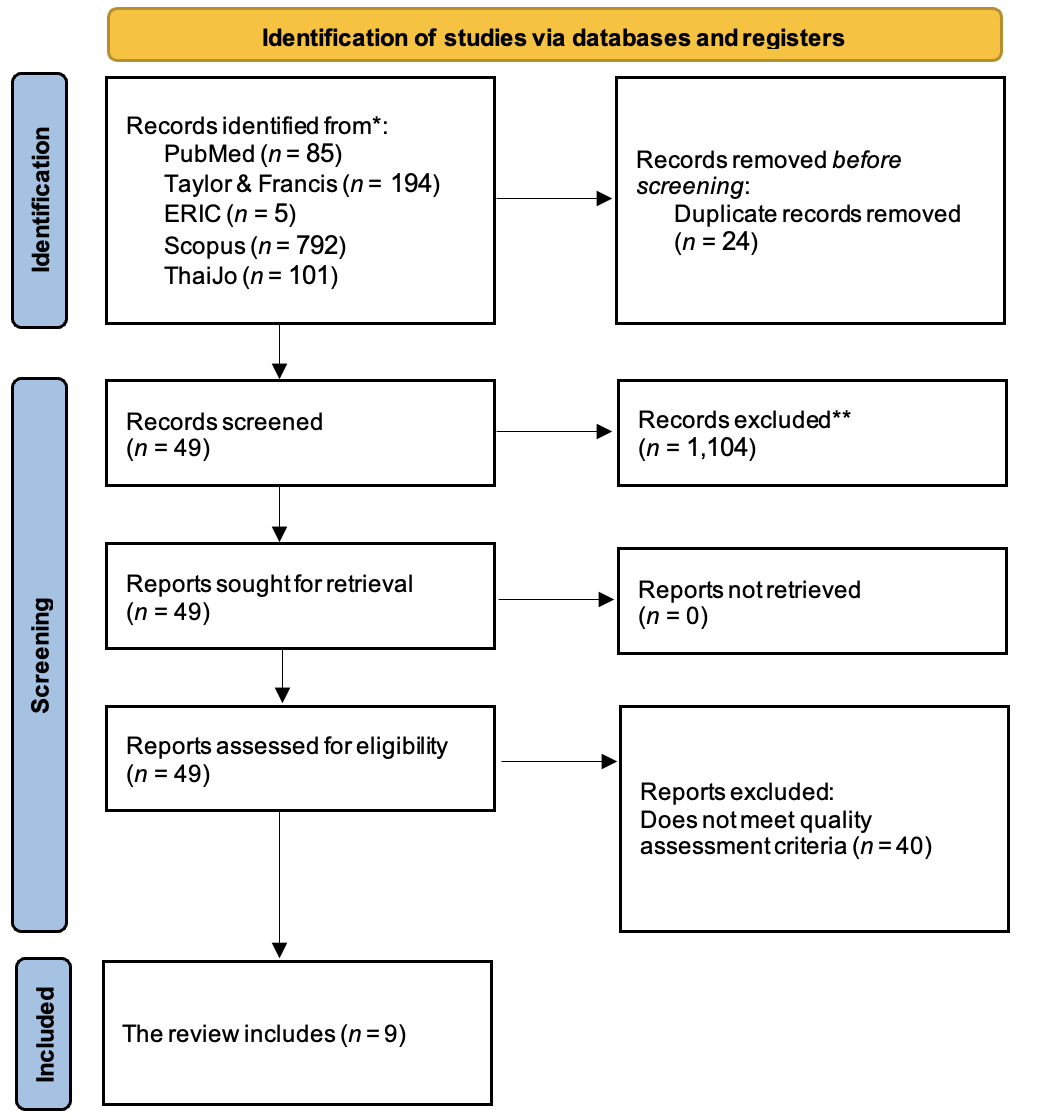
This study aimed to synthesize the essential components, structural characteristics, and emerging trends of resilience-enhancement programs for upper-secondary students using a systematic review approach guided by the PRISMA 2020 framework. Peer-reviewed experimental and quasi-experimental articles published between 2020 and 2024 were retrieved from ERIC, Scopus, PubMed, Taylor & Francis Online, and ThaiJO, yielding 1,177 records, of which nine met the inclusion and quality criteria. These studies focused on developing psychological and social skills associated with adolescent resilience. The synthesis identified six core components commonly embedded in resilience-enhancement programs: (1) self-awareness and self-esteem, (2) emotional flexibility, (3) cognitive flexibility and positive attitudes, (4) self-efficacy and life management, (5) interpersonal and social skills, and (6) external support systems. Frequently adopted program formats included mindfulness training, cognitive-behavioral approaches, active learning, group-based activities, and hybrid models, typically conducted over 6–10 weeks with 60–120-minute sessions. Overall, the findings support the effectiveness of these programs in reducing stress and depressive symptoms while enhancing positive mental health among participants, although limitations concerning sample size and follow-up duration remain and should be addressed in future research to strengthen the long-term reliability of empirical conclusions.
Downloads
References
กรผกา พัฒนกำพล, วาทินี อมรไพศาลเลิศ, และชนัญชิดา ทุมมานนท์. (2565). โปรแกรมส่งเสริมความสามารถในการฟื้นพลังในกลุ่มวัยทำงาน : การสังเคราะห์งานวิจัยด้วยการทบทวนวรรณกรรมอย่างเป็นระบบ. วารสารวิจัยทางการศึกษา, 17(1), 1–18. https://ejournals.swu.ac.th/index.php/jre/article/view/14562
จุฑามาศ สุทินรัมย์. (2560). ผลการใช้ชุดกิจกรรมแนะแนวเพื่อเสริมสร้างความหยุ่นตัวทางอารมณ์ของนักเรียนชั้นมัธยมศึกษาปีที่ 3 ที่มาจากครอบครัวหย่าร้าง โรงเรียนรมย์บุรีพิทยาคม รัชมังคลาภิเษก จังหวัดบุรีรัมย์ [วิทยานิพนธ์ปริญญามหาบัณฑิต, มหาวิทยาลัยสุโขทัยธรรมาธิราช]. Sukhothai Thammathirat Open University Intellectual Repository. http://ir.stou.ac.th/handle/123456789/1635
ชนกชนม์ โคตรสมบัติ, และชูชาติ วงศ์อนุชิต. (2567). ผลของการเสริมสร้างความแข็งแกร่งในชีวิตและการเผชิญปัญหาเพื่อลดภาวะซึมเศร้าในนักเรียนชั้นมัธยมศึกษาตอนปลาย. วารสารสมาคมจิตแพทย์แห่งประเทศไทย, 69(3), 266–273. https://he01.tci-thaijo.org/index.php/JPAT/article/view/271026
นิศารัตน์ สุขตาม, กาญจนา สุทธิเนียม, ชลพร กองคำ, และชูวิทย์ รัตนพลแสนย์. (2565). การเสริมสร้างความเข้มแข็งทางใจของนักเรียนชั้นมัธยมศึกษาตอนปลายที่ถูกกลั่นแกล้งโดยการปรึกษากลุ่มตามทฤษฎีการรู้คิดและพฤติกรรม. วารสาร มจร มนุษยศาสตร์ปริทรรศน์, 8(2), 304–319. https://so03.tci-thaijo.org/index.php/human/article/view/262349
อรไพลิน ไชยวิเชียร, อังคณา จิรโรจน์, และชมชื่น สมประเสริฐ. (2566). ผลของโปรแกรมเสริมสร้างความเข้มแข็งทางใจต่อภาวะสุขภาพจิตของนักเรียนชั้นมัธยมศึกษาตอนปลาย. วารสารพยาบาลทหารบก, 24(1), 143–152. https://he01.tci-thaijo.org/index.php/JRTAN/article/view/251318
ฮาญัร อะหมัด, และสุพัทธ แสนแจ่มใส. (2566). ผลของโปรแกรมการเสริมสร้างความเข้มแข็งทางใจของวัยรุ่นผู้สูญเสียบุคคลอันเป็นที่รักจากสถานการณ์ความไม่สงบจังหวัดชายแดนภาคใต้. Procedia of Multidisciplinary Research, 1(9), บทความเลขที่ 33. https://so09.tci-thaijo.org/index.php/PMR/article/view/3198
Anderson, T. L., Valiauga, R., Tallo, C., Hong, C. B., Manoranjithan, S., Domingo, C., Paudel, M., Untaroiu, A., Barr, S., & Goldhaber, K. (2025). Contributing factors to the rise in adolescent anxiety and associated mental health disorders: A narrative review of current literature. Journal of Child and Adolescent Psychiatric Nursing, 38(1), Article e70009. https://doi.org/10.1111/jcap.70009
Aryuwat, P., Holmgren, J., Asp, M., Lövenmark, A., Radabutr, M., & Sandborgh, M. (2024). Factors associated with resilience among Thai nursing students in the context of clinical education: A cross-sectional study. Education Sciences, 14(1), Article 78. https://doi.org/10.3390/educsci14010078
Barker, T. H., Habibi, N., Aromataris, E., Stone, J. C., Leonardi-Bee, J., Sears, K., Hasanoff, S., Klugar, M., Tufanaru, C., Moola, S., & Munn, Z. (2024). The revised JBI critical appraisal tool for the assessment of risk of bias for quasi-experimental studies. JBI Evidence Synthesis, 22(3), 378–388. https://doi.org/10.11124/JBIES-23-00268
Cai, C., Mei, Z., Wang, Z., & Luo, S. (2025). School-based interventions for resilience in children and adolescents: A systematic review and meta-analysis of randomized controlled trials. Frontiers in Psychiatry, 16, Article 1594658. https://doi.org/10.3389/fpsyt.2025.1594658
Calvete, E., Orue, I., Echezarraga, A., Cortazar, N., & Fernández-González, L. (2022). A growth mindset intervention to promote resilience against online peer victimization: A randomized controlled trial. Computers in Human Behavior, 135, Article 107373. https://doi.org/10.1016/j.chb.2022.107373
Carroza-Pacheco, A. M., León-Del-Barco, B., & Molleda, C. B. (2025). Academic performance and resilience in secondary education students. Journal of Intelligence, 13(5), 1–13. https://doi.org/10.3390/jintelligence13050056
Connor, K. M., & Davidson, J. R. (2003). Development of a new resilience scale: The Connor–Davidson Resilience Scale (CD-RISC). Depression and Anxiety, 18(2), 76–82. https://doi.org/10.1002/da.10113
Ford, T., Degli Esposti, M., Crane, C., Taylor, L., Montero-Marín, J., Blakemore, S.-J., Bowes, L., Byford, S., Dalgleish, T., Greenberg, M. T., Nuthall, E., Phillips, A., Raja, A., Ukoumunne, O. C., Viner, R. M., Williams, J. M. G., Allwood, M., Aukland, L., Casey, T., … Kuyken, W. (2021). The role of schools in early adolescents’ mental health: Findings from the MYRIAD study. Journal of the American Academy of Child & Adolescent Psychiatry, 60(12), 1467–1478. https://doi.org/10.1016/j.jaac.2021.02.016
Gendron, B., Kouremenou, E.-S., & Rusu, C. (2016). Emotional capital development, positive psychology and mindful teaching: Which links? International Journal of Emotional Education, 8(1), 63–74. https://www.um.edu.mt/library/oar//handle/123456789/9995
Grazzani, I., Agliati, A., Cavioni, V., Conte, E., Gandellini, S., Lupica Spagnolo, M., Ornaghi, V., Rossi, F. M., Cefai, C., Bartolo, P., Camilleri, L., & Oriordan, M. R. (2022). Adolescents’ resilience during COVID-19 pandemic and its mediating role in the association between social and emotional learning skills and mental health. Frontiers in Psychology, 13, Article 801761. https://doi.org/10.3389/fpsyg.2022.801761
Grotberg, E. H. (2003). Resilience for today: Gaining strength from adversity. Praeger.
Gupta, S., & McCarthy, P. J. (2022). The sporting resilience model: A systematic review of resilience in sport performers. Frontiers in Psychology, 13, Article 1003053. https://doi.org/10.3389/fpsyg.2022.1003053
Henshall, C., Davey, Z., & Jackson, D. (2020). Nursing resilience interventions–A way forward in challenging healthcare territories. Journal of Clinical Nursing, 29(19–20), 3597–3599. https://doi.org/10.1111/jocn.15276
Hosseinkhani, Z., Hassanabadi, H.-R., Parsaeian, M., Nedjat, S., & Foroozanfar, Z. (2020). The role of mental health, academic stress, academic achievement, and physical activity on self-rated health among adolescents in Iran: A multilevel analysis. Journal of Education and Health Promotion, 9, Article 182. https://doi.org/10.4103/jehp.jehp_161_20
Joulaei, H., Fathi, F., Rakhshani, T., Nazari, M., Hosseinkhani, Z., Fatemi, M., & Foroozanfar, Z. (2022). Gender differences in the effect of resilience training on emotional intelligence in at-risk students in Shiraz, Iran. International Journal of High Risk Behaviors and Addiction, 11(2), Article e121942. https://doi.org/10.5812/ijhrba-121942
Kataoka, S., Langley, A. K., Wong, M., Baweja, S., & Stein, B. D. (2012). Responding to students with posttraumatic stress disorder in schools. Child and Adolescent Psychiatric Clinics of North America, 21(1), 119–133. https://doi.org/10.1016/j.chc.2011.08.009
Konaszewski, K., Niesiobędzka, M., & Surzykiewicz, J. (2021). Resilience and mental health among juveniles: Role of strategies for coping with stress. Health and Quality of Life Outcomes, 19, Article 58. https://doi.org/10.1186/s12955-021-01701-3
Kubrusly, M., Rocha, H. A. L., Maia, A. C. C., Sá, A. K. M., Sales, M. M., & Mazza, S. R. (2019). Resilience in the training of medical students in a university with a hybrid teaching–learning system. Brazilian Journal of Medical Education, 43(Suppl. 1), 357–366. https://doi.org/10.1590/1981-5271v43suplemento1-20190161.ING
Llistosella, M., Goni-Fuste, B., Martín-Delgado, L., Miranda-Mendizabal, A., Franch Martinez, B., Pérez-Ventana, C., & Castellvi, P. (2023). Effectiveness of resilience-based interventions in schools for adolescents: A systematic review and meta-analysis. Frontiers in Psychology, 14, Article 1211113. https://doi.org/10.3389/fpsyg.2023.1211113
Luo, S., Hu, J., Zhang, J., Mei, Z., Tang, Z., & Luo, S. (2025). The correlation between resilience and mental health of adolescents and young adults: A systematic review and meta-analysis. Frontiers in Psychiatry, 16, Article 1536553. https://doi.org/10.3389/fpsyt.2025.1536553
Mahon, C., & Hevey, D. (2023). Pilot trial of a self-compassion intervention to address adolescents’ social-media-related body image concerns. Clinical Child Psychology and Psychiatry, 28(1), 307–322. https://doi.org/10.1177/13591045221099215
Marlotte, L., Klomhaus, A., Ijadi-Maghsoodi, R., Aralis, H., Lester, P., Esperon, K. G., & Kataoka, S. (2023). Implementing depression care in under-resourced communities: A school-based family resilience skill-building pilot randomized controlled trial in the United States. Frontiers in Psychology, 14, Article 1233901. https://doi.org/10.3389/fpsyg.2023.1233901
Masten, A. S. (2021). Resilience in developmental systems: Principles, pathways, and protective processes in research and practice. In M. Ungar (Ed.), Multisystemic resilience: Adaptation and transformation in contexts of change (pp. 113–134). Oxford University Press. https://doi.org/10.1093/oso/9780190095888.003.0007
Mesman, E., Vreeker, A., & Hillegers, M. (2021). Resilience and mental health in children and adolescents: An update of the recent literature and future directions. Current Opinion in Psychiatry, 34(6), 586–592. https://doi.org/10.1097/YCO.0000000000000741
Oakley, E., Vintges, J., Abu Hamad, B., Mitu, K., Seager, J., Yadete, W., Jones, N., & Baird, S. (2025). Adolescence, interrupted: A narrative review of the impact of COVID-19 on adolescent wellbeing. World Development, 185, Article 106786. https://doi.org/10.1016/j.worlddev.2024.106786
Pagaoa, A. E., Uy-Gomes, S., & Antiporda, A. B. (2024). Investigating the relationship between resilience and academic performance in Filipino adolescents: A quantitative analysis. Ignatian International Journal for Multidisciplinary Research, 2(6), 1585–1612. https://doi.org/10.5281/zenodo.12157551
Page, M. J., McKenzie, J. E., Bossuyt, P. M., Boutron, I., Hoffmann, T. C., Mulrow, C. D., Shamseer, L., Tetzlaff, J. M., Akl, E. A., Brennan, S. E., Chou, R., Glanville, J., Grimshaw, J. M., Hróbjartsson, A., Lalu, M. M., Li, T., Loder, E. W., Mayo-Wilson, E., McDonald, S., … Moher, D. (2021). The PRISMA 2020 statement: An updated guideline for reporting systematic reviews. BMJ, 372, Article n71. https://doi.org/10.1136/bmj.n71
Panchal, U., de Pablo, G. S., Franco, M., Moreno, C., Parellada, M., Arango, C., & Fusar-Poli, P. (2021). The impact of COVID-19 on child and adolescent mental health: A systematic review. European Child and Adolescent Psychiatry, 30(8), 1137–1149. https://doi.org/10.1007/s00787-021-01856-w
Pearson, E., Sharp, L., & Hampton, L. (2025). Resilience in context: A synthesis of theories and practices for educational psychologists. Educational Psychology in Practice, 41(4), 439–456. https://doi.org/10.1080/02667363.2025.2518990
Pinto, T. M., Laurence, P. G., Macedo, C. R., & Macedo, E. C. (2021). Resilience programs for children and adolescents: A systematic review and meta-analysis. Frontiers in Psychology, 12, Article 754115. https://doi.org/10.3389/fpsyg.2021.754115
Racine, N., McArthur, B. A., Cooke, J. E., Eirich, R., Zhu, J., & Madigan, S. (2021). Global prevalence of depressive and anxiety symptoms in children and adolescents during COVID-19: A meta-analysis. JAMA Pediatrics, 175(11), 1142–1150. https://doi.org/10.1001/jamapediatrics.2021.2482
Raniti, M., Rakesh, D., Patton, G. C., & Sawyer, S. M. (2022). The role of school connectedness in the prevention of youth depression and anxiety: A systematic review with youth consultation. BMC Public Health, 22(1), Article 2152. https://doi.org/10.1186/s12889-022-14364-6
Reivich, K., & Shatté, A. (2002). The resilience factor: 7 essential skills for overcoming life’s inevitable obstacles. Broadway Books.
Rutter, M. (2012). Resilience as a dynamic concept. Development and Psychopathology, 24(2), 335–344. https://doi.org/10.1017/S0954579412000028
Sae-Koew, J., Gonsalkorale, K., & Cross, D. (2024). Protecting children and adolescents from cyberbullying: An evidence review of risk and protective factors and effective interventions. New South Wales Education Standards Authority. https://www.nsw.gov.au/sites/default/files/2024-08/protecting-children-and-adolescents-from-cyberbullying.pdf
Shapira, S., Sold, A., & Refaeli, T. (2025). The interplay of personal and collective resilience and mental health during prolonged conflict: Insights from young adults in Israel. Stress and Health, 41(3), Article e70047. https://doi.org/10.1002/smi.70047
Southwick, S. M., & Charney, D. S. (2023). Resilience: The science of mastering life’s greatest challenges (3rd ed.). Cambridge University Press.
Steare, T., Gutiérrez Muñoz, C., Sullivan, A., & Lewis, G. (2023). The association between academic pressure and adolescent mental health problems: A systematic review. Journal of Affective Disorders, 339, 302–317. https://doi.org/10.1016/j.jad.2023.07.028
Thanachoksawang, C., Arphorn, S., Jarupat Maruo, S., Punneng, S., Ishimaru, T., & Bangkadanara, G. (2024). Psychological distress among high school students in Bangkok, Thailand. Health Psychology Research, 12, Article 120045. https://doi.org/10.52965/001c.120045
Xing, J., Xu, X., Li, X., & Luo, Q. (2023). Psychological resilience interventions for adolescents during the COVID-19 pandemic. Behavioral Sciences, 13(7), Article 543. https://doi.org/10.3390/bs13070543
Xu, L., Zhang, H., Zhou, C., Zhang, Z., Li, G., Lu, W., Tian, X., Huang, H., Li, D., Schinke, R. J., Yuan, T., Yin, J., & Lin, K. (2023). Deficits in psychological resilience and problem-solving ability in adolescents with suicidal ideation. Child and Adolescent Psychiatry and Mental Health, 17, Article 31. https://doi.org/10.1186/s13034-023-00577-z
Translated Thai References
Ahmad, H., & Sanjamsai, S. (2023). The effect of resilience enhancing program among the bereaved adolescent affected by south of Thailand insurgency. Procedia of Multidisciplinary Research, 1(9), Article 33. https://so09.tci-thaijo.org/index.php/PMR/article/view/3198
Chaivichean, A., Jirorode, A., & Somprasert, C. (2023). The effect of a mental strengthening program on the mental health state of high school students. Journal of the Royal Thai Army Nurses, 24(1), 143–152. https://he01.tci-thaijo.org/index.php/JRTAN/article/view/251318
Khotsombat, C., & Wong-Anuchit, C. (2024). The effect of resilience and coping intervention to reduce depression in senior high school students. Journal of the Psychiatric Association of Thailand, 69(3), 266–273. https://he01.tci-thaijo.org/index.php/JPAT/article/view/271026
Phatthanagumphol, K., Amornpaisarnloet, W., & Thummanond, C. (2022). Enhance resilience program in workplace: A research synthesis by systematic review. Journal of Educational Research, 17(1), 1–18. https://ejournals.swu.ac.th/index.php/jre/article/view/14562
Suktam, N., Suttineam, K., Kongkham, C., & Ruttanapolsan, C. (2022). Enhancing resilience of bullying high school students by cognitive behavior counseling group. Journal of Applied Psychology and Buddhism for Society, 8(2), 304–319. https://so03.tci-thaijo.org/index.php/human/article/view/262349
Sutinram, J. (2017). The effects of using a guidance activities package to enhance emotional resilience of divorced-parent Matthayom Suksa III students at Romburi Pittayakhom Ratchamangala Pisek School in Buri Ram Province [Master’s thesis, Sukhothai Thammathirat Open University]. Sukhothai Thammathirat Open University Intellectual Repository. http://ir.stou.ac.th/handle/123456789/1635
Downloads
Published
How to Cite
Issue
Section
License
Copyright (c) 2025 Siriwit Kessarakun, Piyawan Visessuvanapoom

This work is licensed under a Creative Commons Attribution-NonCommercial-NoDerivatives 4.0 International License.
All published content in JRM is licensed under a Creative Commons Attribution-NonCommercial-NoDerivatives 4.0 International License (CC BY-NC-ND 4.0).

