Introducing the Rule of Five: A Guide to the Literature Review
Keywords:
Conceptual Review, Empirical Review, Literature Review, Methodological Review, Rule of Five, Theoretical ReviewAbstract
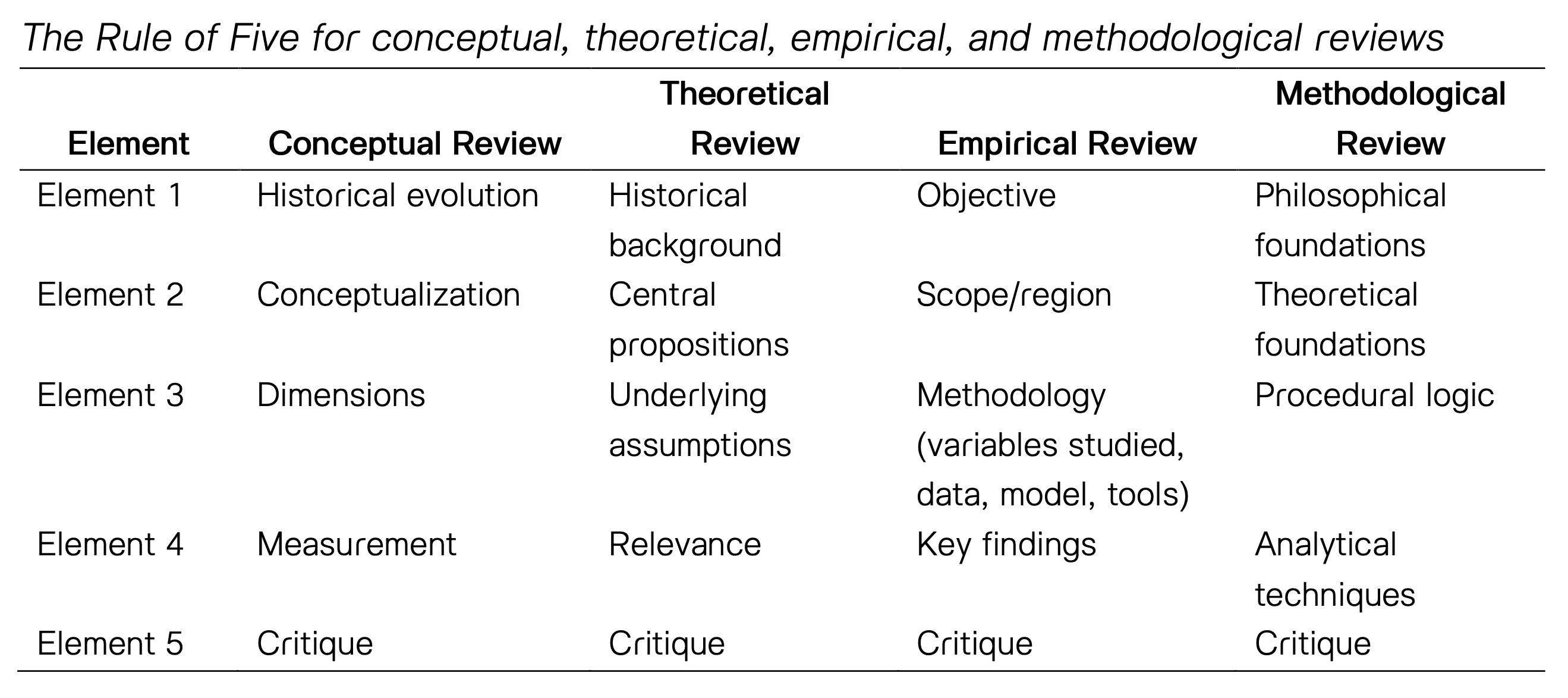
This article proposes the Rule of Five, a practical and structured framework for organizing literature reviews across conceptual, theoretical, empirical, and methodological domains. Recognizing the confusion and fragmentation often experienced by students and early-career researchers, the Rule of Five proposes five core elements that should guide the review of each component of the literature in order to improve clarity, coherence, and analytical depth in academic writing. Each component is approached systematically. For conceptual reviews, the framework emphasizes historical evolution, conceptualization, dimensions, measurement, and critique. The theoretical review is guided by the theory's historical background, central propositions, underlying assumptions, relevance, and critique. Empirical literature is examined through the objective, scope, method, key findings, and critique. Methodological reviews are organized around philosophical foundations, theoretical foundations, procedural logic, analytical techniques, and critique. This article serves as a practical guide for students and researchers seeking to structure their literature reviews systematically, ensuring that key dimensions of academic inquiry are addressed consistently across diverse fields of study. The Rule is intended as both a pedagogical tool and a writing aid, offering a replicable structure that enhances the quality and clarity of literature reviews across disciplines. The article concludes with practical recommendations for applying the Rule of Five in academic writing, teaching, and research supervision.
Downloads
References
Biala, M. I. (2019a). A review of the economist’s approach to pollution and its control. Journal of Environmental Pollution and Control, 2(1), 1-17. https://annexpublishers.co/full-text/JEPC/2102/A-Review-of-the-Economist’s-Approach-to-Pollution-and-its-Control.php
Biala, M. I. (2019b). Synthesizing the economist’s and the psychologist’s approaches to litter control for sustainable waste management. Environmental Economics, 10(1), 1-11. http://doi.org/10.21511/ee.10(1).2019.01
Biala, M. I., & Aregbeyen, O. (2018). An applicability test of the use of deposit-refund system for managing water-sachet litter in Ilorin, Nigeria. Environmental Economics, 9(4), 22–43. http://doi.org/10.21511/ee.09(4).2018.03
Booth, W. C., Colomb, G. G., Williams, J. M., Bizup, J., & FitzGerald, W. T. (2016). The craft of research (4th ed.). University of Chicago Press.
Crotty, M. (1998). The foundations of social research: Meaning and perspective in the research process. Sage Publications.
Grant, M. J., & Booth, A. (2009). A typology of reviews: An analysis of 14 review types and associated methodologies. Health Information & Libraries Journal, 26(2), 91–108. https://doi.org/10.1111/j.1471-1842.2009.00848.x
Hart, C. (1998). Doing a literature review: Releasing the social science research imagination. Sage Publications. https://doi.org/10.1016/j.jbusres.2019.07.039
Jabareen, Y. (2009). Building a conceptual framework: Philosophy, definitions, and procedure. International Journal of Qualitative Methods, 8(4), 49–62. https://doi.org/10.1177/160940690900800406.
Kivunja, C. (2018). Distinguishing between theory, theoretical framework, and conceptual framework: A systematic review of lessons from the field. International Journal of Higher Education 7(6), 44-53. https://ideas.repec.org/a/jfr/ijhe11/v7y2018i6p44.html
Leedy, P. D., & Ormrod, J. E. (2021). Practical research: Planning and design (12th ed.). Pearson.
Machi, L. A., & McEvoy, B. T. (2016). The literature review: Six steps to success (3rd ed.). Corwin Press.
Merriam, S. B. (1988). Case study research in education: A qualitative approach. Jossey-Bass.
Ridley, D. (2012). The literature review: A step-by-step guide for students (2nd ed.). Sage Publications.
Snyder, H. (2019). Literature review as a research methodology: An overview and guidelines. Journal of Business Research, 104, 333–339.
Torraco, R. J. (2005). Writing integrative literature reviews: Guidelines and examples. Human Resource Development Review, 4(3), 356–367. https://doi.org/10.1177/1534484305278283.
Webster, J., & Watson, R. T. (2002). Analyzing the past to prepare for the future: Writing a literature review. MIS Quarterly, 26(2), xiii–xxiii. https://www.jstor.org/stable/4132319
Downloads
Published
How to Cite
Issue
Section
License
Copyright (c) 2025 Musa Ilias Biala

This work is licensed under a Creative Commons Attribution-NonCommercial-NoDerivatives 4.0 International License.
All published content in JRM is licensed under a Creative Commons Attribution-NonCommercial-NoDerivatives 4.0 International License (CC BY-NC-ND 4.0).
