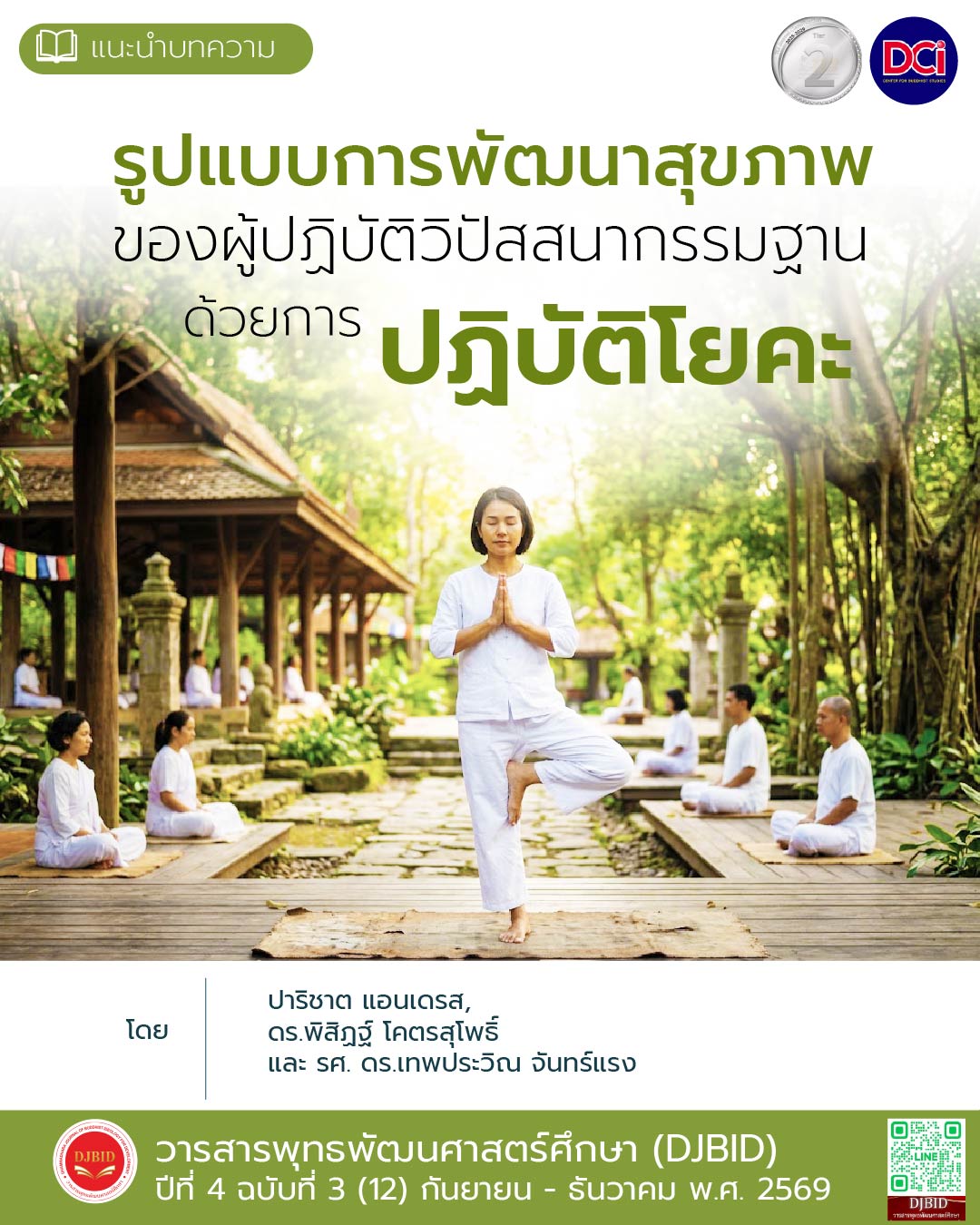
Health Development Model for Vipassana Practitioners based on Yoga Practice
Keywords:
Health Development, Vipassana Meditation, Yoga PracticeAbstract
This article has three objectives: (1) to study the principles of health development through yoga practice; (2) to analyze the health development of Vipassana practitioners at the International Meditation Center, MCU Chiang Mai Campus, through yoga practice; and (3) to propose the health development model for Vipassana practitioners based on yoga practice. This research is a qualitative study, conducted through the review of documents and related research on concepts of health, health in Buddhist principles, Buddhist teachings related to health, Vipassana meditation according to the Four Foundations of Mindfulness (Satipaṭṭhāna 4), as well as concepts and practices of yoga, together with field data collection from 20 key informants, using questionnaires administered before and after yoga practice, in-depth interviews, and focus group discussions with 8 key informants. Data were primarily analyzed by Content Analysis, while numerical data and descriptive statistics were used to support and confirm the research findings.
The findings revealed that: (1) The principles of health development based on yoga practice constitute a holistic health development process aimed at creating balance between body and mind through the principles of Ashtanga Yoga to promote physical, social, mental, and wisdom health; (2) After practicing yoga comprising Asana, Pranayama, and Yoga Nidra, Vipassana practitioners showed a tendency toward improved physical and holistic health. Flexibility, muscular strength and endurance of the legs, cardiovascular endurance and circulatory function, as well as blood oxygen saturation, increased significantly at the 0.05 level. In addition, the mean scores of holistic health increased across the physical, social, mental, and wisdom dimensions. The in-depth interviews and focus group discussions revealed that yoga practice helped reduce physical discomfort, enhance concentration, promote mental calmness, and improve readiness for Vipassana meditation; (3) The study developed the “PARICHAT Model: A Boon Yoga Approach,” a holistic health development model integrating Asana, Pranayama, and Yoga Nidra with the principles of Satipaṭṭhāna 4 to promote physical, social, mental, and wisdom health. The model can be applied according to practitioners’ age, physical condition, and individual practice context.
References
ฉลองชัย ม่านโคกสูง. “ผลของการฝึกหะฐะโยคะที่มีต่อสมรรถภาพทางกายเพื่อสุขภาพและระดับความเครียดของประชาชนวัยผู้ใหญ่จังหวัดสกลนคร”. วารสารศิลปะศาสตร์ มหาวิทยาลัยสงขลานครินทร์. ปีที่ 3 ฉบับที่ 2 (กรกฎาคม–ธันวาคม 2554 ). 88–102.
ชิดชนก ทัพไทย. “การบูรณาการฝึกสมาธิโดยใช้สติปัฏฐานสี่และโยคศาสตร์”. วิทยานิพนธ์พุทธศาสตรดุษฎีบัณฑิต สาขาพระพุทธศาสนา. บัณฑิตวิทยาลัย: มหาวิทยาลัยมหาจุฬาลงกรณราชวิทยาลัย, 2561.
นันทนา วงษ์สวัสดิ์. “การพัฒนาโปรแกรมการฝึกโยคะอาสนะตามแนวพุทธจิตวิทยาเพื่อเพิ่มพฤฒิพลังในผู้สูงอายุ”. วิทยานิพนธ์พุทธศาสตรดุษฎีบัณฑิต สาขาวิชาพุทธจิตวิทยา. บัณฑิตวิทยาลัย:มหาวิทยาลัยมหาจุฬาลงกรณราชวิทยาลัย, 2563.
มหาจุฬาลงกรณราชวิทยาลัย. พระไตรปิฎกภาษาไทย ฉบับมหาจุฬาลงกรณราชวิทยาลัย. กรุงเทพฯ: มหาจุฬาลงกรณราชวิทยาลัย, 2539.
เย็นจิต สิงหะพันธุ และสาระ มุขดี. “ผลของโปรแกรมการฝึกโยคะแนวพุทธจิตวิทยาเพื่อพัฒนาความสมดุลของชีวิตของพนักงานบริษัทเอกชน”. วารสารพุทธจิตวิทยา. ปีที่ 4 ฉบับที่ 1 (มกราคม–มิถุนายน 2562). 76–89.
สิริทรัพย์ สีหะวงษ์ และคณะ. “ผลของโยคะต่อสุขภาพกายและจิตของอาสาสมัครสาธารณสุขประจำหมู่บ้าน”. วารสารวิทยาศาสตร์และเทคโนโลยี หัวเฉียวเฉลิมพระเกียรติ. ปีที่ 9 ฉบับที่ 1 (มกราคม–มิถุนายน 2566). 44–54.
เสรี ศรีงาม และคณะ. “คุณค่าของการฝึกโยคะสมาธิตามแนวทางพุทธปรัชญา”. วารสาร มจร.เลย ปริทัศน์. ปีที่ 1 ฉบับที่ 2 (พฤษภาคม–สิงหาคม 2563). 20–31.
เอ็ม.แอล. ฆาโรเต. ศาสตร์และศิลป์แห่งโยคะ. แปลโดย วีระพงษ์ ไกรวิทย์ และจิรวรรณ ตั้งจิตเมธี. กรุงเทพฯ: สถาบันโยคะไทย, 2560.
อังคณารัชต์ แก้วแสงใส และคณะ. “ผลของการออกกำลังกายแบบไอเยนกะโยคะต่อความรุนแรงของโรคข้อเข่าเสื่อมในผู้สูงอายุ”. พยาบาลสาร มหาวิทยาลัยเชียงใหม่. ปีที่ 47 ฉบับที่ 1 (มกราคม–มีนาคม 2563). 175–184.
Adrijana D’Silva et al. “Meditation and Yoga for Irritable Bowel Syndrome: Study Protocol for a Randomized Clinical Trial (MY-IBS Study)”. BMJ Open. Vol. 12 No. 5 (May 2002). 1–7.
B.K.S. Iyengar. Yoga: The Path to Holistic Health. 3rd ed. London: Dorling Kindersley Ltd, 2014.
Manish Kumar Dwivedi. “Effectiveness of Yoga Nidra Intervention (Meditation) in Improving Well-being of an Individual”. Indian Journal of Social Psychiatry. Vol. 38 No. 1 (January–March 2022). 73–85.
Patanjali. Patanjali Yoga Sutras. Tr. by Swami Vivekananda. Delhi: Sharma Printers, 2017.
Stephanie Voss et al. “Yoga Impacts Cognitive Health: Neurophysiological Changes and Stress-regulation Mechanisms”. Exercise and Sport Sciences Reviews. Vol. 51 No. 2 (April 2024). 73–81.
Sunita et al. “Effect of Practicing Meditation, Pranayama, and Yoga on the Mental Health of Female Undergraduate Medical Students: An Interventional Study”. Cureus – Journal of Medical Science. Vol. 14 No. 9 (September 2022). 1–9.
Swami Niranjanananda Saraswati. Prana and Pranayama. Munger: Yoga Publication Trust, 2016.
Swami Satyananda Saraswati. Yoga Nidra. 9th ed. Munger: Yoga Publications Trust, 2012.
World Health Organization. Constitution of the World Health Organization. New York: International Health Conference, 1946.