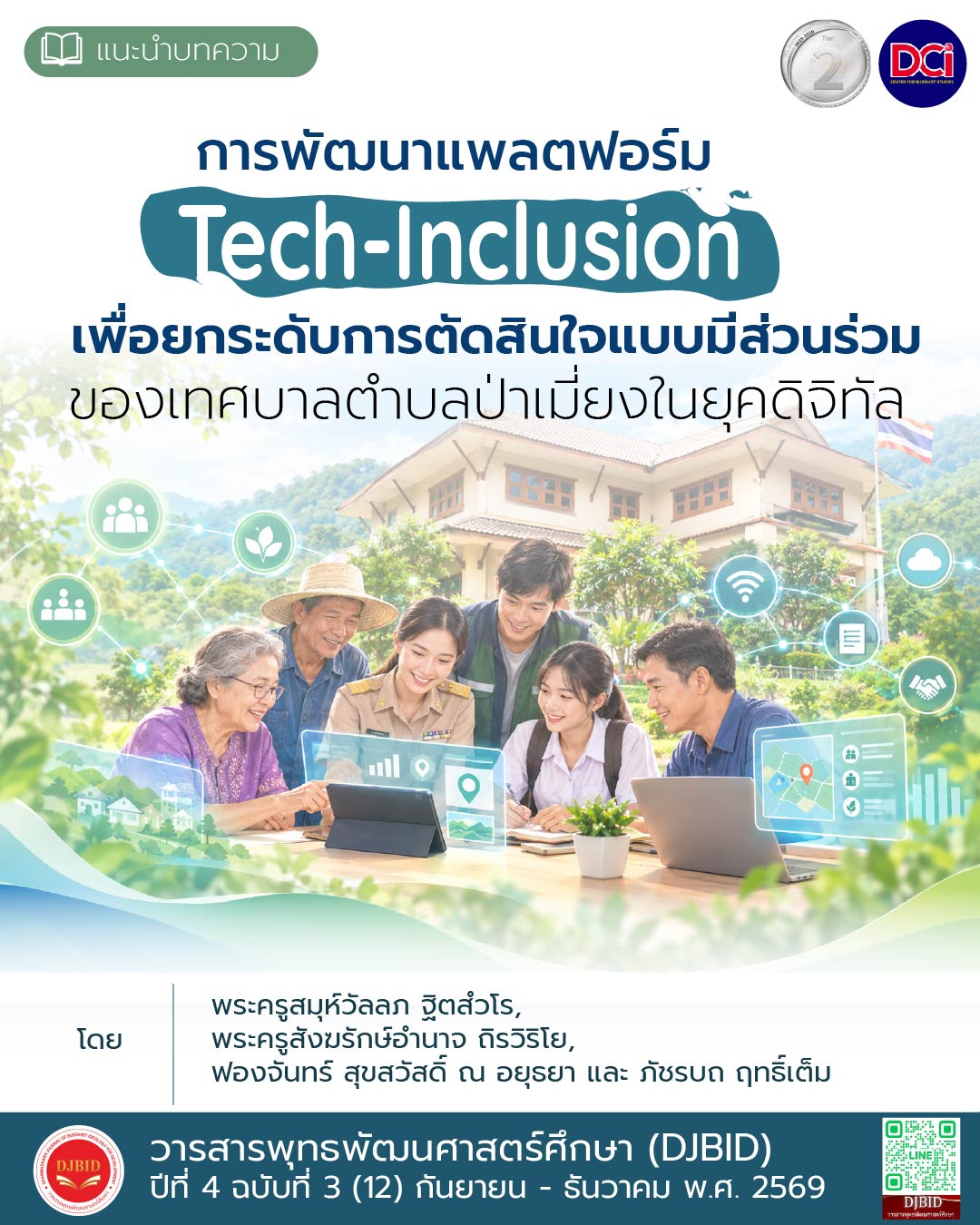
Development of the Tech-Inclusion Platform to Enhance Participatory Decision-Making in Pa Miang Subdistrict Municipality in the Digital Era
Keywords:
Tech-Inclusion, Digital Platform, Participatory Decision‑Making, Local GovernmentAbstract
This research had three objectives: (1) to examine the current state of participatory decision-making in Pa Miang Subdistrict Municipality in the digital era; (2) to develop the Tech-Inclusion platform to support participatory decision-making in Pa Miang Subdistrict Municipality; and (3) to evaluate users’ satisfaction with the Tech-Inclusion platform. The study employed a mixed-methods design, with action research used as the process for platform development. Quantitative data were obtained from 29 municipal administrators and officials and 179 residents of Pa Miang Subdistrict Municipality, totaling 208 participants. The resident sample was determined using the Taro Yamane formula and selected through stratified random sampling from a population of 3,492 residents. Qualitative data were obtained from 30 key informants, comprising 10 local administrators, officials, and municipal council members; 10 community representatives; and 10 academics in information technology, political science, and community development. Six participants selected from the interview groups also participated in a focus group discussion. The research instruments included a questionnaire, an in-depth interview form, and focus group discussion guidelines. The questionnaire yielded item-objective congruence values ranging from 0.67 to 1.00 and a reliability coefficient of 0.82. Quantitative data were analyzed using frequency, percentage, mean, and standard deviation, while qualitative data were analyzed using content analysis.
The findings revealed that: (1) public participation occurred through several mechanisms, including public hearings, community meetings, monitoring, and online communication. However, participation remained intermittent, relied substantially on conventional mechanisms, and lacked systematic consolidation of project and participation data. Some citizens also encountered limitations in technology access and digital skills. (2) The Tech-Inclusion platform was developed as a central space for communication and participation. It organized information according to local development strategies and supported access to project information, voting, commenting, searching, and filtering. (3) The overall mean score for user satisfaction with the platform was 3.94 (S.D. = 0.90). Ease of use received the highest mean score (4.07), followed by intention to continue using the platform (4.04), system speed (3.96), process transparency (3.92), completeness of information (3.84), and perceived actual participation (3.82). The findings indicate that technology-supported participatory decision-making requires an integrated mechanism linking access to information, participation processes, decision-support information, and feedback to citizens. Further development is needed to reduce the digital divide and strengthen feedback mechanisms showing how citizens’ inputs influence local decision-making.
References
เกียรติขจร วัจนะสวัสดิ์. การมีส่วนร่วมของประชาชนต่อการดำเนินนโยบายของรัฐบาลด้านการบริการจัดหางาน. กรุงเทพฯ: กองแผนงานและสารสนเทศ กรมการจัดหางาน กระทรวงแรงงาน, 2550.
เจมส์ แอล. เครย์ตัน. คู่มือการมีส่วนร่วมของประชาชน: การตัดสินใจที่ดีกว่าโดยให้ชุมชนมีส่วนร่วม. แปลโดย วันชัย วัฒนศัพท์, ถวิลวดี บุรีกุล และเมธิศา พงษ์ศักดิ์ศรี. กรุงเทพฯ: โรงพิมพ์ศิริภัณฑ์ ออฟเซ็ท, 2551.
ณัฏฐ์ณัชชา ไชยประเสริฐ. “บทบาทท้องถิ่นกับการบริหารจัดการเมืองแบบ Smart City”. วารสาร มจร บาฬีศึกษาพุทธโฆสปริทรรศน์, ปีที่ 8 ฉบับที่ 1 (2565). 72–84.
ณัฐพงษ์ คันธรส, อัมฤตา สารธิวงค์, อัญธิชา รุ่งแสง และฐาปนี ชุมพลวงศ์. “การบริหารราชการแบบมีส่วนร่วม: จากแนวคิดสู่การพัฒนาภาครัฐในยุคประเทศไทย 4.0”. วารสารวิชาการ สถาบันเทคโนโลยีแห่งสุวรรณภูมิ, ปีที่ 7 ฉบับที่ 2 (2564). 130–144.
นภสร สุดท้วม. “ประสิทธิภาพการปฏิบัติงานด้านเทคโนโลยีในยุคดิจิทัลของบุคลากรสำนักงานคณะกรรมการอัยการ สำนักงานอัยการสูงสุด”. เอกสารรวมบทความ รัฐประศาสนศาสตรมหาบัณฑิต, กรุงเทพฯ: มหาวิทยาลัยรามคำแหง, 2564.
พงศ์เทพ ไข่มุกด์. การพัฒนาระบบเทคโนโลยีในการใช้บริหารงานปกครองและการบริการประชาชนของกระทรวงมหาดไทย. กรุงเทพฯ: สำนักงานปลัดกระทรวงมหาดไทย, 2563.
ยุทธพร อิสรชัย. การมีส่วนร่วมทางการเมืองในระบอบประชาธิปไตย. กรุงเทพฯ: สำนักการพิมพ์ สำนักงานเลขาธิการสภาผู้แทนราษฎร, 2561.
สุกัญญา มิตรเมฆ และเทพศักดิ์ บุณยรัตพันธุ์. “การปรับตัวของการบริหารงานขององค์กรปกครองส่วนท้องถิ่นในจังหวัดชุมพร ภายใต้นโยบายไทยแลนด์ 4.0”. เอกสารสืบเนื่องการประชุมหาดใหญ่วิชาการระดับชาติและนานาชาติ ครั้งที่ 13. มหาวิทยาลัยหาดใหญ่, 2565.
อนุวัฒน์ ทองแสง, อนุพันธ์ เรืองพรวิสุทธิ์, ปุณณดา ทรงอิทธิสุข และโชติ บดีรัตน์. “นโยบายการบริหารกิจการสาธารณะยุคดิจิทัล”. วารสาร มจร อุบลปริทรรศน์, ปีที่ 7 ฉบับที่ 2, (พฤษภาคม–สิงหาคม 2565). 130–144.
Intaprom, W. “Model of public participation in the local development”. Journal of Graduate Studies Valaya Alongkorn Rajabhat University, Vol. 8 No. 3 (2014). 280–291.