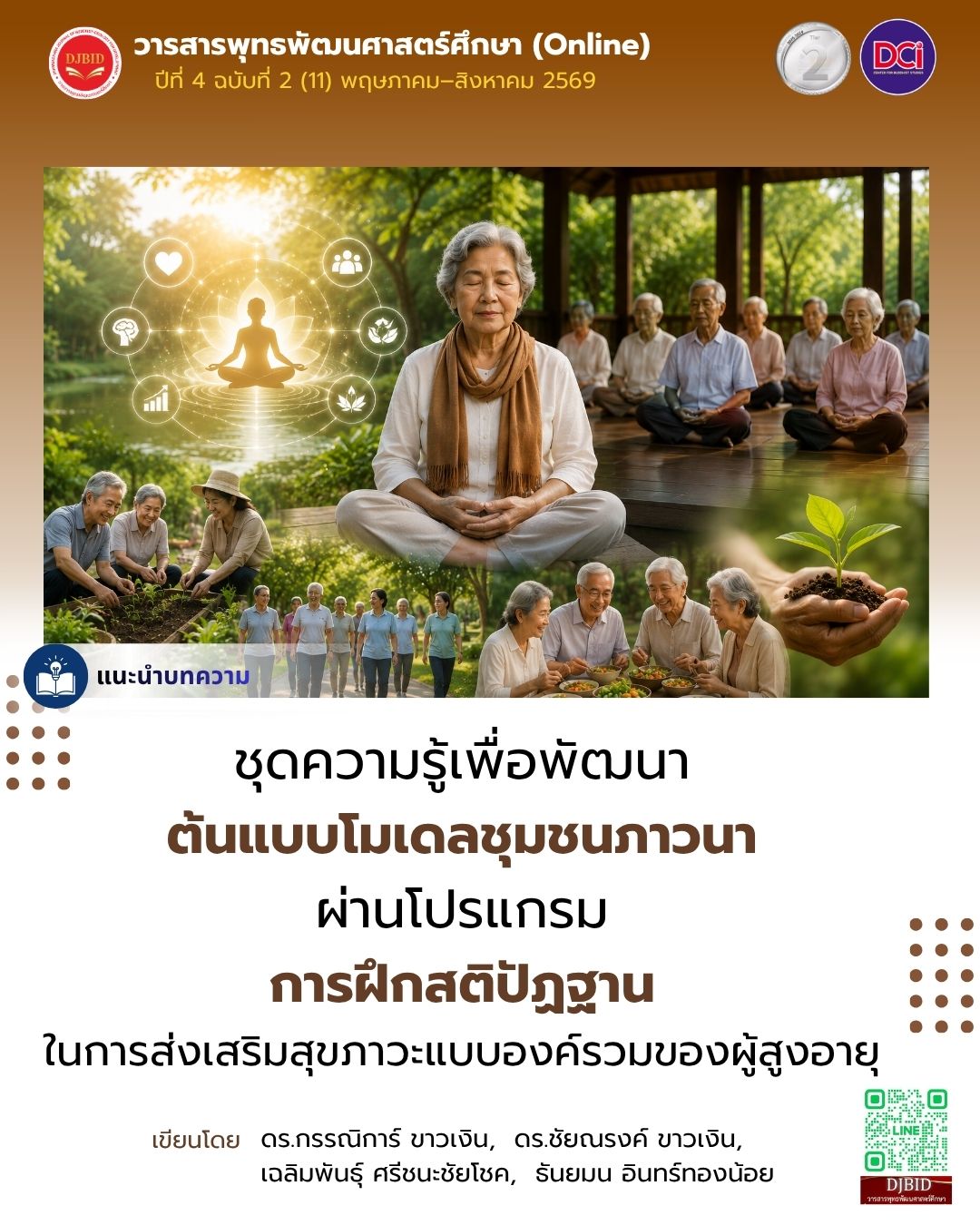
A Knowledge Package for Developing a Prototype Contemplative Community Model Based on Satipaṭṭhāna Practice for Promoting Holistic Well-Being among Older Adults
Keywords:
Satipaṭṭhāna, Contemplative Community, Holistic Well-being, Older Adults, Documentary ResearchAbstract
This study aimed to: (1) examine the principles of Satipaṭṭhāna and the concept of holistic well-being as relevant to older adults in Thai society; and (2) synthesize a knowledge package on Satipaṭṭhāna practice that could be used as a framework for designing a contemplative community model to promote the holistic well-being of older adults in Thailand. Documentary research was employed. Data were collected from the Tipiṭaka, commentaries, research articles, books, and academic documents related to holistic well-being promotion, community development, and older adults. The data were then analyzed through content analysis and knowledge synthesis.
The findings revealed that Satipaṭṭhāna plays an important role in cultivating self-awareness by integrating contemplation of the body, feelings, mind, and dhammas into the daily lives of older adults in a holistic manner. It enhances their capacity for self-awareness, regulation of physical states and emotions, management of thoughts, acceptance of age-related decline, and meaningful living, particularly within the context of Thai society. The knowledge package for designing a prototype contemplative community model should be grounded in an integrative Buddhist framework comprising three components: (1) mindfulness and wisdom that support the regulation of the body, emotions, and thoughts, as well as acceptance of age-related decline; (2) practical activities associated with physical movement that can be incorporated into daily life, such as mindful walking, sitting, rising, standing, eating, sleeping, and conscious breathing; and (3) supportive social structures involving families, temples, communities, and health service units that encourage the active participation of older adults. The body of knowledge generated by this study is a framework for designing a contemplative community model to promote the holistic well-being of older adults in Thai society. The model is regarded as an important mechanism for advancing community-based health care, with Satipaṭṭhāna practice functioning as a process factor that contributes to holistic well-being. These findings are academically valuable because they extend the integrative Buddhist conceptual framework for ageing studies and are practically significant because they can contribute to improving the quality of life of older adults at the local community level.
References
กมล มัยรัตน์ และวรรณี พงษ์โสภา. “ประสิทธิผลของโปรแกรม E75 ที่มีต่อสมรรถภาพทางกาย และการทรงตัวของผู้สูงอาย”. วารสารการส่งเสริมสุขภาพและอนามัยสิ่งแวดล้อม. ปีที่ 48 ฉบับที่ 2 (เมษายน–มิถุนายน 2568). 24–39.
กรมกิจการผู้สูงอายุ. กลุ่มเสริมสร้างและพัฒนาศักยภาพเครือข่าย กองส่งเสริมศักยภาพผู้สูงอายุ. สังคมผู้สูงอายุในปัจจุบันและเศรษฐกิจในประเทศไทย. ออนไลน์. https://www.dop.go.th/th/know/15/926. [15 มีนาคม 2569].
จงจิต สร้อยจักร. “ผลของโปรแกรมการให้คำปรึกษาเชิงบำบัดต่อความเข้มแข็งทางจิตใจของผู้มีอาการซึมเศร้าในผู้สูงอายุตำบลแคนน้อย อำเภอคำเขื่อนแก้ว จังหวัดยโสธร”. วารสารสิ่งแวดล้อมศึกษาการแพทย์และสุขภาพ. ปีที่ 10 ฉบับที่ 2 (เมษายน–มิถุนายน 2568). 772–780.
ฐาวรี ขันสำโรง และคณะ. “การสังเคราะห์งานวิจัยเปรียบเทียบการฝึกสติ โยคะ และชี่กง (ไทเก๊ก) ต่อภาวะซึมเศร้าและความวิตกกังวลในผู้ป่วยโรคหลอดเลือดสมอง”. วารสารสหศาสตร์การพัฒนาสังคม. ปีที่ 3 ฉบับที่ 1 (มกราคม–กุมภาพันธ์ 2568). 535–555.
ปฏิมาพร เคลือขอน และพัฒนภาณุ ทูลธรรม. “โรงเรียนผู้สูงอายุ: การเสริมสร้างคุณภาพชีวิตผู้สูงอายุแบบองค์รวมภายใต้บริบทสังคมสูงวัยในพื้นที่เทศบาลตำบลพลายชุมพล อำเภอเมือง จังหวัดพิษณุโลก”. วารสารการจัดการและพัฒนาท้องถิ่น มหาวิทยาลัยราชภัฏพิบูลสงคราม. ปีที่ 5 ฉบับที่ 1 (มกราคม–มิถุนายน 2568). 155–165.
ประวิทย์ ฤทธิบูลย์ และพัชราภัณฑ์ ไชยสังข์. “การพัฒนารูปแบบกิจกรรมการออกกำลังกายโดยใช้ท่านาฏศิลป์ประยุกต์สำหรับผู้สูงอายุ”. Silpakorn University e-Journal (Social Sciences, Humanities, and Arts). ปีที่ 43 ฉบับที่ 6 (พฤศจิกายน–ธันวาคม 2567). 91–105.
ปาริชาติ แว่นไวศาสตร์ และคณะ. “การรับรู้และประสบการณ์การส่งเสริมสุขภาพจิตของผู้สูงอายุไทย: การวิจัยเชิงปรากฏการณ์วิทยา”. วารสารวิจัยสุขภาพและการพยาบาล. ปีที่ 39 ฉบับที่ 1 (มกราคม–เมษายน 2566). 170–181.
พนัสพร ศิริงาม, รังสิมันต์ สุนทรไชยา และนุชนาถ บรรทุมพร. “ผลของโปรแกรมประยุกต์การเจริญสติต่อความผาสุกทางใจของผู้สูงอายุโรคซึมเศร้า”. วารสารแพทย์นาวี. ปีที่ 52 ฉบับที่ 2 (พฤษภาคม–สิงหาคม 2568). 388–401.
พระครูปฐมธรรมรักษ์ (ประสิทธิ์ชัย คำดี) และพระมหาวิโรจน์ คุตฺตวีโร. “การปฏิบัติวิปัสสนาภาวนาในคัมภีร์พระพุทธศาสนาเถรวาท”. วารสารบัณฑิตศึกษาปริทรรศน์. ปีที่ 20 ฉบับที่ 3 (กันยายน–ธันวาคม 2567). 60–73.
พระครูวินัยธรจิรภัทรส์ จิตฺตโสภโณ (มีทองแสน) และพระมหาโกมล กมโล. “กระบวนการส่งเสริมสุขภาวะผู้สูงอายุด้วยหลักวิปัสสนากรรมฐาน”. วารสาร มจร บาฬีศึกษาพุทธโฆสปริทรรศน์. ปีที่ 11 ฉบับที่ 3 (กันยายน–ธันวาคม 2568). 1080–1093.
พระชยานันทมุนี (ธรรมวัตร จรณธมฺโม) และคณะ. “วิเคราะห์ขบวนการเสริมสร้างสุขภาวะองค์รวมของผู้สูงอายุด้วยหลักสติปัฏฐาน 4 ในจังหวัดน่าน”. วารสารพุทธนวัตกรรมและการจัดการ. ปีที่ 8 ฉบับที่ 4 (กรกฎาคม–สิงหาคม 2568). 15–19.
พระเทพวิสุทธิโสภณ (เฉลา เตชวนฺโต) และนเรศ ฤทธิเดช. “การปฏิบัติวิปัสสนากรรมฐานที่เหมาะสมของผู้สูงอายุในจังหวัดพระนครศรีอยุธยา”. วารสารพุทธนวัตกรรมและการจัดการ. ปีที่ 8 ฉบับที่ 1 (มกราคม–กุมภาพันธ์ 2568). 37–49.
พระนิธิชัย สุขสำราญ และธานี สุวรรณประทีป. “การประยุกต์ใช้สติปัฏฐาน 4 เพื่อใช้ในการดำเนินชีวิต”. วารสารนวัตกรรมการจัดการศึกษาและการวิจัย. ปีที่ 7 ฉบับที่ 1 (มกราคม–กุมภาพันธ์ 2568). 13–20.
พระอธิการทัดธน กตปุญฺโญ และคณะ. “การประยุกต์ใช้หลักสติปัฎฐาน 4 ในการปฏิบัติธรรมของชาวพุทธ ตำบลโคกกว้าง อำเภอบุ่งคล้า จังหวัดบึงกาฬ”. วารสารพุทธศาสตร์ มจร.อุบลราชธานี. ปีที่ 4 ฉบับที่ 2 (กรกฎาคม–ธันวาคม 2565). 157–168.
พระอธิการปฏิยุทธ์ วีตโสโก (อ่อนเผ่า), สุขเกษม ขุนทอง และโกนิฏฐ์ ศรีทอง. “การพัฒนารูปแบบการส่งเสริมสุขภาวะตามแนวสติปัฏฐานธรรมของผู้สูงอายุ ชุมชนสวนมะม่วงวังทับไทร อำเภอสากเหล็ก จังหวัดพิจิตร”. วารสาร มจร ทวารวดีปริทรรศน์. ปีที่ 3 ฉบับที่ 2 (กรกฎาคม–ธันวาคม 2567), 17–27.
มหาจุฬาลงกรณราชวิทยาลัย. พระไตรปิฎกภาษาไทย ฉบับมหาจุฬาลงกรณราชวิทยาลัย. กรุงเทพฯ: โรงพิมพ์มหาจุฬาลงกรณราชวิทยาลัย, 2539.
____. อรรถกถาภาษาไทย พระสุตตันตปิฎก ทีฆนิกาย สีลักขันธวรรค ฉบับมหาจุฬาลงกรณราชวิทยาลัย. กรุงเทพฯ: โรงพิมพ์มหาจุฬาลงกรณราชวิทยาลัย, 2557.
ลออ สิงหโชติสุขแพทย์ และธัญชนก ลีธีระ. “ผลของโปรแกรมกลุ่มสนับสนุนทางสังคมต่อภาวะสุขภาพจิตของผู้สูงอายุ ในชมรมผู้สูงอายุเขตอำเภอเมือง จังหวัดเพชรบุรี”. วารสารการพยาบาลจิตเวชและสุขภาพจิต. ปีที่ 36 ฉบับที่ 3 (กันยายน–ธันวาคม 2565). 14–28.
วรัชยา ธีรฉัตรวัฒน์. “ประสิทธิผลของการฝึกเดินด้วยการเดินจงกรมแบบ ๖ ระยะที่มีต่อความสามารถในการทรงตัวของผู้สูงอายุ ในชมรมผู้สูงอายุโรงพยาบาลบางกรวย จังหวัดนนทบุรี”. วารสารการแพทย์และสาธารณสุข มหาวิทยาลัยอุบลราชธานี. ปีที่ 9 ฉบับที่ 1 (มกราคม–เมษายน 2569). 1–13
วิไลรัตน์ บรรจงเลิศ, สุนิตดา เทศนิยม, ธีรพล กาญจนากาศ และสมคิด ดวงจักร์. “ปัจจัยสนับสนุนทางสังคมที่ส่งผลต่อคุณภาพชีวิตผู้สูงอายุในเขตองค์การบริหารส่วนตำบลไกรใน อำเภอกงไกรลาศ จังหวัดสุโขทัย”. Journal of Spatial Development and Policy. ปีที่ 3 ฉบับที่ 3 (พฤษภาคม–มิถุนายน 2568). 89–100.
เวชสุวรรณ อาจวิชัย และคณะ. “พุทธบูรณาการการพัฒนารูปแบบการดูแลผู้สูงอายุกลุ่มเปราะบางเพื่อยกระดับคุณภาพชีวิตวิถีใหม่และความมั่นคงของมนุษย์ในภาคตะวันออกเฉียงเหนือ”. เสฏฐวิทย์ปริทัศน์. ปีที่ 5 ฉบับที่ 3 (กันยายน–ธันวาคม 2568). 1380–1395.
สำนักงานคณะกรรมการสุขภาพแห่งชาติ. สังคมสูงวัย ‘วิกฤต’ หรือ ‘โอกาส’ ของประเทศไทย. ออนไลน์. https://old.nationalhealth.or.th/th/node/4901. [15 มีนาคม 2569].
สันต์ทัศน์ สินสมบัติ และคณะ. “การพัฒนาต้นแบบนวัตกรรมอุปกรณ์อัจฉริยะช่วยเดินจงกรมวิปัสสนาสำหรับผู้สูงอายุ”. วารสาร มจร พุทธปัญญาปริทรรศน์. ปีที่ 10 ฉบับที่ 2 (มีนาคม–เมษายน 2568). 537–548.
สาธิมาน มากชูชิต และคณะ. “แนวทางการพัฒนาคุณภาพชีวิตผู้สูงอายุในชุมชนเทศบาลนครยะลา โดยใช้ศูนย์การเรียนรู้ชุมชนเป็นฐาน”. มหาราชนครศรีธรรมราชเวชสาร. ปีที่ 7 ฉบับที่ 1 (กรกฎาคม–ธันวาคม 2566). 142–159.
สำราญ บุญรักษา และคณะ. “ผลของโปรแกรมกระตุ้นความจำและการฝึกสติต่อความจำของผู้สูงอายุสมองเสื่อมระดับเล็กน้อย”. วารสารการพยาบาลจิตเวชและสุขภาพจิต. ปีที่ 35 ฉบับที่ 3 (กันยายน–ธันวาคม 2564). 126–140.
สุนิษา เชือกทอง และคณะ. “ผลของโปรแกรมการสร้างอารมณ์เชิงบวกต่อความสุขของผู้สูงอายุ”. วารสารพยาบาลทหารบก. ปีที่ 24 ฉบับที่ 3 (กันยายน–ธันวาคม 2566). 123–132.
สุวรรณา วุฒิรณฤทธิ์, จุฑามาศ วงจันทร์, กฤษณา อุไรศรีพงศ์ และพรพรรณ มนสัจจกุล. “วิถีการมีส่วนร่วมกิจกรรมทางสังคมเพื่อให้เกิดการสูงวัยอย่างมีศักยภาพ: กรณีศึกษาโรงเรียนผู้สูงอายุประเทศไทย”. วารสารพยาบาลกระทรวงสาธารณสุข. ปีที่ 33 ฉบับที่ 2 (พฤษภาคม–สิงหาคม 2566). 138–149.
อุบลวรรณา ภวกานันท์ และศรัณย์ กอสนาน. “รูปแบบการมีส่วนร่วมในการสนับสนุนการปรับตัวทางสังคมของผู้สูงอายุโดยองค์กรเครือข่าย”. วารสารสังคมศาสตร์ปัญญาพัฒน์. ปีที่ 6 ฉบับที่ 2 (เมษายน–มิถุนายน 2567). 87–100.
Anantanasuwong D. “Population Ageing in Thailand: Critical Issues in the Twenty-First Century”. Education for the Elderly in the Asia Pacific. Vol. 59 No. Concerns and Prospects (September 2021). 31–56.
Chowdhary N. et al. “Reducing the Risk of Cognitive Decline and Dementia: WHO Recommendations”. Front. Neurol. Vol.12 No. 1 (January 2022). 765584.
Gianfredi V., et al. “Aging, Longevity, and Healthy Aging: The Public Health Approach”. Aging Cilinical and Experimental Research. Vol. 37, No. 1 (April 2025). 125.
González-Martín AM, Aibar-Almazán A, Rivas-Campo Y, Marín-Gutiérrez A, and Castellote-Caballero Y. “Effects of Mindfulness-Based Cognitive Therapy on Older Adults With Sleep Disorders: A Systematic Review and Meta-Analysis”. Front. Public Health. Vol. 11 No. 12 (December 2023). 1242868.
Hattapradit F., Punpuing S., Tangchonlatip K., Katewongsa P., Sawangdee Y. and Chuanwan S. “Ageing in Place Readiness in Thailand: Urban and Rural Comparison”. BMC Geriatr. Vol. 26 No.1 (December 2025). 49.
Hong C., Sun L., Liu G., Guan B., Li C. and Luo Y. “Response of Global Health Towards the Challenges Presented by Population Aging”. China CDC Wkly. Vol. 5 No. 39 (September 2023). 884–887.
Inhye Kim, Hyunseo An, Sohyeon Yun and Hae Yean Park. “Effectiveness of Community-Based Interventions for Older Adults Living Alone: A Systematic Review And Meta-Analysis”. Epidemiol Health. Vol. 46 No. 1 (January 2024). e2024013.
Inui, Taichi, Bryan Hanley, E Siong Tee, Jun Nishihira, Kraisid Tontisirin, Peter Van Dael and Manfred Eggersdorfer. “The Role of Micronutrients in Ageing Asia: What Can Be Implemented with the Existing Insights”. Nutrients. Vol. 13 No. 7 (June 2021). 2222.
Juraga D., Roviš D., Marinović Glavić M., Bilajac L., Antonić M., Raat H. and Vasiljev V. “Improving Mental Health, Self-Efficacy and Social Support in Older People Through Community Intervention Based on Mindfulness: A Quasi-Experimental Study”. Healthcare (Basel). Vol. 14 No. 2 (January 2026). 229.
Karnsunaphat Balthip et al. “Living with Wisdom and Compassion: A Grounded Theory of Enhancing Harmony in the Lives of Older Thai People During the COVID-19 Pandemic”. Pacific Rim Int J Nurs Res. Vol. 29 No. 2 (April–June 2025). 246–259.
Keating N. “A research framework for the United Nations Decade of Healthy Ageing (2021–2030)”. European Journal of Ageing. Vol. 19 No. 3 (September 2022). 775–787.
Li, Y., Tang, J. and Chen, G. “The Effect of Meditation-Based Mind-Body Interventions on Older Adults with Poor Sleep Quality: A Meta-Analysis of Randomized Controlled Trials”. Behavioral Sleep Medicine. Vol. 23 No. 3 (May–June 2025). 341–359.
Noguchi T., Saito M., Aida J. et al. “Association between social isolation and depression onset among older adults: a cross-national longitudinal study in England and Japan”. BMJ Open. Vol. 11 No. 3 (March 2021). e045834.
Patil U. and Braun KL. “Interventions for Loneliness in Older Adults: A Systematic Review of Reviews”. Front. Public Health. Vol. 12 No. 7 (July 2024). 1427605.
Shevelkova, V., Mattocks, C. and Lafortune, L. “Efforts to address the Sustainable Development Goals in older populations: a scoping review”. BMC Public Health. Vol. 23 No. 1 (March 2023). 456.
Upasen R., Saengpanya W., Awae W. and Prasitvej P. “The Influence of Resilience and Social Support on Mental Health of Older Adults Living in Community: a Cross-Sectional Study”. BMC Psychol. Vol. 12 No. 1 (July 2024). 397.
Yang Q., Zhang Y. and Li S. “The Impact of Mind–Body Exercise on the Quality of Life in Older Adults: The Chain Mediation Effect of Perceived Social Support and Psychological Resilience”. Front. Public Health. Vol. 12 No. 10 (October 2024). 1446295.
World Health Organization. Mental health of older adults. Online. https://www.who.int/news-room/fact-sheets/detail/mental-health-of-older-adults. [15 มีนาคม 2569].
World Health Organization. WHO’s work on the UN Decade of Healthy Ageing (2021–2030). Online. https://www.who.int/initiatives/decade-of-healthy-ageing. [15 มีนาคม 2569].