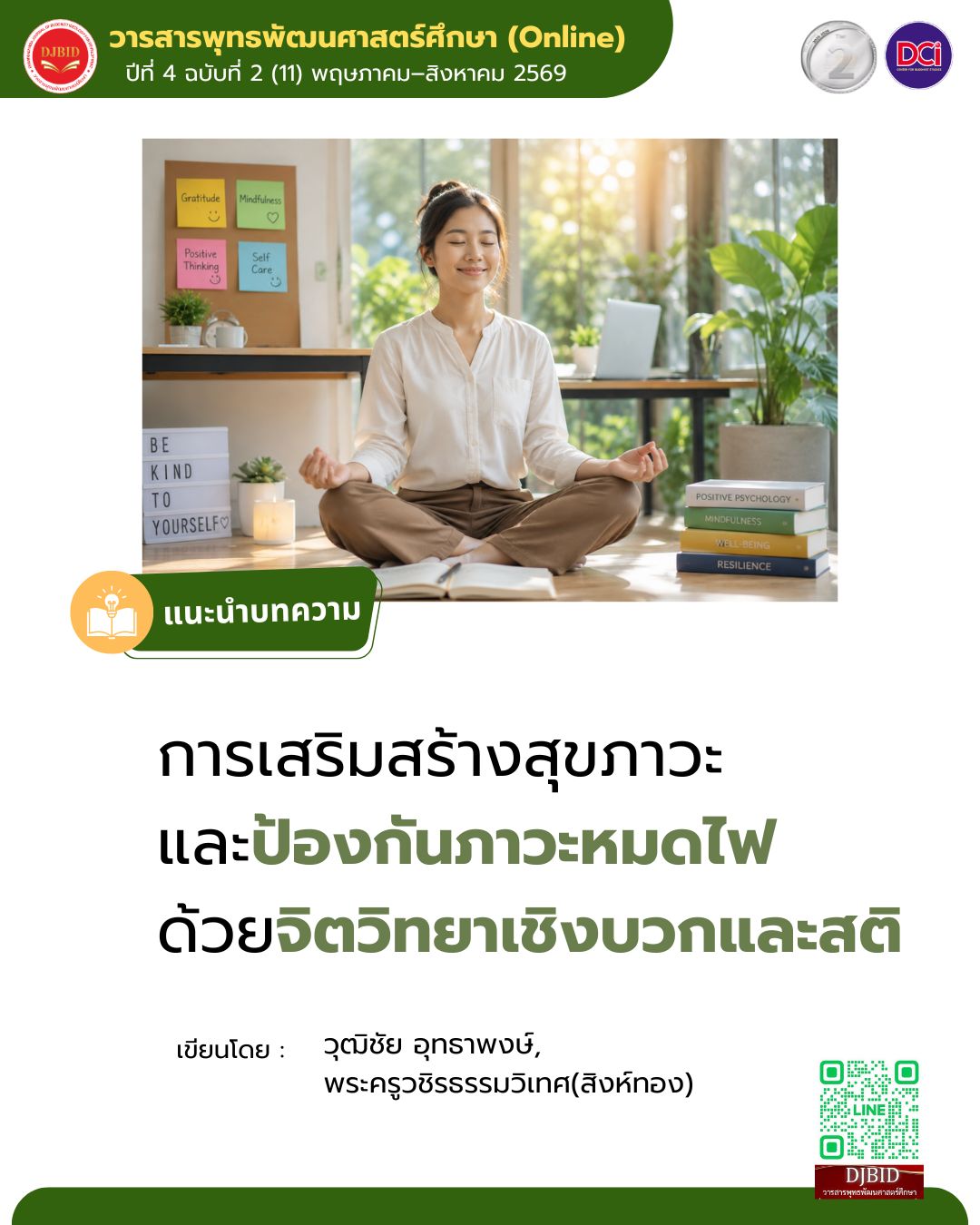
Enhancing Well-being and Preventing Burnout Through Positive Psychology and Mindfulness
Keywords:
Mindfulness, Positive Psychology, Occupational BurnoutAbstract
Occupational burnout is a consequence of chronic organizational stress, adversely affecting mental health, quality of life, and work performance. Current trends underscore the importance of integrating Positive Psychology with mindfulness to enhance psychological well-being and reduce the risk of burnout in a systematic and sustainable manner. A review of more than 30 studies indicates that Satipatthana, a foundational Buddhist practice, aims to cultivate awareness and wisdom to alleviate suffering. This is achieved through the Four Foundations of Mindfulness: contemplation of the body, feelings, mind, and mental phenomena. As articulated in the Mahasatipatthana Sutta of the Pali Canon, this “direct path” (Ekāyana-magga) is regarded as a means for mental purification and the cessation of suffering, emphasizing sustained mindfulness (sati) and clear comprehension (sampajañña) in all activities, including breathing. Contemporary research further demonstrates that integrating the PERMA model with Mindfulness-Based Stress Reduction (MBSR) significantly reduces stress and enhances job satisfaction through the development of attentional control, emotional regulation, and non-judgmental present-moment awareness. This article proposes an integrative practical framework tailored to Thai organizational and healthcare contexts. Grounded in the concept of “MBSR as a foundation for mental cultivation,” the framework promotes awareness of sensations (vedanā) and mental states in accordance with Buddhist principles. This process functions as a form of “psychological immunization,” enabling individuals to effectively activate the components of PERMA and leading to sustainable strategies for the prevention and management of burnout.
References
มหาจุฬาลงกรณราชวิทยาลัย. พระไตรปิฎกภาษาไทย ฉบับมหาจุฬาลงกรณราชวิทยาลัย. กรุงเทพฯ: โรงพิมพ์มหาจุฬาลงกรณราชวิทยาลัย, 2539.
กองทุนเพื่อความเสมอภาคทางการศึกษา (EEF). Learning Loss ภาวะการเรียนรู้ถดถอย. ออนไลน์. https://research.eef.or.th/learning-loss-recession/. [12 มีนาคม 2569]
กุลธิดา วรรณฤทธิ์. ภาวะหมดไฟในการทำงาน (Burnout Syndrome). กรุงเทพฯ: คณะแพทยศาสตร์ศิริราชพยาบาล มหาวิทยาลัยมหิดล, 2562.
Anālayo. Satipaṭṭhāna: The Direct Path to Realization. Birmingham: Windhorse Publications, 2003.
Bodhi, B. “What Does Mindfulness Really Mean? A Canonical Perspective”. Contemporary Buddhism. Vol. 12 (2011). 19–39. https://doi.org/10.1080/14639947.2011.564813.
Christopher Peterson and Martin E. P. Seligman. Character Strengths and Virtues: A Handbook and Classification. Oxford: Oxford University Press, 2004.
Fredrickson B. L. “The role of positive emotions in positive psychology: The broaden-and-build theory of positive emotions”. American Psychologist. Vol. 56 No. 3 (2001). 218–226. https://doi.org/10.1037/0003-066X.56.3.218.
Good, D. J., C. J. Lyddy, T. M. Glomb, J. E. Bono, K. W. Brown, M. K. Duffy, R. A. Baer, J. A. Brewer and S. W. Lazar. “Contemplating Mindfulness at Work: An Integrative Review”. Journal of Management. Vol. 42 No. 5 (2016). 1145–1183. https://doi.org/10.1177/0149206315617003.
Kabat-Zinn, J. Wherever You Go, There You Are: Mindfulness Meditation in Everyday Life. New York: Hyperion, 1994.
____. “Mindfulness-Based Interventions in Context”. Clinical Psychology: Science and Practice. Vol. 10 No. 2 (2003). 144–156. https://doi.org/10.1093/clipsy.bpg016.
Martin E. P. Seligman. Flourish: A Visionary New Understanding of Happiness and Well-being. New York: Free Press, 2011.
Maslach, C. and M. P. Leiter. “Burnout” In Stress: Concepts, Cognition, Emotion, and Behavior. Edited by G. Fink. San Diego, CA, USA: Academic Press, 2016.
____. “Burnout, Understanding the Burnout Experience”. World Psychiatry. Vol. 15 No. 2 (2016). 103–111. https://doi.org/10.1002/wps.20311.
Payutto, P. A. Buddhadhamma: The Laws of Nature and Their Benefits to Life. Translated by B. Evans. Bankok: Buddhadhamma Foundation, 2018.
Vago, D. R. and D. A. Silbersweig. “Self-awareness, Self-regulation, and Self-transcendence (S-ART)”. Frontiers in Human Neuroscience. Vol. 6 (2012). 296. https://doi.org/10.3389/fnhum.2012.00296.
World Health Organization. “QD85 Burn-out”. ICD-11, 2019.
Zindel V. Segal, J. Mark G. Williams, and John D. Teasdale. Mindfulness-Based Cognitive Therapy for Depression. 2nd ed. New York: Guilford Press, 2013.