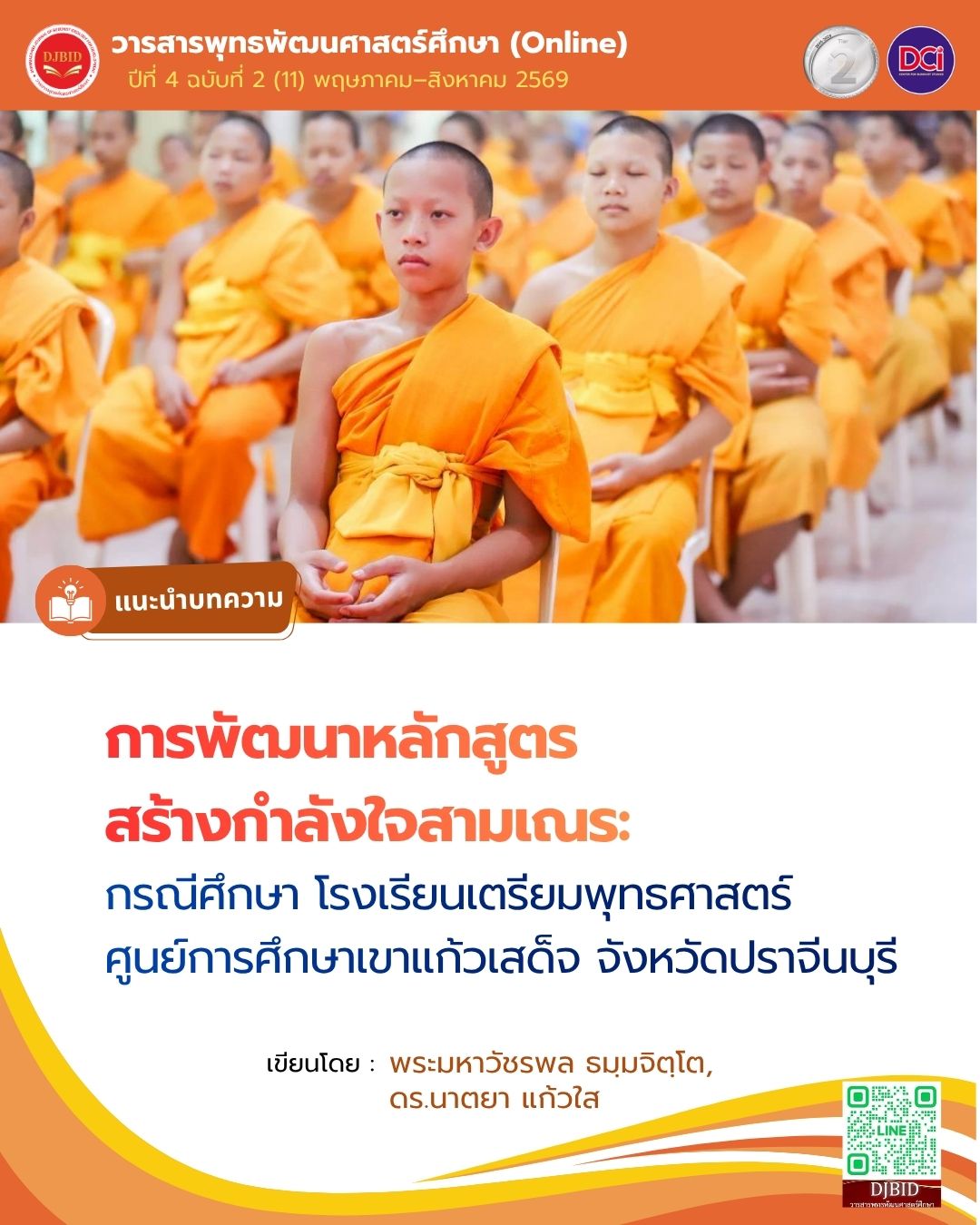
Curriculum Development for Enhancing Motivation among Novice Monks: A Case Study of Triambhuddhasad School, Khao Kaew Sadet Educational Center, Prachinburi Province
Keywords:
Motivation-Building Curriculum, Novice Monks, Buddhist Monastic School, Active Learning, 5E Instructional Model, DCI Buddhist Studies CenterAbstract
This research aimed to: 1) develop a motivation-building curriculum for novice monks; 2) study the participants’ satisfaction with the curriculum and training; and 3) study the participants’ attitudes toward the DCI Center for Buddhist Studies. The study employed a Mixed Methods Research design. The research instruments included training satisfaction questionnaires and attitude interview forms. The researcher collaborated with three expert monastic teachers to develop the curriculum under the project titled “Meet the Seniors – DCI Activity.” The program consisted of three training modules conducted four weeks apart. The curriculum was implemented with the research population, comprising all 93 novice monks studying in Matthayom 2–3 (Grades 8–9) and Matthayom 4–6 (Grades 10–12). After each training module, participants completed a satisfaction questionnaire. Upon completion of all three modules, the researcher conducted Focus Group Discussions using the attitude interview forms to collect in-depth qualitative data.
The results revealed that: 1. The developed curriculum consisted of three modules: (i) Self-Understanding Module, featuring three topics—MBTI Personality Decoding, Cultivating a Growth Mindset, and DCI for Future Building—along with the “Evolution Game” outdoor activity; (ii) Teamwork Module, featuring two topics—Teamwork and Principles of Project Proposal Writing—along with the “Ball-into-Basket Game”; and (iii) Mind-Body Empowerment Module, consisting of four recreational outdoor activities: Spoon Relay Race, Magical Crystal Game, Water Balloon Challenge, and Endurance Eating Game. The training applied the 5E Instructional Model, consisting of five steps: Engagement, Exploration, Explanation, Elaboration, and Evaluation. The instructional materials included five sets of presentation slides and six sets of activity equipment. 2. The participants’ satisfaction with all three training modules was at the highest level, with average scores of 4.67, 4.63, and 4.50, respectively. 3. Regarding attitudes toward the DCI Center for Buddhist Studies, all 93 novice monks (100%) expressed positive attitudes, exceeding the research hypothesis.
It can be concluded that the motivation-building curriculum for novice monks is effective and has strong potential for further expansion to other Buddhist monastic schools.
References
ธนพล วิริยะไพบูลย์. “การส่งเสริมสุขภาวะทางจิตของสามเณรผ่านกิจกรรมนันทนาการในโรงเรียนพระปริยัติธรรม”. วารสารพัฒนาชุมชนและคุณภาพชีวิต. ปีที่ 9 ฉบับที่ 1 (2564). 84–96.
บุญธรรม กาญจนธรรม. “การพัฒนาหลักสูตรส่งเสริมแรงจูงใจภายในสำหรับเยาวชนในระบบการศึกษาทางเลือก”. วารสารการวิจัยเพื่อพัฒนาชุมชน. ปีที่ 10 ฉบับที่ 2 (2561). 120–135.
วรรณา ปุณณะจินดา. “การจัดกิจกรรมการเรียนรู้แบบ 5E เพื่อส่งเสริมทักษะการคิดวิเคราะห์และแรงจูงใจในการเรียนวิทยาศาสตร์ของนักเรียนระดับชั้นมัธยมศึกษาปีที่ 2”. วารสารวิจัยทางการศึกษา มหาวิทยาลัยบูรพา. ปีที่ 16 ฉบับที่ 2 (2564). 94–115.
ศูนย์ข้อมูลกลางทางวัฒนธรรม. โรงเรียนเตรียมพุทธศาสตร์. ออนไลน์. http://m-culture.in.th/album/138670/โรงเรียนเตรียมพุทธศาสตร์. [30 พฤศจิกายน 2568].
ศูนย์พุทธศาสตร์ศึกษา DCI. ประวัติศูนย์พุทธศาสตร์ศึกษา DCI. ออนไลน์. https://dcicenter.org/about/. [30 พฤศจิกายน 2568].
สมชาย ปัญญาดี. “กระบวนการเรียนรู้เพื่อค้นหาความหมายชีวิต: กรณีศึกษากลุ่มเยาวชนในสำนักเรียนพระปริยัติธรรม”. วารสารพุทธศาสตร์ศึกษา. ปีที่ 13 ฉบับที่ 1 (2565). 85–98.
สายฝน แสงสุวรรณ. “รูปแบบกิจกรรมเพื่อเสริมสร้างความผูกพันและแรงจูงใจของสามเณรในโรงเรียนพระปริยัติธรรมแผนกสามัญศึกษา”. วารสารมนุษยศาสตร์และสังคมศาสตร์ มหาวิทยาลัยราชภัฏสุราษฎร์ธานี. ปีที่ 15 ฉบับที่ 2 (2562). 225–236.
สุนิสา พัฒนจักร. “ผลของการจัดการเรียนรู้แบบวัฏจักรการเรียนรู้ 5E ที่มีต่อผลสัมฤทธิ์ทางการเรียนและทัศนคติของนักเรียนระดับมัธยมศึกษาตอนต้น”. วารสารครุศาสตร์ มหาวิทยาลัยราชภัฏเชียงใหม่. ปีที่ 21 ฉบับที่ 1 (2562). 54–66.
Albert Bandura. Social Learning Theory. Editor by Englewood Cliffs. New Jersey: Prentice-Hall, 1977.
Carol S. Dweck. Mindset: The New Psychology of Success. New York: Random House, 2006.
John W. Best. Research in Education. Editor by Englewood Cliffs. New Jersey: Prentice-Hall, 1977.
Loc Tan Le. “Adolescents’ Change in Motivation as a Result of Buddhist Education: How Does It Make a Difference in Their Learning Outcomes?”. Journal for the Scientific Study of Religion. Vol. 62 No. 2 (2023). 382–396.
Phaphon Plumwongrota and Piriya Pholphirul. “Participating in Religious Activities and Adolescents’ Self-Esteem: Empirical Evidence from Buddhist Adolescents in Thailand”. International Journal of Adolescence and Youth. Vol. 26 No. 1 (2021).
Rodger W. Bybee et al. The BSCS 5E Instructional Model: Origins and Effectiveness and Applications Executive Summary. Colorado Springs, CO: Biological Sciences Curriculum Study, 2006.