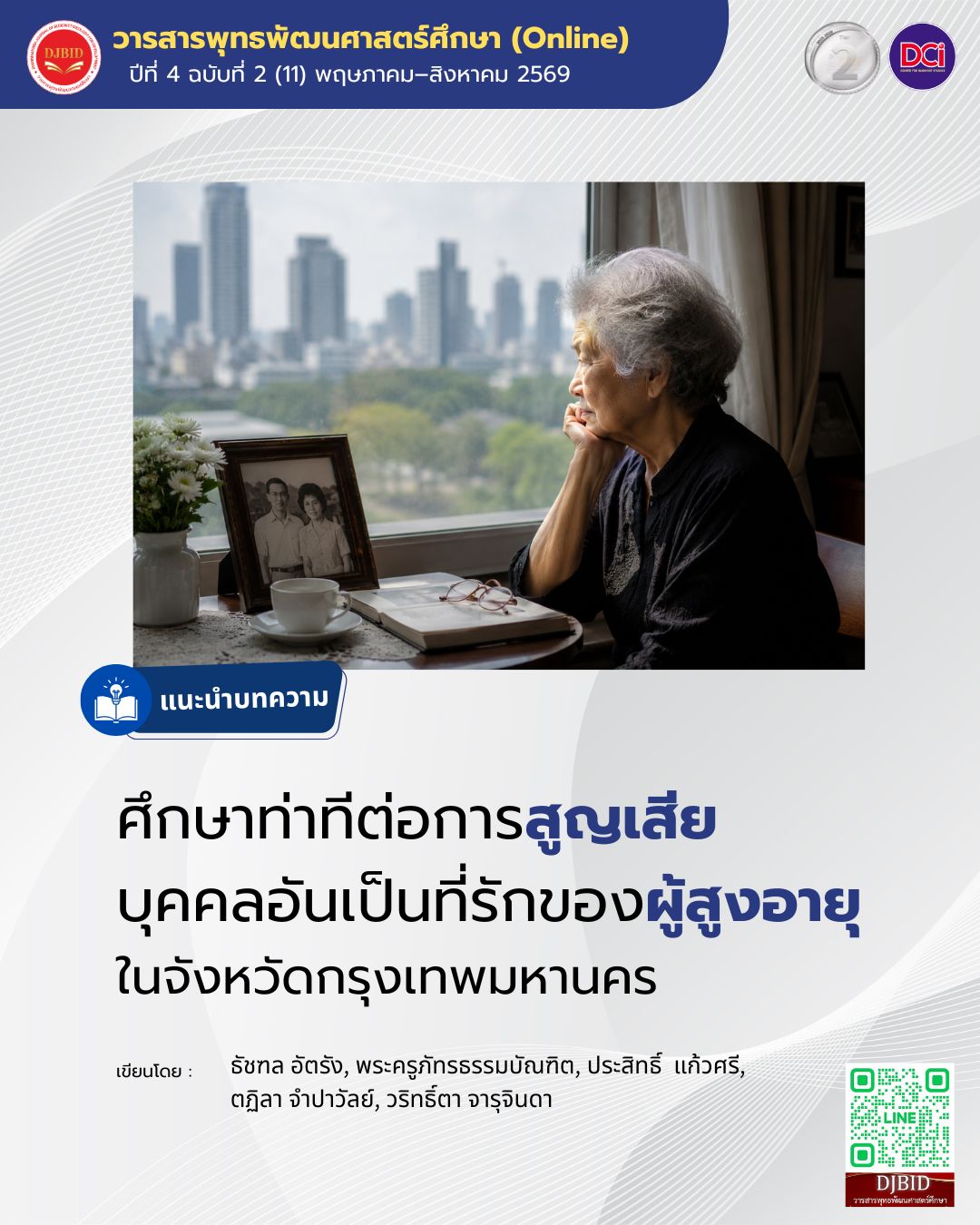
A Study of Attitudes Toward the Loss of a Loved One among Older Adults in Bangkok
Keywords:
Bereavement, Grief, Older Adults, Bangkok, Integrated Care, BuddhismAbstract
This study aimed to: (1) examine attitudes toward the loss of a loved one among older adults in Bangkok; (2) analyze the relationships between demographic factors and attitudes toward loss; and (3) develop coping approaches for bereavement among older adults. The study employed a mixed-methods design following the framework of Creswell, integrating qualitative and quantitative approaches with psychological perspectives and Buddhist principles.
The quantitative sample comprised 150 older adults aged 60 years and above who had experienced the loss of a loved one within the past five years, selected through stratified random sampling. The research instrument was an attitudes-toward-loss questionnaire with a reliability coefficient of 0.96. Quantitative data were analyzed using descriptive statistics (frequency, percentage, mean, and standard deviation) and inferential statistics (Pearson’s correlation coefficient). Qualitative data were derived from documentary research and academic seminars and analyzed using content analysis and methodological triangulation.
The findings indicated that: (1) overall attitudes toward the loss of a loved one among older adults in Bangkok were at a high level (X = 3.78, S.D. = 0.74). Among the three dimensions, the cognitive and meaning-making dimension had the highest mean score (X = 3.92), followed by the emotional dimension (X = 3.85), while the behavioral and adjustment dimension was at a moderate level (X = 3.58). (2) Demographic factors showing strong correlations with attitudes toward loss included the type of person lost (r = 0.49) and time since the loss (r = -0.46). Moderate correlations were found for primary source of support (r = -0.45), living arrangements (r = 0.37), and nature of the loss (r = 0.34), whereas gender (r = 0.25) showed a weak correlation. (3) The developed coping framework comprises four integrated care approaches: individualized care, time-based care, holistic care, and network-based care. These approaches integrate modern scientific knowledge with Buddhist principles to promote acceptance of loss and sustainable post-bereavement growth.
References
กรมกิจการผู้สูงอายุ กระทรวงการพัฒนาสังคมและความมั่นคงของมนุษย์. สถานการณ์ผู้สูงอายุไทย พ.ศ. 2567. กรุงเทพฯ: กรมกิจการผู้สูงอายุ, 2567.
กัลยา วานิชย์บัญชา. ปัจจัยที่มีผลต่อการปรับตัวของผู้สูงอายุในสังคมไทย. กรุงเทพฯ: จุฬาลงกรณ์มหาวิทยาลัย, 2563.
คณะกรรมการผู้สูงอายุแห่งชาติ. แผนผู้สูงอายุแห่งชาติ ฉบับที่ 3 (พ.ศ. 2565–2579). กรุงเทพฯ: สำนักงานคณะกรรมการผู้สูงอายุแห่งชาติ, 2565.
มูลนิธิสถาบันวิจัยและพัฒนาผู้สูงอายุไทย. สถานการณ์ผู้สูงอายุไทย พ.ศ. 2566. กรุงเทพฯ: มูลนิธิสถาบันวิจัยและพัฒนาผู้สูงอายุไทย, 2566.
พระพรหมคุณาภรณ์ (ป.อ. ปยุตฺโต). พุทธธรรม. กรุงเทพฯ: มหาจุฬาลงกรณราชวิทยาลัย, 2554.
สำนักงานกองทุนสนับสนุนการสร้างเสริมสุขภาพ. รายงานสถานการณ์ผู้สูงอายุในเขตเมือง. กรุงเทพฯ: สำนักงานกองทุนสนับสนุนการสร้างเสริมสุขภาพ, 2566.
สำนักงานสถิติแห่งชาติ. สถิติประชากรกรุงเทพมหานคร พ.ศ. 2567. กรุงเทพฯ: สำนักงานสถิติแห่งชาติ, 2567.
สุรางค์ โค้วตระกูล. “บทบาทของครอบครัวในการดูแลผู้สูงอายุไทย: การศึกษาเชิงคุณภาพ”. วารสารสังคมศาสตร์. ปีที่ 12 ฉบับที่ 2 (2564), 45–62.
Aoun, S. M., Rumbold, B., Howting, D., et al. “Bereavement support for families following the death of a family member: A comparative study”. Palliative Medicine. Vol. 34 No. 4 (2020), 525–535.
Analayo. Satipaṭṭhāna: The Direct Path to Realization. Birmingham: Windhorse, 2003.
Bhikkhu Bodhi. The Noble Eightfold Path: Way to the End of Suffering. Kandy: Buddhist Publication Society, 2011.
Beng, T. S., Chin, L. E., Guan, N. C., et al. “The experiences of suffering and dealing with loss: A qualitative study in palliative care patients”. BMC Palliative Care. Vol. 20 No. 1 (2021), 1–12.
Bergman, E. J., Haley, W. E., and Small, B. J. “The role of social support in adjusting to widowhood among older adults”. The Journals of Gerontology: Series B. Vol. 77 No. 3 (2022), 456–467.
Bonanno, G. A., Wortman, C. B., Lehman, D. R., et al. “Resilience to loss and chronic grief: A prospective study from preloss to 18-months postloss”. Journal of Personality and Social Psychology. Vol. 83 No. 5 (2002), 1150–1164.
Coelho, A., and Barbosa, A. “Anticipatory grief in palliative care: Prevalence and psychosocial correlates”. Palliative and Supportive Care. Vol. 18 No. 6 (2020), 667–675.
Cohen, J. Statistical power analysis for the behavioral sciences. 2nd ed. Hillsdale, NJ: Lawrence Erlbaum Associates.
Creswell, J. W., and Plano Clark, V. L. Designing and conducting mixed methods research. 3rd ed. Thousand Oaks: SAGE, 2018.
Faul, F., Erdfelder, E., Lang, A. G., and Buchner, A. “G*Power 3: A flexible statistical power analysis program for the social, behavioral, and biomedical sciences”. Behavior Research Methods. Vol. 39 No. 2 (2007), 175–191.
Fried, E. I., and Robinaugh, D. J. “Systems all the way down: Embracing complexity in mental health research”. BMC Medicine. Vol. 18 No. 1 (2020), 1–4.
Gençöz, F., Aydın, G., and Ergün-Başak, B. “Grief trajectories and their predictors among older widows: A longitudinal study”. Death Studies. Vol. 44 No. 9 (2020), 561–571.
Infurna, F. J., Gerstorf, D., and Zarit, S. H. “Spousal loss and health in late life: Moving beyond emotional trauma to a broader understanding of risk and resilience”. The Journals of Gerontology: Series B. Vol. 78 No. 1 (2023), 3–14.
Jacobs, S., Hansen, F., Berkman, L., et al. “Depression of bereavement”. Comprehensive Psychiatry. Vol. 30 No. 3 (1989), 218–224.
Kristjanson, L. J., and Aoun, S. “Palliative care for families: Remembering the hidden patients”. Canadian Journal of Psychiatry. Vol. 49 No. 6 (2004), 359–365.
Kübler-Ross, E. On death and dying. New York: Macmillan, 1969.
Lalor, J. G., Devane, D., and Begley, C. M. “Cultural influences on grief and bereavement: A systematic review”. Omega: Journal of Death and Dying. Vol. 85 No. 2 (2022), 401–425.
Morris, S. E., Moment, A., and Thomas, J. D. “Social ecological influences on bereavement outcomes: A narrative review”. Journal of Social Work in End-of-Life & Palliative Care. Vol. 18 No. 1 (2022), 41–59.
Neimeyer, R. A., Klass, D., and Dennis, M. R. “Meaning reconstruction in bereavement: Development of a research program”. Death Studies. Vol. 47 No. 1 (2023), 1–15.
Pai, M., and Carr, D. “Living arrangements and bereavement outcomes among older widowed persons”. The Journals of Gerontology: Series B. Vol. 76 No. 7 (2021), 1464–1475.
Parkes, C. M. Bereavement: Studies of grief in adult life. 3rd ed. London: Routledge, 1996.
Stroebe, M., and Schut, H. “The dual process model of coping with bereavement: Rationale and description”. Death Studies. Vol. 23 No. 3 (1999), 197–224.
Stroebe, M., Schut, H., and Stroebe, W. “Health outcomes of bereavement”. The Lancet. Vol. 370 No. 9603 (2007), 1960–1973.
Suwankhong, D., and Liamputtong, P. “Grief, loss and coping among the Muslim elderly in southern Thailand following widowhood: A qualitative study”. Omega: Journal of Death and Dying. Vol. 83 No. 4 (2021), 654–674.
Worden, J. W. Grief counseling and grief therapy: A handbook for the mental health practitioner. 5th ed. New York: Springer, 2018.
World Health Organization. Ageing and health. Geneva: World Health Organization, 2022.
Zisook, S., and Shear, K. “Grief and bereavement: What psychiatrists need to know”. World Psychiatry. Vol. 8 No. 2 (2009), 67–74.