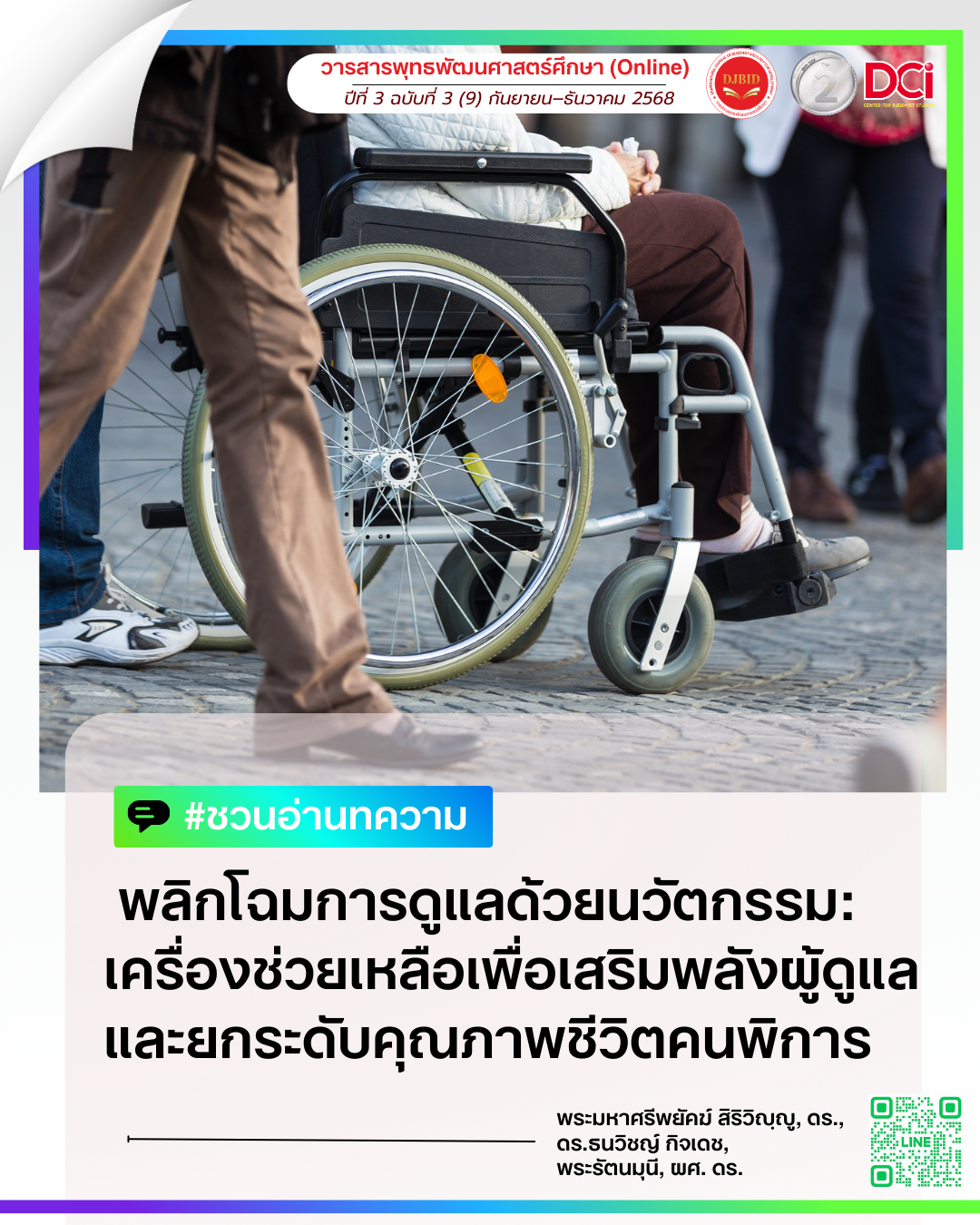
Transforming Care with Innovation: Assistive Devices to Empower Carers and Enhance the Quality of Life for People with Disabilities
Keywords:
People with Disabilities, Caregivers, Quality of Life, Innovation, Buddhist IntegrationAbstract
This academic article examines the significance of both physical and mental care for people with disabilities and their caregivers, emphasizing the role of innovative assistive devices in supporting disabled individuals—particularly those with mobility impairments and bedridden conditions. Such individuals often face health problems such as pressure ulcers and other physical complications. The integration of assistive technologies aims to promote comfort, ease the physical burden of care, and reduce the risk of accidents. In addressing psychological well-being, the study applies Buddhist principles related to care for the sick, caregivers, and daily conduct to cultivate mental resilience and mindfulness in coping with physical suffering.
The findings reveal that the integration of Buddhist teachings—namely 1) the characteristics of patients who are easy or difficult to nurse, 2) the qualities of suitable and unsuitable caregivers, and 3) Buddhist principles concerning enlightenment, natural law, and life goals—combined with assistive innovations, effectively supports holistic and sustainable care for people with disabilities. This integrative approach, termed Empowering Care for Sustainable Well-being of People with Disabilities, comprises three key components: 1) People with disabilities – improving their quality of life both physically and mentally; 2) Caregivers – enhancing their physical and mental capacity to provide effective care; and 3) Empowering care processes – promoting sustainable development in technology, economy, society, and morality.
References
กรมส่งเสริมและพัฒนาคุณภาพชีวิตคนพิการ. รายงานประจำปี 2565. กรุงเทพฯ: กรมส่งเสริมและพัฒนาคุณภาพชีวิตคนพิการ, 2566.
กระทรวงการพัฒนาสังคมและความมั่นคงของมนุษย์. แผนพัฒนาคุณภาพชีวิตคนพิการแห่งชาติ. กรุงเทพฯ: กระทรวงการพัฒนาสังคมและความมั่นคงของมนุษย์, 2566.
มหามกุฏราชวิทยาลัย. พระไตรปิฎกฉบับสยามรัฐ (แปล) เล่ม 1–45. นครปฐม: มหามกุฏราชวิทยาลัย, 2552.
_____. พระไตรปิฎกและอรรถกถาแปล เล่ม 1–91. นครปฐม: มหามกุฏราชวิทยาลัย, 2543.
พระมหาวีรวิชญ์ สัตตารัมย์ และเผด็จ จงสกุลศิริ. “การพัฒนานวัตกรรมการศึกษาเพื่อการจัดการเรียนรู้ในระบบการศึกาไทย”. วารสารพุทธพัฒนศาสตร์ศึกษา. ปีที่ 1 ฉบับที่ 2 (พฤษภาคม–สิงหาคม 2566). 54–71.
วิเชียร เกตุสิงห์. การดูแลผู้พิการติดเตียงกับการป้องกันภาวะแทรกซ้อน. พิมพ์ครั้งที่ 2. กรุงเทพฯ: สำนักพิมพ์สุขภาพชุมชน, 2566.
สถานคุ้มครองและพัฒนาคนพิการบางปะกง. รายงานผลการดำเนินงานประจำปี 2565. ฉะเชิงเทรา: สถานคุ้มครองและพัฒนาคนพิการบางปะกง, 2566.
สมพร ล้อมวงศ์. สุขภาวะและคุณภาพชีวิตของผู้พิการไทย. นครปฐม: มหาวิทยาลัยมหิดล, 2564.
สว่างบุญ วงก์ฟ้าเลื่อน. “การประยุกต์ใช้หลักกุศลกรรมบถในพระพุทธศาสนาเพื่อเสริมสร้างคุณภาพชีวิตมนุษย์ในสังคมดิจิทัล”. วารสารพุทธพัฒนศาสตร์ศึกษา. ปี 1 ฉบับที่ 1 (มกราคม–เมษายน 2566). 63–79.
สุภาวดี ศรีสมบัติ. บทบาทผู้ดูแลในการดูแลผู้สูงอายุและผู้พิการติดเตียง. ขอนแก่น: มหาวิทยาลัยขอนแก่น, 2565.
Chen, J., and Lee, H. Integrated Rehabilitation Engineering. London: Springer, 2019.
Department of Empowerment and Quality of Life for Persons with Disabilities. Strategy and Planning Division. 2024.
Kaew, T. Light Rays. “Types of disabilities and access to welfare information and services from The state of disabled women in Thailand”. Journal of Demography. Vol. 36 No.2 (2020). 1–24.
Keyes, C. L. M. “Social well-being”. Social Psychology Quarterly, Vol. 61 No. 2 (1998). 121–140.
Ministry of Public Health, Department of Health. “Elderly assessment form by potential group according to Ability to perform daily activities (Barthel Index for activity of daily living: ADL)”. Health Center. No. 9 (2024).
Ministry of Social Development and Older Persons Security. Screening assessment of ability in Active Living (ADL). Department of Older Persons Affairs, 2024.
United Nations. Disability and Development Report 2019: Realizing the Sustainable Development Goals by, for and with Persons with Disabilities. New York: United Nations, 2019.
World Health Organization. Global Disability Action Plan 2014–2021: Better Health for All People With Disability. Geneva: World Health Organization, 2015.
World Health Organization. World Report on Disability. Geneva: World Health Organization, 2011.