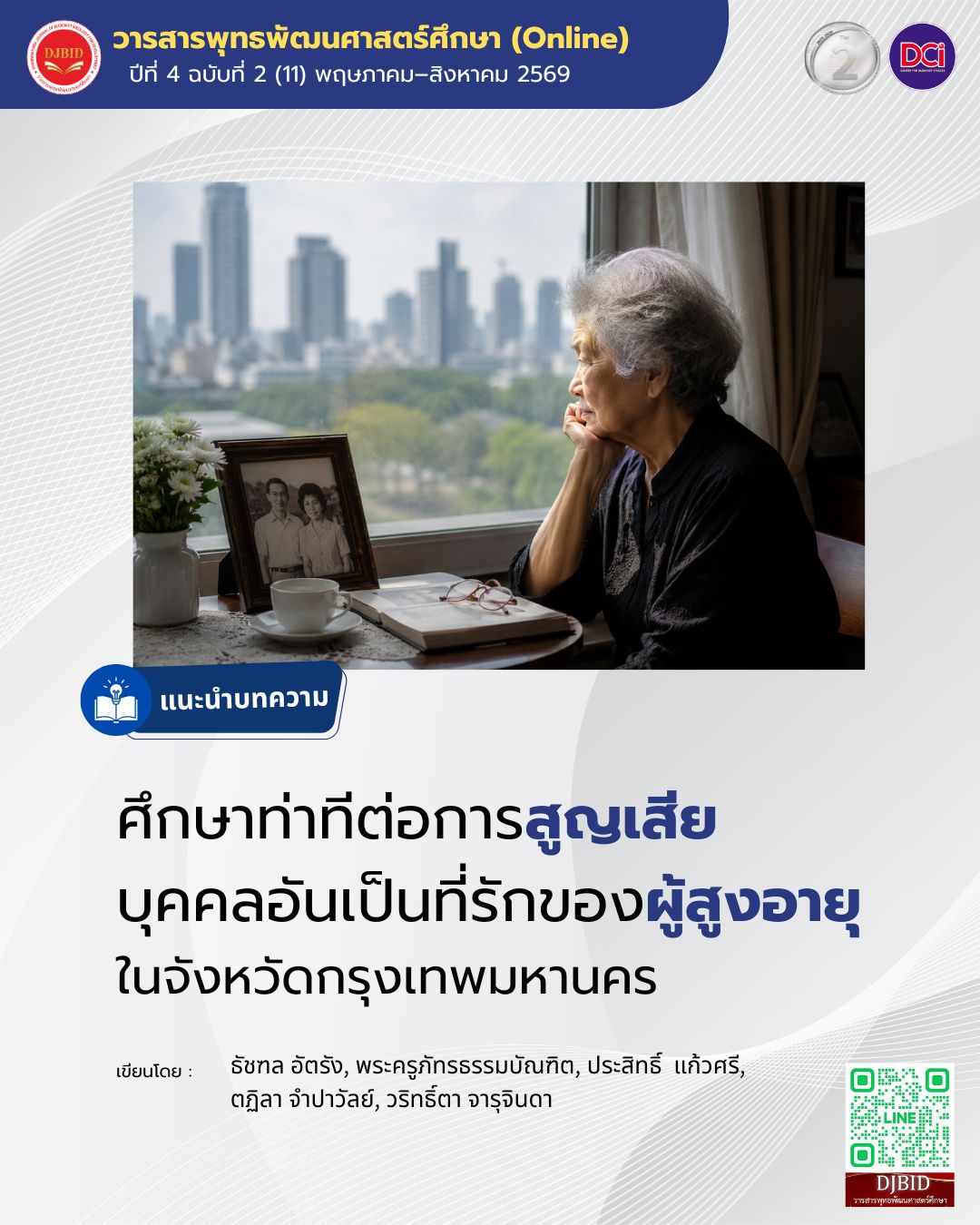
การศึกษาท่าทีต่อการสูญเสียบุคคลอันเป็นที่รัก ของผู้สูงอายุในกรุงเทพมหานคร
คำสำคัญ:
การสูญเสียบุคคลอันเป็นที่รัก, ความโศกเศร้า, ผู้สูงอายุ, กรุงเทพมหานคร, การดูแลแบบบูรณาการ, พระพุทธศาสนาบทคัดย่อ
การวิจัยครั้งนี้มีวัตถุประสงค์เพื่อ 1) ศึกษาท่าทีต่อการสูญเสียบุคคลอันเป็นที่รักของผู้สูงอายุในกรุงเทพมหานคร 2) วิเคราะห์ความสัมพันธ์ระหว่างปัจจัยประชากรศาสตร์กับท่าทีต่อการสูญเสีย และ 3) พัฒนาแนวทางการรับมือต่อการสูญเสียของผู้สูงอายุ การวิจัยใช้ระเบียบวิธีแบบผสานวิธี (Mixed Methods Research) ตามแนวคิดของ John W. Creswell โดยบูรณาการการวิจัยเชิงคุณภาพและเชิงปริมาณร่วมกับกรอบแนวคิดทางจิตวิทยาและหลักพระพุทธศาสนา กลุ่มตัวอย่างเชิงปริมาณคือผู้สูงอายุอายุ 60 ปีขึ้นไปที่มีประสบการณ์การสูญเสียบุคคลอันเป็นที่รักภายใน 5 ปี จำนวน 150 คน คัดเลือกด้วยการสุ่มแบบแบ่งชั้นภูมิ เครื่องมือที่ใช้คือ แบบสอบถามท่าทีต่อการสูญเสีย ซึ่งมีค่าความเชื่อมั่นเท่ากับ 0.96 วิเคราะห์ข้อมูลเชิงปริมาณด้วยสถิติเชิงพรรณนา ได้แก่ ความถี่ ร้อยละ ค่าเฉลี่ย และส่วนเบี่ยงเบนมาตรฐาน และสถิติเชิงอนุมาน ได้แก่ ค่าสัมประสิทธิ์สหสัมพันธ์ ข้อมูลเชิงคุณภาพได้จากการวิจัยเอกสารและการสัมมนาวิชาการ วิเคราะห์ด้วยการวิเคราะห์เนื้อหาและการสังเคราะห์แบบพหุวิธี
ผลการวิจัยพบว่า 1) ท่าทีต่อการสูญเสียบุคคลอันเป็นที่รักของผู้สูงอายุในกรุงเทพมหานครโดยรวมอยู่ในระดับสูง (X = 3.78, S.D. = 0.74) โดยมิติด้านความคิดและการให้ความหมาย มีค่าเฉลี่ยสูงสุด (X = 3.92) รองลงมาคือ มิติด้านอารมณ์และความรู้สึก (X = 3.85) และมิติด้านพฤติกรรมและการปรับตัวอยู่ในระดับปานกลาง (X = 3.58) 2) ปัจจัยประชากรศาสตร์ที่มีความสัมพันธ์กับท่าทีต่อการสูญเสียในระดับสูง ได้แก่ บุคคลที่สูญเสีย (r = 0.49) และระยะเวลาหลังการสูญเสีย (r = -0.46) ขณะที่แหล่งสนับสนุนหลัก (r = -0.45) ลักษณะการอยู่อาศัย (r = 0.37) และลักษณะการสูญเสีย (r = 0.34) มีความสัมพันธ์ในระดับปานกลาง ส่วนเพศ (r = 0.25) มีความสัมพันธ์ในระดับต่ำ 3) แนวทางการรับมือต่อการสูญเสียที่พัฒนาขึ้นประกอบด้วยการดูแลแบบบูรณาการ 4 แนวทาง ได้แก่ การดูแลแบบเฉพาะบุคคล การดูแลตามช่วงเวลา การดูแลแบบองค์รวม และการดูแลแบบเครือข่าย โดยผสานองค์ความรู้ทางวิทยาศาสตร์สมัยใหม่กับหลักพระพุทธศาสนา เพื่อส่งเสริมการยอมรับความสูญเสียและการเติบโตหลังความโศกเศร้าอย่างยั่งยืน
เอกสารอ้างอิง
กรมกิจการผู้สูงอายุ กระทรวงการพัฒนาสังคมและความมั่นคงของมนุษย์. สถานการณ์ผู้สูงอายุไทย พ.ศ. 2567. กรุงเทพฯ: กรมกิจการผู้สูงอายุ, 2567.
กัลยา วานิชย์บัญชา. ปัจจัยที่มีผลต่อการปรับตัวของผู้สูงอายุในสังคมไทย. กรุงเทพฯ: จุฬาลงกรณ์มหาวิทยาลัย, 2563.
คณะกรรมการผู้สูงอายุแห่งชาติ. แผนผู้สูงอายุแห่งชาติ ฉบับที่ 3 (พ.ศ. 2565–2579). กรุงเทพฯ: สำนักงานคณะกรรมการผู้สูงอายุแห่งชาติ, 2565.
มูลนิธิสถาบันวิจัยและพัฒนาผู้สูงอายุไทย. สถานการณ์ผู้สูงอายุไทย พ.ศ. 2566. กรุงเทพฯ: มูลนิธิสถาบันวิจัยและพัฒนาผู้สูงอายุไทย, 2566.
พระพรหมคุณาภรณ์ (ป.อ. ปยุตฺโต). พุทธธรรม. กรุงเทพฯ: มหาจุฬาลงกรณราชวิทยาลัย, 2554.
สำนักงานกองทุนสนับสนุนการสร้างเสริมสุขภาพ. รายงานสถานการณ์ผู้สูงอายุในเขตเมือง. กรุงเทพฯ: สำนักงานกองทุนสนับสนุนการสร้างเสริมสุขภาพ, 2566.
สำนักงานสถิติแห่งชาติ. สถิติประชากรกรุงเทพมหานคร พ.ศ. 2567. กรุงเทพฯ: สำนักงานสถิติแห่งชาติ, 2567.
สุรางค์ โค้วตระกูล. “บทบาทของครอบครัวในการดูแลผู้สูงอายุไทย: การศึกษาเชิงคุณภาพ”. วารสารสังคมศาสตร์. ปีที่ 12 ฉบับที่ 2 (2564), 45–62.
Aoun, S. M., Rumbold, B., Howting, D., et al. “Bereavement support for families following the death of a family member: A comparative study”. Palliative Medicine. Vol. 34 No. 4 (2020), 525–535.
Analayo. Satipaṭṭhāna: The Direct Path to Realization. Birmingham: Windhorse, 2003.
Bhikkhu Bodhi. The Noble Eightfold Path: Way to the End of Suffering. Kandy: Buddhist Publication Society, 2011.
Beng, T. S., Chin, L. E., Guan, N. C., et al. “The experiences of suffering and dealing with loss: A qualitative study in palliative care patients”. BMC Palliative Care. Vol. 20 No. 1 (2021), 1–12.
Bergman, E. J., Haley, W. E., and Small, B. J. “The role of social support in adjusting to widowhood among older adults”. The Journals of Gerontology: Series B. Vol. 77 No. 3 (2022), 456–467.
Bonanno, G. A., Wortman, C. B., Lehman, D. R., et al. “Resilience to loss and chronic grief: A prospective study from preloss to 18-months postloss”. Journal of Personality and Social Psychology. Vol. 83 No. 5 (2002), 1150–1164.
Coelho, A., and Barbosa, A. “Anticipatory grief in palliative care: Prevalence and psychosocial correlates”. Palliative and Supportive Care. Vol. 18 No. 6 (2020), 667–675.
Cohen, J. Statistical power analysis for the behavioral sciences. 2nd ed. Hillsdale, NJ: Lawrence Erlbaum Associates.
Creswell, J. W., and Plano Clark, V. L. Designing and conducting mixed methods research. 3rd ed. Thousand Oaks: SAGE, 2018.
Faul, F., Erdfelder, E., Lang, A. G., and Buchner, A. “G*Power 3: A flexible statistical power analysis program for the social, behavioral, and biomedical sciences”. Behavior Research Methods. Vol. 39 No. 2 (2007), 175–191.
Fried, E. I., and Robinaugh, D. J. “Systems all the way down: Embracing complexity in mental health research”. BMC Medicine. Vol. 18 No. 1 (2020), 1–4.
Gençöz, F., Aydın, G., and Ergün-Başak, B. “Grief trajectories and their predictors among older widows: A longitudinal study”. Death Studies. Vol. 44 No. 9 (2020), 561–571.
Infurna, F. J., Gerstorf, D., and Zarit, S. H. “Spousal loss and health in late life: Moving beyond emotional trauma to a broader understanding of risk and resilience”. The Journals of Gerontology: Series B. Vol. 78 No. 1 (2023), 3–14.
Jacobs, S., Hansen, F., Berkman, L., et al. “Depression of bereavement”. Comprehensive Psychiatry. Vol. 30 No. 3 (1989), 218–224.
Kristjanson, L. J., and Aoun, S. “Palliative care for families: Remembering the hidden patients”. Canadian Journal of Psychiatry. Vol. 49 No. 6 (2004), 359–365.
Kübler-Ross, E. On death and dying. New York: Macmillan, 1969.
Lalor, J. G., Devane, D., and Begley, C. M. “Cultural influences on grief and bereavement: A systematic review”. Omega: Journal of Death and Dying. Vol. 85 No. 2 (2022), 401–425.
Morris, S. E., Moment, A., and Thomas, J. D. “Social ecological influences on bereavement outcomes: A narrative review”. Journal of Social Work in End-of-Life & Palliative Care. Vol. 18 No. 1 (2022), 41–59.
Neimeyer, R. A., Klass, D., and Dennis, M. R. “Meaning reconstruction in bereavement: Development of a research program”. Death Studies. Vol. 47 No. 1 (2023), 1–15.
Pai, M., and Carr, D. “Living arrangements and bereavement outcomes among older widowed persons”. The Journals of Gerontology: Series B. Vol. 76 No. 7 (2021), 1464–1475.
Parkes, C. M. Bereavement: Studies of grief in adult life. 3rd ed. London: Routledge, 1996.
Stroebe, M., and Schut, H. “The dual process model of coping with bereavement: Rationale and description”. Death Studies. Vol. 23 No. 3 (1999), 197–224.
Stroebe, M., Schut, H., and Stroebe, W. “Health outcomes of bereavement”. The Lancet. Vol. 370 No. 9603 (2007), 1960–1973.
Suwankhong, D., and Liamputtong, P. “Grief, loss and coping among the Muslim elderly in southern Thailand following widowhood: A qualitative study”. Omega: Journal of Death and Dying. Vol. 83 No. 4 (2021), 654–674.
Worden, J. W. Grief counseling and grief therapy: A handbook for the mental health practitioner. 5th ed. New York: Springer, 2018.
World Health Organization. Ageing and health. Geneva: World Health Organization, 2022.
Zisook, S., and Shear, K. “Grief and bereavement: What psychiatrists need to know”. World Psychiatry. Vol. 8 No. 2 (2009), 67–74.