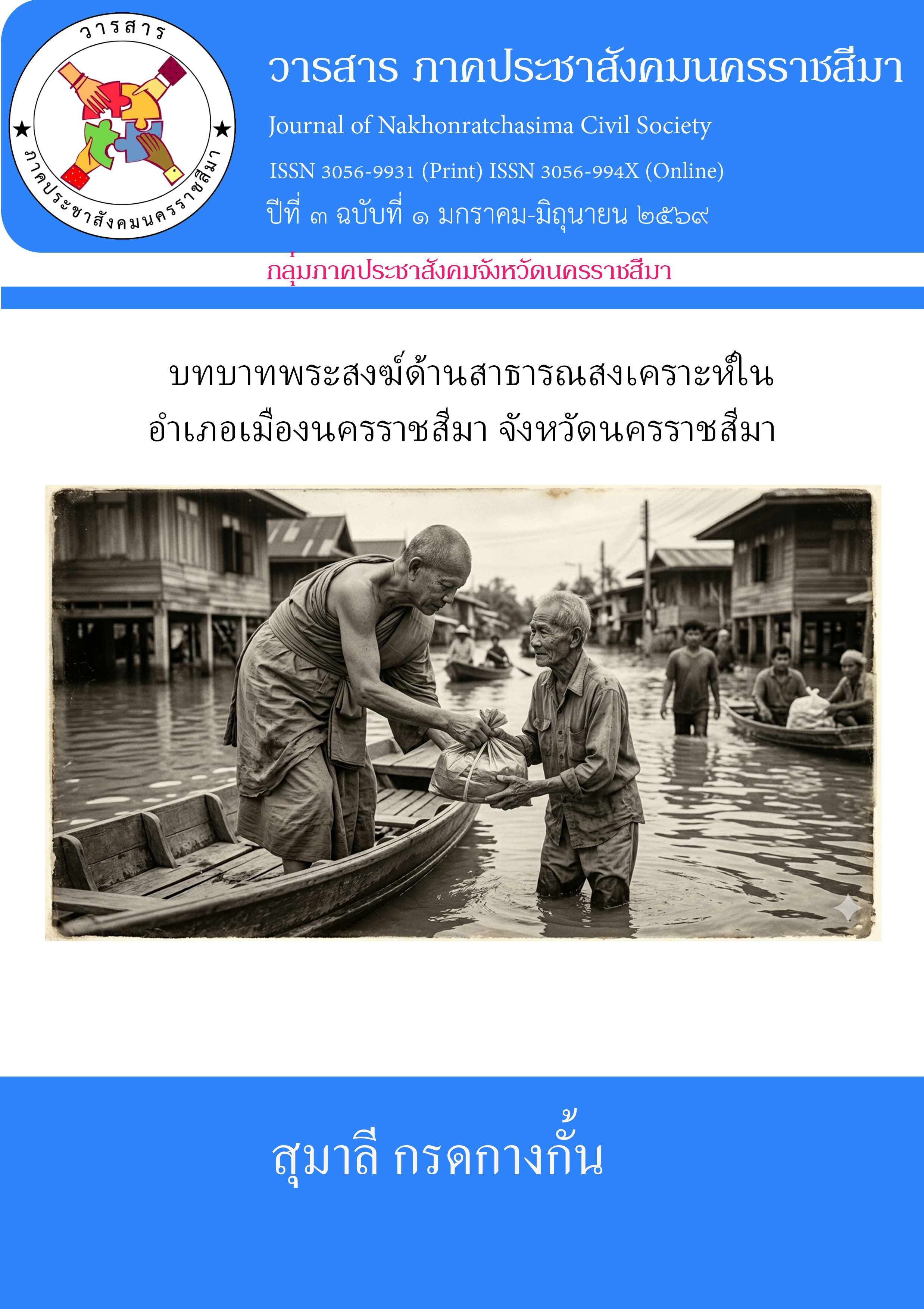
THE ROLE OF BUDDHIST MONKS IN SOCIAL WELFARE IN MUEANG NAKHON RATCHASIMA DISTRICT, NAKHON RATCHASIMA PROVINCE
Keywords:
Role, Monks, Social welfareAbstract
This research aims to 1) study the role of Buddhist monks in social welfare in Mueang Nakhon Ratchasima District, Nakhon Ratchasima Province; 2) compare opinions on the role of Buddhist monks in social welfare in Mueang Nakhon Ratchasima District, Nakhon Ratchasima Province, categorized by personal factors; and 3) study guidelines for developing the role of Buddhist monks in social welfare in Mueang Nakhon Ratchasima District, Nakhon Ratchasima Province. The research employs a mixed-methods approach. Quantitative research uses questionnaires as a data collection tool. The sample group consists of 400 residents of Mueang Nakhon Ratchasima District, Nakhon Ratchasima Province. Statistical analyses include frequency, percentage, mean, and standard deviation. Hypothesis testing is conducted using t-tests, F-tests, and one-way ANOVA. Qualitative research uses in-depth interviews with 9 key informants (monks or individuals). Data is analyzed using descriptive content analysis.
The research findings indicate that 1) the overall role of Buddhist monks in social welfare in Mueang Nakhon Ratchasima District, Nakhon Ratchasima Province, is at a high level, with a mean of 4.26; and 2) a comparison of opinions on the role of Buddhist monks in social welfare in Mueang Nakhon Ratchasima District, Nakhon Ratchasima Province, is presented. In Nakhon Ratchasima Province, people with different genders, ages, education levels, occupations, and monthly incomes did not have significantly different opinions regarding the role of Buddhist monks in social welfare in Mueang Nakhon Ratchasima District, Nakhon Ratchasima Province. Therefore, the research hypothesis is rejected. 3) Guidelines for developing the role of Buddhist monks in social welfare in Mueang Nakhon Ratchasima District, Nakhon Ratchasima Province should focus on promoting integrated cooperation between temples, communities, and government agencies to provide more systematic and comprehensive assistance to the public. Developing the capabilities of Buddhist monks in social welfare, management, and technology use will increase the efficiency of operations and communication with the community.
References
กรมการศาสนา. (2560). บทบาทของพระสงฆ์กับการพัฒนาสังคม. กรุงเทพฯ : กระทรวงวัฒนธรรม.
พระครูวินัยธรกมลเมธ กตปุญฺโญ (โคว้ตระกูล). (2567).การบริหารกิจการคณะสงฆ์เพื่อความมั่นคงของพระพุทธศาสนา ในอำเภอเมือง จังหวัดนครนายก. สารนิพนธ์พุทธศาสตรมหาบัณฑิต สาขาวิชาการจัดการเชิงพุทธ. บัณฑิตวิทยาลัย : มหาวิทยาลัยมหาจุฬาลงกรณราชวิทยาลัย.
พระธรรมปิฎก (ป.อ. ปยุตฺโต). (2546). พุทธธรรม. กรุงเทพฯ : มหาจุฬาลงกรณราชวิทยาลัย.
พระปลัดพิสิทธิ์ ญาณิสฺสโร (ศรีแก้ว). (2567). ประสิทธิภาพการจัดการงานสาธารณสงเคราะห์ของพระสังฆาธิการ ในอำเภอคง จังหวัดนครราชสีมา. วิทยานิพนธ์พุทธศาสตรมหาบัณฑิตสาขาวิชาการจัดการเชิงพุทธ. บัณฑิตวิทยาลัย : มหาวิทยาลัยมหาจุฬาลงกรณราชวิทยาลัย.
พระมหาวรเมธ เตชธมฺโม (ดีสุรกุล).(2561).การส่งเสริมการบริหารกิจการคณะสงฆ์ด้านสาธารณสงเคราะห์ของอำเภอแก้งคร้อ จังหวัดชัยภูมิ. สารนิพนธ์พุทธศาสตรมหาบัณฑิต สาขาวิชาการจัดการเชิงพุทธ. บัณฑิตวิทยาลัย : มหาวิทยาลัยมหาจุฬาลงกรณราชวิทยาลัย.
สำนักงานพระพุทธศาสนาแห่งชาติ. (2562). แนวทางการส่งเสริมบทบาทพระสงฆ์ด้านสาธารณสงเคราะห์. กรุงเทพฯ : สำนักงานพระพุทธศาสนาแห่งชาติ.
สุมน อมรวิวัฒน์. (2553). การศึกษาเพื่อพัฒนาสังคมไทย. กรุงเทพฯ : สำนักพิมพ์แห่งจุฬาลงกรณ์มหาวิทยาลัย.