Information
- RJCM Publication Policy
- Guideline to References
- For Authors
- Submission of Manuscripts
- Publication Ethics
- RJCM Research Ethics
- Peer Review Process
- Publication Fee
- Call for Papers
- Reprints
Peer Review Process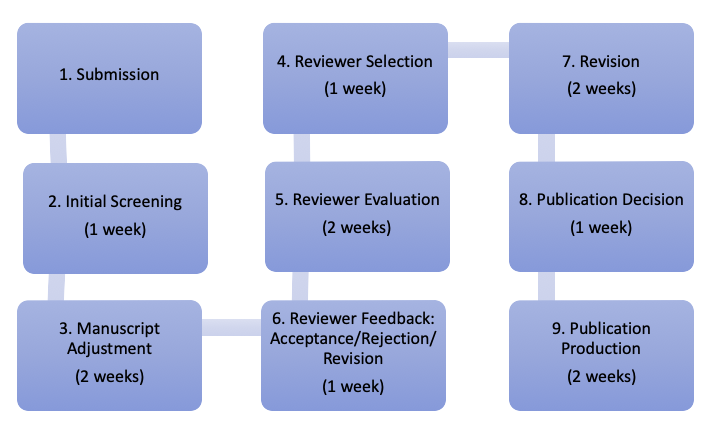
RJCM uses a double-blind peer review system by three independent reviewers who are experts in a specific field relevant to the type of research/academic work reported in the author’s submitted manuscript. Invited reviewers evaluate the quality and validity of research/academic work before it is published. RJCM peer review process ensures that high-quality research is disseminated and that flawed studies are filtered out. Essentially, it enables researchers/academics to get feedback on their work before publication, as well as serves as a mechanism to control the paper’s quality and suitability for publication.
To ensure that only high-quality, reliable, and original research/academic work is published, RJCM peer review process ensures that the manuscript under review is (i) Valid: The findings are accurate and reliable; (ii) Original: The research is novel and not simply replication of existing work; (iii) Significant: The research makes a meaningful contribution to the field; and (iv) Ethical: The research is conducted according to ethical guidelines.
RJCM Peer Review Process in Nine Stages:
(1) Submission: Authors submit their manuscript to RJCM, as guided in the journal publication policy and the submission procedure via <https://so12.tci-thaijo.org/index.php/RJCM>.
(2) Initial Screening: The editor-in-chief (EIC) screens the submitted manuscript regarding the topic areas pertinent to the journal’s scope, the required components, originality, validity of claims, and the consistency of references used in the text with those on the reference list. After plagiarism check, the EIC sends initial feedback to the corresponding author for reference re-checking and provision of complete reference items. The author is reminded to recheck all paper components to ensure that the manuscript to be sent to three independent reviewers, reasonably contains all major components required in a research/academic paper. (Duration: 1 week)
(3) Manuscript Adjustment: Based on the EIC’s feedback on the paper components and editorial suggestions, the author adjusts the manuscript as a final version for peer review evaluation. (Duration: 2 weeks)
(4) Reviewer Selection: The EIC selects three independent reviewers with expertise relevant to the topic area of the manuscript. The selected reviewers will receive a peer review invitation with a link to the manuscript/review guidelines/evaluation form via the journal web, specifying the response date within one week and review submission date within two weeks. (Duration: 1 week)
(5) Reviewer Evaluation: Reviewers after responding to the peer review invitation, assess the manuscript based on the criteria concerning research/academic work components, as specified in the review guidelines and evaluation form for a decision on acceptance/rejection/revision. Reviewers are in the double-blinded peer review process in evaluating the assigned manuscript, and have no known competing financial interests or personal relationships that could have appeared to influence the work reported in the reviewed paper. It is imperative that reviewers’ decision on paper acceptance/rejection/revision be justified by constructive comments or suggestions, as guided by professional ethics in selecting scholarly work for publication. Given comments must be written in an objective and professional manner without sarcasm or severe criticism. Reviewers shall keep their reviews strictly confidential in all circumstances. (Duration: 2 weeks)
(6) Reviewer Feedback: Reviewers provide their review feedback to the EIC via the web journal by the due date of review submission in two weeks. The EIC will send anonymous comments via the journal web to the corresponding author for revision based on the given comments. Should two reviewers specify ‘rejection’, or all three reviewers require a major revision, the EIC will inform the author of the given comments and ask for the submission of a new manuscript, preferably incorporating the points raised by the reviewers. (Duration: 1 week)
(7) Revision: The author completes the revised version within two weeks, as specified by the EIC for the final copyediting stage to ensure that the revised version should incorporate all important points raised by the EIC (or Section Editor, if assigned) and the reviewers. (Duration: 2 weeks)
(8) Publication Decision: The editor makes a final publication decision on acceptance for the revised version of the paper based on the reviewers’ given comments. Once the revised version has been rechecked for accuracy, completeness, and plagiarism recheck, the EIC and the editorial team will finalize its format and proceed to the production stage. (Duration: 1 week)
(9) Publication Production: At the production stage, the Assistant Editor and journal web administrators will recheck proofreading and formatting before uploading the final version of the paper with its obtained DOI number on the journal web. To safeguard the accuracy of the paper to be published on the journal web, the editorial team customarily leaves three days for meticulous checks from all stakeholders concerned prior to the actual publishing date. (Duration: 2 weeks)
RJCM Review Process is to ensure quality in identifying and correcting errors, inconsistencies, and biases in research/ academic work prior to publication. This is to promote rigor in authors’ work in providing sufficient evidence and justification for their claims. RJCM expects that its systematic review process can help support researchers and scholars in disseminating current knowledge based on their findings as well as forefront innovations to international academic communities.
References: https://authorservices.wiley.com, https://authorservices.taylorandfrancis.com, https://www.researchgate.net