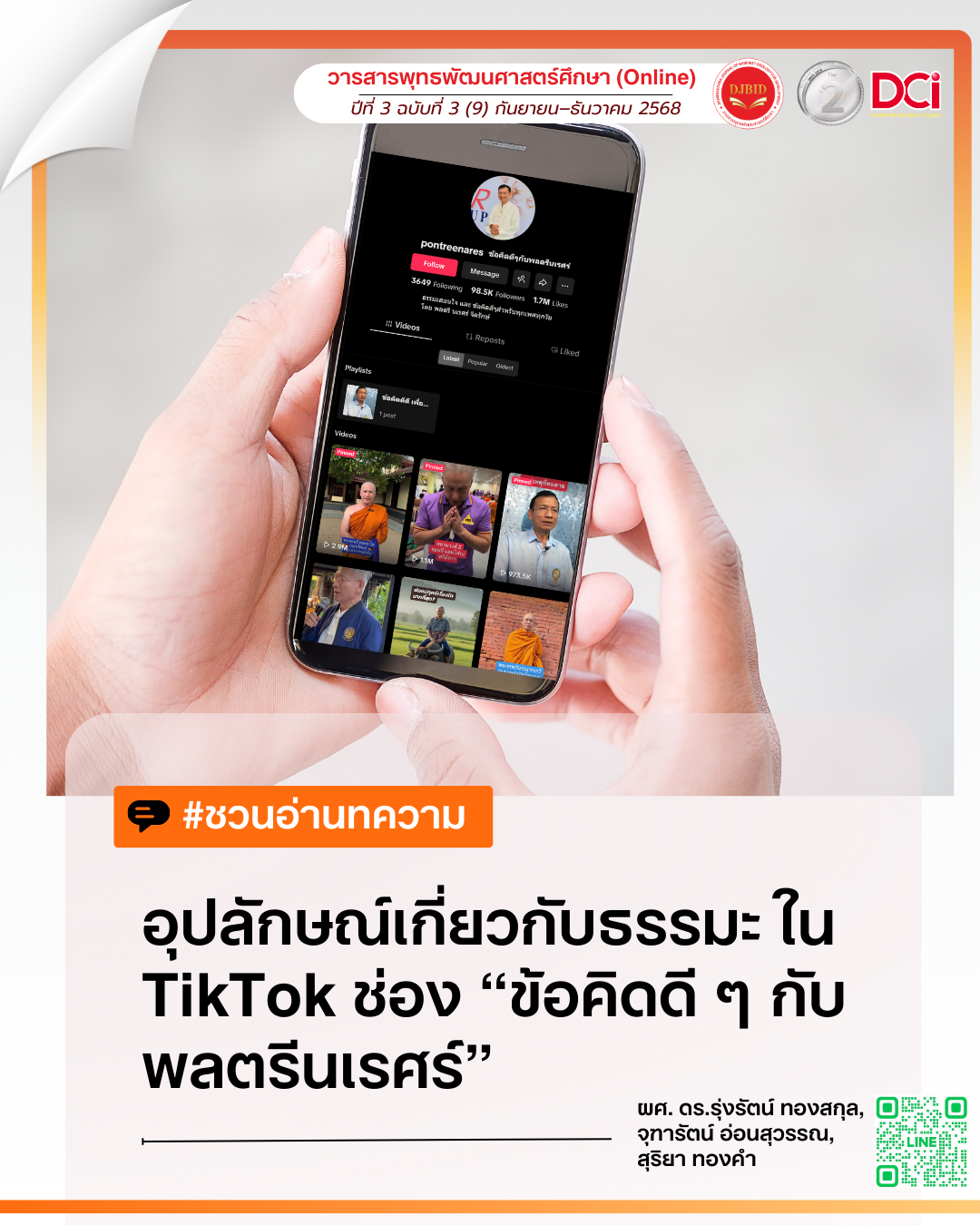
อุปลักษณ์เกี่ยวกับธรรมะ ใน TikTok ช่อง “ข้อคิดดี ๆ กับพลตรีนเรศร์”
คำสำคัญ:
อุปลักษณ์, ธรรมะ, คำกลอน, TikTok, พลตรีนเรศร์บทคัดย่อ
งานวิจัยนี้มีวัตถุประสงค์เพื่อศึกษาอุปลักษณ์เกี่ยวกับธรรมะใน TikTok ช่อง “ข้อคิดดี ๆ กับพลตรีนเรศร์” เก็บรวบรวมข้อมูลใน TikTok ช่อง “ข้อคิดดี ๆ กับพลตรีนเรศร์” ที่เผยแพร่ระหว่างวันที่ 5 สิงหาคม 2565 – 21 พฤศจิกายน 2567 จำนวน 1,310 คลิป โดยเลือกแบบเจาะจงเฉพาะคลิปคำกลอนที่นำเสนอเนื้อหาเกี่ยวกับหลักธรรมคำสอน มียอดวิว จำนวน 10,000 ครั้งขึ้นไป จำนวน 127 คลิป 189 คำกลอน และนำข้อมูลทั้งหมด มาวิเคราะห์อุปลักษณ์เกี่ยวกับธรรมะตามประเด็นที่กำหนดไว้
ผลการศึกษาพบว่า การใช้อุปลักษณ์เกี่ยวกับธรรมะ 11 มโนอุปลักษณ์ ตามลำดับที่พบ ได้แก่ 1. ธรรมะ คือ การปลดพันธนาการ พบ 108 คำกลอน 2. ธรรมะ คือ การปกครอง พบ 29 คำกลอน 3. ธรรมะ คือ การทำสงคราม พบ 13 คำกลอน 4. ธรรมะ คือ การรักษาโรค พบ 9 คำกลอน 5. ธรรมะ คือ การดับความร้อน พบ 7 คำกลอน 6. ธรรมะ คือ การทำความสะอาด พบ 7 คำกลอน 7. ธรรมะ คือ การรับประทานอาหาร พบ 6 คำกลอน 8. ธรรมะ คือ การกำจัดความมืด พบ 5 คำกลอน 9. ธรรมะ คือ การทำเกษตรกรรม พบ 3 คำกลอน 10. ธรรมะ คือ การทำบุญพบ 1 คำกลอน 11. ธรรมะ คือ การทำงาน พบ 1 คำกลอน ข้อมูลทั้ง 189 คำกลอน เป็นการสอนคุณธรรม และจริยธรรมตามหลักพระพุทธศาสนาที่มีความหมายโดยนัย ผู้รับสารจึงต้องตีความเพื่อให้เข้าใจสาร การใช้อุปลักษณ์จึงเป็นวิธีการหนึ่งที่ช่วยอธิบายธรรมะที่เป็นนามธรรมให้เข้าใจง่ายขึ้น
เอกสารอ้างอิง
นเรศร์ จิตรักษ์. ข้อคิดดี ๆ กับพลีตรีนเรศร์. ออนไลน์. https://www.tiktok.com/@pontreenares?_t=8rzqiuhZhiS&_r=1. [27 พฤศจิกายน 2567].
ปิยภรณ์ อบแพทย์. “อุปลักษณ์เกี่ยวกับชีวิตในหนังสือธรรมะ”. วิทยานิพนธ์อักษรศาสตรมหาบัณฑิต. จุฬาลงกรณ์มหาวิทยาลัย, 2552. ออนไลน์. https://www.car.chula.ac.th/display7.php?bib=1867480. [27 พฤศจิกายน 2567].
พรพิมล จอโภชาอุดม. (2565). “การวิเคราะห์กลยุทธ์การเผยแผ่พระพุทธศาสนาของพระพุทธเจ้าในพระไตรปิฎก”. ปริญญาพุทธศาสตรดุษฎีบัณฑิต. มหาวิทยาลัยมหาจุฬาลงกรณราชวิทยาลัย, 2565. ออนไลน์. https://so06.tci-thaijo.org/index.php/jmb/article/view/260622. [27 พฤศจิกายน 2567].
พระครูสังฆรักษ์พิทยา ญาณธโร. “ศึกษาการเผยแผ่พระพุทธศาสนาในยุคดิจิทัล”. ปริญญาพุทธศาสตรดุษฎีบัณฑิต. มหาวิทยาลัยมหาจุฬาลงกรณราชวิทยาลัย, 2564. ออนไลน์. https://so04.tci-thaijo.org/index.php/JSBA/article/view/249930. [27 พฤศจิกายน 2567].
พระทองพจน์ ธีรธมฺโม (พรมราช), ธิติวุฒิ หมั่นมี และเกียรติศักดิ์ สุขเหลือง. “หลักสัปปุริสธรรมกับการไขวิกฤติปัญหาสังคม”. วารสารสมาคมศิษย์เก่า. ปีที่ 6 ฉบันที่ 1 (มกราคม–มิถุนายน 2561). 51–65. ออนไลน์. https://gradpol.mcu.ac.th/wp-content/uploads/2023/03/30. (2567, 27 พฤศจิกายน).
ศรณ์ชนก ศรแก้ว. (2561). “อุปลักษณ์เชิงมโนทัศน์เกี่ยวกับบุคคลที่สามของความรักในเพลงไทย: การเปรียบเทียบมโนทัศน์ของผู้ที่มีสถานภาพต่างกันที่มีต่อบุคคลที่สาม”. วิทยานิพนธ์อักษรศาสตรมหาบัณฑิต. มหาวิทยาลัยศิลปากร, 2561. ออนไลน์. https://he02.tci-thaijo.org/index.php/Veridian-E-Journal/article/view/121545. [27 พฤศจิกายน 2567].
สิริมา เชียงเชาว์ไว. “อุปลักษณ์เกี่ยวกับธรรมะในปาฐกถาธรรมของพุทธทาสภิกขุ” ปริญญาอักษรศาสตรดุษฎีบัณฑิต. มหาวิทยาลัยศิลปากร, 2556. ออนไลน์. https://sure.su.ac.th/xmlui/handle/123456789/11592?attempt=2&. [27 พฤศจิกายน 2567].
สาธิต ทรงทรัพย์. “อุปลักษณ์เชิงมโนทัศน์เกี่ยวกับเมียหลวงและเมียน้อยในละครโทรทัศน์ไทย”. วิทยานิพนธ์อักษรศาสตรมหาบัณฑิต. มหาวิทยาลัยศิลปากร, 2564. ออนไลน์. http://ithesis-ir.su.ac.th/dspace/handle/123456789/3512. [27 พฤศจิกายน 2567].